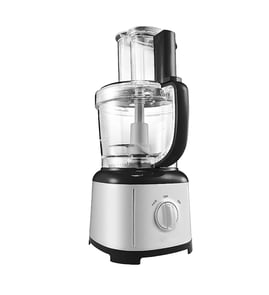

Is a 16 cup food processor too big?
A 16-cup food processor is not too big if you regularly cook for a family, meal-prep in batches, or entertain; the extra bowl capacity reduces the number of batches you need. For a KitchenAid food processor like model KFP1319CU0, “too big” mainly comes down to storage space and how often you use the larger capacity.
- Choose a larger capacity (14 to 16 cups) if you often shred cheese, slice vegetables, or make big batches of salsa, dough, or slaw.
- Choose a smaller capacity if you mostly chop small amounts of herbs, nuts, or single-meal prep.
- If your counter and cabinet space are limited, the footprint and bowl height matter as much as cup size.
- If you dislike washing large parts for small jobs, a big bowl can feel inconvenient.
| Task | 16-cup food processor | Smaller processor (7 to 11 cup) |
|---|---|---|
| Big-batch slicing/shredding | Excellent | Often requires multiple batches |
| Dough mixing (larger recipes) | Better capacity | Can be tight depending on recipe |
| Small chopping (garlic, herbs) | Works, but less convenient | Usually easier |
| Storage and handling | Bulkier | Easier to store |
- Measure your cabinet opening height and shelf depth before committing to a larger unit.
- Plan on using the feed tube and pushers for faster prep; if yours is cracked or won’t latch, replace the lid assembly.
- If the bowl is cloudy, cracked, or won’t lock in place, replacing the bowl restores safe operation and better sealing.
Helpful model-matched parts:
Using the right capacity improves results and safety: overfilling can cause uneven chopping, poor slicing, and lid or bowl stress, while a larger bowl makes batch prep faster and more consistent.
Last updated: January 2026
What is the best reasonably priced food processor?
A “best reasonably priced” food processor is the one that matches your batch size and the jobs you do most (chopping, slicing, shredding, dicing) without paying for attachments you will not use. If you already own the KitchenAid KFP1319CU0, replacing a worn bowl or lid can restore performance for less than buying a new unit.
- Capacity that fits your cooking: 8 to 14 cups covers most family prep.
- Strong slicing and shredding results: consistent cuts matter more than peak watts.
- Easy assembly and cleaning: fewer parts and dishwasher-safe pieces save time.
- Stable base: less walking on the counter when shredding cheese or slicing potatoes.
- Parts availability: being able to replace a bowl, lid, or accessory extends lifespan.
Before replacing the whole food processor, we recommend checking the most commonly replaced items:
- Cracked bowl, leaks, or cloudy plastic: consider the 13 13 cup work bowl assy W11685527
- Lid will not lock, pusher is damaged, or feed tube issues: consider the work bowl cover assy w/ pushers W11680388
- You want dicing capability without upgrading machines: consider the dicing kit W11519129
| Option | Best when | Typical cost outcome |
|---|---|---|
| Replace a bowl or lid | Motor runs fine; container or lock system is worn | Often lower than a new midrange processor |
| Add an accessory (like dicing) | You like the machine; want new functions | Mid-cost upgrade |
| Buy a new processor | Motor is weak, noisy, or intermittent | Highest cost, but full refresh |
Food processors are long-life countertop appliances; most last 7 to 10 years with normal home use. Keeping the bowl, lid, and accessories in good shape is usually the most cost-effective way to maintain safe locking, consistent slicing, and reliable prep.
Last updated: January 2026
How do I find the model number on my KFP1319CU0?
The model number on your KitchenAid food processor is printed on the rating label; on most units like KFP1319CU0, it’s on the underside of the motor base or on the bottom/back area near the power cord. Match that label exactly when ordering parts.
Check these common label locations:
- Bottom of the motor base (flip the base over and look for a sticker or stamped plate)
- Back of the motor base near where the power cord exits
- Under the base rim or rubber feet area (look around the perimeter)
- On the packaging or purchase paperwork (helpful if the label is worn)
Use the model number exactly as printed; letters and numbers matter.
| Label item | What to do with it |
|---|---|
| Model number (example: KFP1319CU0) | Use it to match diagrams and ensure part fit |
| Serial number | Useful for identifying production run and verifying compatibility |
| Electrical rating (volts/amps) | Helps confirm you are working with the correct appliance |
KitchenAid food processor parts can look similar across models, but bowls, lids, and attachments are model-specific. Using the correct model number helps you avoid ordering the wrong work bowl, cover, or accessory.
If your label reads KFP1319CU0, these are examples of model-matched items you may see listed for it:
- 13 13 cup work bowl assy W11685527 (work bowl assembly)
- Work bowl cover assy w/ pushers W11680388 (lid/cover with pushers)
- Dicing kit W11519129 (dicing accessory)
Last updated: March 2026