Owner’s manual
 View engine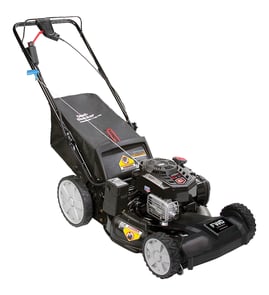




How to find Craftsman model number?
On the Craftsman rotary lawn mower model 917377284, the model and serial numbers are printed on a decal attached to the rear of the mower housing (rear of the deck). We recommend writing down both numbers before ordering parts or looking up specifications in the 917377284 owner's manual.
Where to look on the mower
Check these common spots on a walk-behind mower deck:
- Rear of the mower housing (most common on this model)
- Back of the deck between the lower handle mounts
- Near the rear discharge door or bagging opening
- On the side of the deck close to the wheel height adjuster
What to record (and why)
When you find the decal, record:
- Model number (example: 917.377284)
- Serial number (unique to your mower)
- Date of purchase (helpful for maintenance tracking)
Quick ID checklist
Use this table to confirm you are reading the right information.
| Item on decal | What it tells you | Used for |
|---|---|---|
| Model number | Exact mower version | Correct parts diagrams and parts fit |
| Serial number | Production run identifier | Service reference and documentation |
| Date of purchase | Ownership timeline | Maintenance schedule planning |
Why it matters
The model number is what ties your mower to the correct parts list and specifications. For example, the manual for model 917.377284 lists key specs like oil capacity, spark plug type, and blade bolt torque, which helps you maintain the mower correctly and avoid ordering the wrong parts.
Last updated: January 2026
Should I use 87 or 91 gas for lawn mower?
For the Craftsman 917377284 rotary lawn mower, use fresh regular unleaded gasoline (typically 87 octane). Higher octane (91) does not add power or improve reliability in small mower engines; fuel freshness and correct storage matter far more.
What to use (and what to avoid)
- Use fresh, clean regular unleaded gasoline (commonly 87 octane).
- Avoid stale fuel; old gas is a top cause of no-start conditions.
- Keep water and dirt out of the fuel can; contamination leads to hard starting and rough running.
- Do not store gasoline from one mowing season to the next.
- If your gas can starts to rust, replace it to prevent rust and debris from getting into the tank.
Quick troubleshooting if it will not start after fueling
The 917377284 manual lists fuel-related issues as common no-start causes. Check these in order:
- Confirm the tank has fuel and the control bar is held in the run position.
- If fuel is old, drain the tank and carburetor and refill with fresh fuel.
- If you suspect water in fuel, drain and refill with fresh clean fuel.
- Inspect and service the air filter if it is dirty.
Fuel choice vs. fuel condition (what matters most)
| Topic | 87 octane (regular) | 91 octane (premium) |
|---|---|---|
| Power gain in a mower engine | None expected | None expected |
| Helps with starting | Only if fresh and clean | Only if fresh and clean |
| Best use case | Normal mowing | Not needed for normal mowing |
Why it matters
Most mower performance problems blamed on “bad gas” are really caused by stale fuel, water in fuel, or dirty storage containers, which can lead to hard starting and carburetor issues. Using fresh regular gas and storing it correctly prevents many seasonal start-up problems.
For model-specific operating and storage guidance, follow the 917377284 owner’s manual.
Last updated: January 2026
What is the average lifespan of 917377284?
A Craftsman rotary walk-behind mower like model 917377284 typically lasts 8 to 12 years with normal residential use and routine maintenance. Lifespan depends most on engine care, blade impacts, and keeping the drive system clean and adjusted per the 917377284 owner's manual.
What most affects mower lifespan
- Oil changes and correct oil type (SAE 30 above 32°F; SAE 5W-30 below 32°F)
- Clean air filter and fresh fuel (stale fuel shortens engine life)
- Blade condition and bolt torque (manual lists 35 to 40 ft-lbs)
- Drive system wear (belt, gears, wheel bearings)
- Storage (dry storage reduces corrosion and cable sticking)
Maintenance checkpoints that add years
Use this schedule as a practical baseline for 917377284; follow the manual for the exact intervals.
| Item | What to do | Why it matters |
|---|---|---|
| Engine oil | Keep at proper level; change regularly | Prevents accelerated engine wear |
| Blade and adapter | Inspect for bends/cracks; replace if damaged | Reduces vibration and crankshaft stress |
| Drive belt | Check for glazing/cracks; replace if slipping | Restores self-propel performance |
| Wheels and height adjusters | Clean debris; verify smooth movement | Prevents uneven cut and extra load |
Parts that commonly determine “end of life”
When these wear out, the mower can still be worth repairing if the engine is strong.
- Belt 532157769 (self-propel drive issues)
- Lawn mower mulching blade 532406713 (poor cut, vibration)
- Lawn mower blade adapter 581547901 (blade wobble, stripped fit)
- Control cable 532168552 (drive or control engagement problems)
Why it matters
Most “mower lifespan” complaints come from preventable wear: running low on oil, hitting rocks with the blade, or letting grass and dirt build up around moving parts. The manual also notes that oil and dirt can shorten the life of self-lubricating bearings, so keeping the deck and wheel areas clean directly extends service life.
Last updated: March 2026