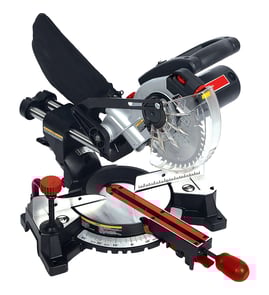

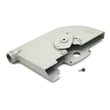

What are the parts of a miter saw?
On a Craftsman miter saw like model 113234633, the main parts include the base and fence (to support the workpiece), the miter and bevel adjustment systems (to set angles), and the motor, blade, and blade guard (to make the cut safely and accurately).
Main miter saw parts (what they do)
- Base: The platform that supports the saw and helps keep it stable.
- Fence: The vertical backstop that helps keep the board square to the blade.
- Table/turntable: The rotating surface that lets you set the miter angle.
- Miter scale and pointer: Shows the selected miter angle (commonly 0° to 45° left/right).
- Miter lock handle/knob: Locks the turntable at the chosen miter setting.
- Bevel pivot and bevel scale: Lets the saw head tilt for bevel cuts.
- Bevel lock lever/knob: Locks the bevel angle so it does not drift during the cut.
Cutting head and safety parts
- Motor: Drives the blade (corded models use a trigger switch and power cord).
- Spindle/arbor: The shaft the blade mounts to.
- Blade: The cutting wheel; tooth count and blade type affect cut quality.
- Blade guard (upper and lower): Covers the blade; the lower guard retracts as you lower the head.
- Handle and trigger switch: Controls the saw; many models also have a lock-off feature.
Common support and accuracy features
| Feature | What it helps with | Typical use |
|---|---|---|
| Work clamp | Holding the workpiece | Repeat cuts, narrow stock |
| Depth stop | Limiting cut depth | Dados, lap joints |
| Dust port/bag | Capturing sawdust | Cleaner work area |
| Slide rails (if sliding) | Wider crosscuts | Cutting wider boards |
Why it matters
Knowing the names and functions of the miter saw parts helps us diagnose issues faster (for example, a cut that is not square often points to fence alignment, miter detents, or bevel lock slippage) and choose the right replacement components.
Helpful related DIY reading
- Use a multimeter for switch or cord checks: how to use a multimeter to test electrical parts video
- If the cord or internal leads look damaged: how to repair broken or damaged wires video
- For safe DIY habits around power tools: are diy appliance repairs safe
Last updated: February 2026
Will any miter saw stand work with any miter saw?
No. A stand is not automatically a perfect fit for every miter saw; for your Craftsman 113234633 miter saw, you need a stand (or mounting method) that matches the saw’s base size and mounting-hole pattern, and supports the saw’s weight and cutting capacity.
What to check for a true fit
- Mounting-hole spacing: Measure center-to-center distances on the saw base and compare to the stand’s bracket range.
- Base footprint: The saw base should sit flat without rocking or overhanging in a way that stresses the frame.
- Weight rating: The stand’s max load must exceed the saw’s weight (plus workpiece support forces).
- Fence and bevel clearance: Make sure brackets do not block bevel pivots, miter locks, or fence travel.
- Work support height: Stand supports should align close to the saw table height to prevent board “droop.”
Common stand types and what they mean for compatibility
| Stand type | Typical compatibility | Best for |
|---|---|---|
| Universal stand with adjustable brackets | Works with many saws if hole spacing falls in range | Mixed-brand shops, occasional transport |
| Stand with quick-release mounting rails | Works well if you can bolt the saw to the rails | Frequent setup and teardown |
| Brand or model-specific stand | Best direct fit when designed for a specific base | Maximum stability and alignment |
| Shop-built bench or plywood adapter plate | Works with almost any saw when built to your measurements | Permanent setups, custom height |
If the holes do not line up
Use one of these proven approaches:
- Plywood adapter plate: Bolt the saw to a flat plate, then bolt the plate to the stand.
- Universal mounting rails: Attach rails to the saw, then clamp or bolt rails to the stand.
- Repositionable brackets: Choose a stand with sliding brackets that can match your measurements.
- Dedicated bench mounting: Through-bolt the saw to a sturdy bench top for maximum rigidity.
Why it matters
A poor stand match can cause vibration, shifting during cuts, inaccurate miters, and binding when cutting long stock. A stable mount improves cut accuracy and reduces the chance of kickback from a moving workpiece.
For help confirming you have the correct model number before shopping for a stand or mounting hardware, use how to find your appliance model number (and what it means for parts).
Last updated: February 2026
What size is the miter slot on a Craftsman table saw?
The Craftsman 113234633 is a miter saw, not a table saw; it does not use a table-saw style miter-gauge slot (the common 3/4 inch by 3/8 inch slot). If you are trying to fit a jig or gauge, first confirm which tool you have and how the accessory mounts.
What to check on your tool
Use these quick identifiers to avoid buying the wrong accessory:
- Table saw: flat table with a blade coming up through the tabletop; uses miter slots for miter gauges and sleds.
- Miter saw (113234633): pivoting arm and blade that cuts down into the work; uses a fence, miter detent plate, and table/turntable, not a miter slot.
- Look for the model tag on the saw to confirm the exact model number.
- Check whether your accessory is meant to clamp to a fence/table (miter saw) or slide in a slot (table saw).
If you actually meant a Craftsman table saw
Most Craftsman table saws use a standard miter slot around 3/4 inch wide by 3/8 inch deep, but you should measure your specific saw because some tables use a T-slot undercut or a non-standard profile.
How to measure a table-saw miter slot
- Measure the top opening width with calipers.
- Measure the depth from tabletop to slot bottom.
- Check for a T-slot undercut below the opening.
| Measurement | What you’re measuring | Typical value |
|---|---|---|
| Width | opening at the tabletop | 3/4 in |
| Depth | tabletop to slot bottom | 3/8 in |
Why it matters
Slot size determines whether a miter gauge bar or sled runner fits safely and accurately; a poor fit causes binding, wobble, and inaccurate cuts.
Helpful reference
If you need to confirm the model number before ordering accessories or parts, use how to find your appliance model number (and what it means for parts).
Last updated: February 2026