 Owner’s manual

How to change tip on Craftsman drill?
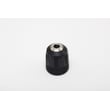
To change the bit (tip) on your Craftsman 315116890 drill/driver, lock the trigger, open the keyless chuck, insert the new bit straight, then tighten the chuck firmly in the LOCK direction. These steps match the bit install and removal procedure in the owner's manual.
Steps to remove the old bit
- Set the direction-of-rotation selector to the center (lock) position so the trigger cannot run.
- Hold the chuck and rotate the chuck body toward UNLOCK (release) to open the chuck jaws.
- Pull the bit straight out of the chuck.
- If the bit is stuck, open the jaws a little more and wiggle the bit while pulling straight out.
Steps to install the new bit
- With the selector still in center lock, open the chuck jaws slightly larger than the bit shank.
- Insert the bit straight into the chuck jaws (not at an angle).
- Rotate the chuck body toward LOCK (tighten) until the jaws clamp the bit securely.
- Give the chuck one more firm hand-tighten to prevent slipping.
Quick reference
| Task | What you do | What to avoid |
|---|---|---|
| Remove bit | Center-lock selector; rotate chuck to UNLOCK; pull bit out | Running the trigger while holding the chuck |
| Install bit | Insert bit straight; rotate chuck to LOCK; hand-tighten firmly | Tightening with the bit angled in the jaws |
Why it matters
A bit that is not seated straight and tightened securely can wobble, slip, or get thrown from the chuck during drilling or driving. Locking the trigger first also prevents accidental starts while your hand is on the chuck.
Last updated: February 2026
How to remove the chuck on a Craftsman drill?
To remove the chuck on your Craftsman drill/driver model 315116890, lock the trigger, use a 5/16-inch (or larger) hex key and a mallet to loosen the internal chuck screw, then remove that screw (it is left-hand threaded) and unthread the chuck from the spindle. For diagrams, use the owner's manual.
Safety and prep
- Remove the battery pack (or unplug the tool, if corded).
- Set the direction-of-rotation selector to the center lock position.
- Wear eye protection; the mallet taps can jar the tool.
- Use a stable work surface so the drill does not twist.
Chuck removal steps (keyless chuck)
- Lock the trigger: put the forward/reverse selector in the center position.
- Tighten a hex key in the chuck: insert a 5/16-inch or larger hex key and tighten the chuck jaws securely.
- Loosen the chuck screw: tap the hex key sharply with a mallet in a clockwise direction. This loosens the screw inside the chuck.
- Remove the chuck screw: open the jaws, remove the hex key, then use a screwdriver to remove the chuck screw by turning it clockwise (the screw uses left-hand threads).
- Unthread the chuck: reinsert the hex key, tighten the jaws, then tap the hex key sharply with a mallet counterclockwise to break the chuck loose from the spindle. Unscrew the chuck by hand.
Direction guide (what turns which way)
| What you are loosening | Tool used | Turn direction | Why |
|---|---|---|---|
| Internal chuck screw | Screwdriver | Clockwise | Screw has left-hand threads |
| Chuck from spindle | Hex key + mallet | Counterclockwise (tap) | Breaks chuck free to unthread |
Why it matters
Removing the chuck the right way prevents stripped screw heads, damaged spindle threads, and chuck wobble. It also keeps the bit clamped straight and reduces the chance of the chuck binding during tightening.
Last updated: February 2026
What are the parts of a drill?
On the Craftsman 315116890 drill/driver, the main user-facing parts include the keyless chuck (holds the bit), the switch trigger (controls speed), the direction-of-rotation selector (forward/reverse/center lock), and the torque adjustment ring (24 clutch settings). For diagrams, use the owner's manual.
Main parts you will use most
- Keyless chuck and chuck jaws: hand-tighten or release the drill bit
- Switch trigger (variable speed): more trigger pressure equals higher speed
- Direction-of-rotation selector: forward, reverse, or center lock (helps prevent accidental starts)
- Torque adjustment ring (clutch): 24 positions to match screw size and material
- Level: helps keep the bit level while drilling
- Bit storage: storage area on the base for the included bit
- Battery pack and charger: 19.2 V DC battery; charger is designed for 10 to 12 hour charging
Quick reference: what each part does
| Part | What it does | When you use it |
|---|---|---|
| Keyless chuck | Secures the bit | Bit changes, tightening before drilling/driving |
| Torque adjustment ring (clutch) | Limits torque to reduce stripping | Driving screws into wood, drywall, metal |
| Direction selector | Changes rotation; center locks trigger | Removing screws; safe carry/storage |
| Variable-speed trigger | Controls speed | Starting holes slowly; driving screws smoothly |
| Level | Helps keep the tool straight | Drilling level holes; aligning fasteners |
Why it matters
Knowing these parts helps you set the clutch correctly, choose the right direction (forward or reverse), and control speed. That prevents stripped screw heads, snapped bits, and binding or kickback when a bit breaks through material.
Safety and handling tips we recommend
- Lock the trigger using the center lock position before changing bits.
- Hand-tighten the chuck; do not use the drill’s power to tighten the chuck.
- Clamp the workpiece so it cannot spin while drilling.
- Avoid running at low speed for long periods; it can overheat the drill.
Last updated: February 2026
Does Craftsman make a right angle drill?
Yes. Craftsman makes right-angle drills designed for tight spaces; the 90° head helps you drill or drive where a standard drill body will not fit. Your Craftsman model 315116890 is a straight drill/driver, so a right-angle drill is a separate tool choice.
When a right-angle drill is the right choice
- Working between studs, joists, or inside cabinets
- Drilling close to a wall or inside a corner
- Driving screws behind plumbing or ductwork
- Using hole saws or spade bits where clearance is limited
- Reaching around obstacles without removing surrounding parts
Options if you already own model 315116890
A right-angle drill is one solution, but these alternatives often work for occasional tight-clearance jobs:
| Need | Common solution | Why it helps |
|---|---|---|
| Slightly tight clearance | Right-angle attachment for a drill/driver | Shortens the working length and changes the drive angle |
| Very tight clearance | Dedicated right-angle drill | More compact head and better control |
| Driving only | Right-angle impact driver or adapter | Higher torque for fasteners in cramped spots |
| Precision work | Short bits plus a compact driver | Reduces wobble and improves access |
Compatibility and safety notes (important)
Our 315116890 operator guidance emphasizes safe operation and using recommended accessories.
- Wear eye protection (safety glasses with side shields)
- Avoid non-recommended attachments that can bind or break
- Use the correct bit type for wood, metal, plastics, or laminates
- Remove the battery pack before changing accessories or troubleshooting
Why it matters
Using the right tool for tight spaces reduces bit slippage, stripped screws, and wrist strain. It also helps you keep the drill square to the work, which improves hole accuracy and fastener hold.
For operating and accessory guidance specific to your Craftsman 315116890 drill/driver, use the owner's manual.
Last updated: February 2026