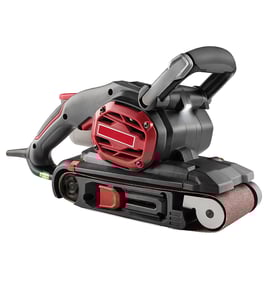

What are the 5 most common mistakes people make with a random orbital sander?
The 5 most common mistakes with a random orbital sander (including the Porter Cable 333) are pressing too hard, skipping grits, sanding without a plan, lifting the pad while it’s still spinning, and letting dust build up. These habits cause swirl marks, uneven scratch patterns, and slow sanding.
The 5 mistakes (and what to do instead)
- Pressing too hard: Let the tool’s weight do the work; heavy pressure stalls the pad and creates pigtails.
- Skipping grits: Move in steps (for example, 80 to 120 to 180) so each grit removes the previous scratches.
- Not sanding progressively (no process): Start with the lowest grit needed to flatten the surface, then refine.
- Lifting the sander while it’s running: Keep the pad flat; turn it off on the workpiece, then lift after it stops.
- Not managing dust: Clean the pad and use dust collection; dust trapped under the disc acts like random grit.
Quick grit progression guide
Use this as a practical starting point; adjust based on finish type and how rough the surface is.
| Task | Typical starting grit | Typical finishing grit |
|---|---|---|
| Remove old finish / heavy leveling | 60 to 80 | 120 to 150 |
| General smoothing before stain | 100 to 120 | 180 |
| Prep before paint | 120 to 150 | 180 to 220 |
| Between coats (light scuff) | 220 | 320 |
Why it matters
Random orbital sanders are designed to cut efficiently with light, even pressure and a consistent scratch pattern. When pressure, grit steps, or dust control are off, the pad can stop rotating freely and the abrasive can re-scratch the surface, which shows up as swirls after stain or clear coat.
A fast checklist for better results
- Mark the surface with light pencil lines; sand until the marks disappear evenly.
- Overlap passes by about 50% and keep the sander moving at a steady pace.
- Replace discs when they stop cutting; dull paper makes you push harder.
- Vacuum or blow off the work and the disc between grit changes.
- If you see swirls, drop back one grit, then work up again.
For basic electrical troubleshooting that affects sanding performance (intermittent power, weak speed), use how to use a multimeter to test electrical parts video.
Last updated: February 2026
What is the best corded random orbital sander?
The “best” corded random orbital sander depends on your priorities (finish quality, vibration control, dust collection, and pad size). For most DIY and light shop use, a 5-inch variable-speed corded ROS with strong dust collection and low vibration is the best all-around choice.
What to look for in a corded random orbital sander
- Pad size: 5-inch is the most common for general sanding; 6-inch removes material faster on larger surfaces.
- Variable speed: Helps prevent swirl marks on soft woods and improves control on edges.
- Dust collection: A sealed pad and efficient canister or vacuum port keeps paper cutting longer.
- Vibration control: Lower vibration reduces fatigue and improves finish consistency.
- Hook-and-loop pad: Faster disc changes; check that the pad pattern matches common discs.
Quick comparison (what “best” usually means)
| If you care most about… | Prioritize these features | Typical tradeoff |
|---|---|---|
| Smoothest finish | Low vibration, consistent orbit, good pad brake | Higher cost |
| Fast stock removal | 6-inch pad, higher amp motor, aggressive discs | More risk of swirl |
| Cleanest sanding | Strong dust seal, vacuum-ready port | Bulkier hose setup |
| Long sessions | Ergonomic grip, low noise, low vibration | May sand slower |
How this relates to your Porter Cable model 333
Your Porter Cable 333 is a corded sander platform many owners use for general-purpose sanding. If you are comparing upgrades, focus on dust collection efficiency and vibration control first; those two factors usually make the biggest real-world difference in results and comfort.
Why it matters
A random orbital sander that matches your work (paint prep, hardwood finishing, or heavy leveling) saves time, reduces rework from swirl marks, and lowers consumable costs by keeping sanding discs from clogging.
Helpful DIY reference
For cord and wiring issues on a corded sander (intermittent power, no start, cuts out when moved), use how to repair broken or damaged wires video.
Last updated: February 2026
What is the difference between 3 16 and 3 32 orbital sander?
A 3/16-inch orbit orbital sander (like many setups used with the Porter Cable 333) removes material faster and leaves a coarser scratch pattern, while a 3/32-inch orbit sands more slowly but produces a finer finish that is easier to polish or paint over.
What the orbit size changes
Orbit size is the diameter of the sanding pad’s tiny circular motion. Bigger orbit equals faster cutting; smaller orbit equals finer finishing.
- 3/16 inch orbit: faster stock removal, more aggressive scratch
- 3/32 inch orbit: finer scratch, better for final prep
- Both can use the same grit range, but the orbit changes how that grit “behaves”
Which one should you choose?
Use this quick guide based on the job you are doing.
| Task | Better choice | Why |
|---|---|---|
| Shaping filler (Bondo), leveling edges, stripping finishes | 3/16 inch | Cuts faster and levels quicker |
| Final sanding before primer or paint | 3/32 inch | Leaves a finer, easier-to-cover scratch |
| Wood finishing between coats | 3/32 inch | Reduces swirl marks |
| General purpose sanding | 3/16 inch | Faster progress on most surfaces |
Grit pairing tips (practical rule of thumb)
Orbit and grit work together. If you switch to a larger orbit, you often need to step up to a finer grit sooner.
- 3/16 inch orbit: start around 80 to 120 grit for leveling; finish 150 to 220 grit
- 3/32 inch orbit: start around 120 to 150 grit; finish 220 to 320 grit (or finer for paint prep)
- Keep the sander flat and let it do the work; extra pressure increases swirls
Why it matters
Choosing the right orbit saves time and rework. A 3/16-inch orbit can leave scratches that show through stain or paint if you do not refine the grit steps, while a 3/32-inch orbit helps you reach a cleaner finish with less risk of visible swirl marks.
For electrical troubleshooting related to sanding performance (intermittent power, damaged cord, loose connections), use our guide: how to repair broken or damaged wires video.
Last updated: February 2026