 Owner’s manual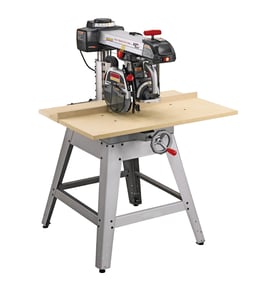


Are radial arm saws worth anything?
Yes. A Craftsman radial arm saw like model 113199450 is worth owning (and can be worth money) when it’s complete, tight, and properly set up; it excels at accurate crosscuts and dado-style work, but it only holds value when it runs smoothly and all guards and locks work correctly (per the safety and setup guidance in the 113199450 owner's manual).
What drives the value of a radial arm saw
Condition and completeness matter more than age. We see the best value when the saw is safe, accurate, and ready to use.
- Guarding is complete and installed (blade guard and anti-kickback/spreader assembly)
- No excessive vibration or unfamiliar noise; those issues should be corrected before use
- Locks and clamps hold firmly (arm, yoke, bevel, carriage)
- Carriage travel is smooth with minimal play
- Table and fence are serviceable (not broken, badly warped, or missing)
Quick safety and setup checks (also protect resale value)
The manual calls out a few must-do checks that directly affect both safety and performance.
- Unplug before inspecting; remove the switch key when not in use
- Verify no play in the column support and carriage; tighten arm, yoke, and bevel locks
- Do not operate if parts are missing, bent, or broken; replace failed parts before using
- Use the proper guard for sawing and dado-type operations
- Stop immediately if the saw vibrates excessively or makes an unfamiliar noise
Typical “worth it” scenarios vs “not worth it” scenarios
| Scenario | Usually worth it? | Why |
|---|---|---|
| Accurate crosscuts on wider stock | Yes | Radial arm design handles wide crosscuts well when tuned |
| Dadoes/rabbets with correct guarding | Yes | Versatile joinery capability when set up correctly |
| General-purpose ripping without careful setup | No | Higher risk and more technique-dependent |
Why it matters
A radial arm saw’s value is tied to safe, repeatable accuracy. When the arm indexes correctly, the yoke locks, and the guard system is intact, the saw becomes a reliable shop tool instead of a project.
If you’re pricing one to sell or deciding whether to restore it, start by following the inspection and control setup steps in the 113199450 owner's manual, then use 113199450 to search parts and diagrams on Sears PartsDirect.
Last updated: February 2026
What is the best brand of radial arm saw?
There is no single “best” brand for every shop; the best radial arm saw depends on how you use it (crosscutting vs. ripping), how much capacity you need, and whether you want a vintage cast-iron saw or a modern production machine. For many DIY woodworkers, a well-tuned Craftsman 113199450 can be an excellent value.
How we recommend choosing a “best” brand
- Match the saw to the work: frequent crosscuts and dados need smooth carriage travel and solid arm locks.
- Prioritize safety features: a functional guard, spreader, and anti-kickback pawls matter most when ripping.
- Check parts support: older saws can be great, but only if you can still source wear items.
- Look for rigidity: heavier arms and yokes typically hold alignment better.
- Buy based on condition: a clean, complete saw often beats a “better” brand that is worn out.
Brand and use-case comparison
| Use case | What to look for | Brands commonly chosen |
|---|---|---|
| Hobbyist and home shop | Value, availability, easy tune-up | Craftsman (vintage), DeWalt (vintage) |
| Heavy-duty vintage iron | Mass, long-term durability | DeWalt, Delta/Rockwell |
| New, high-end production | Modern support, industrial build | Original Saw Company, Maggi |
| Top-tier industrial (rare) | Precision, very heavy build | Northfield |
Why it matters (especially on a 10-inch radial saw)
Radial arm saws are versatile, but they demand correct setup and guarding. Your Craftsman model’s manual calls out key safety and operating practices, including using the proper guarding and anti-kickback components during ripping and following the basic operating steps for controlled cuts. Use the 113199450 owner's manual to confirm the correct configuration for your cut type before you judge any brand by “power” alone.
Practical checklist before you commit to any brand
- Verify the arm lock and indexing hold firmly at common angles.
- Confirm the carriage bearings roll smoothly without play.
- Inspect the blade guard and anti-kickback pawls for completeness and free movement.
- Plan on a fresh, correct blade for the job (crosscut blade vs. rip blade).
- When you are ready to source parts by model number, start with the model parts list, then search by model on Sears PartsDirect.
Last updated: February 2026
Why are radial arm saws no longer made?
Radial arm saws like the Craftsman 113199450 became less common because they require more frequent alignment and stricter guarding discipline than newer saw designs. As compound miter saws and table saws improved, most buyers chose tools that are faster to set up and easier to use consistently.
What changed in the market
Radial arm saws can crosscut, miter, bevel, and sometimes rip, but newer tools made those same jobs simpler and more repeatable.
- Sliding/compound miter saws made angle cuts quick to set and easy to repeat
- Table saws became the standard for ripping workflows and jigs
- Many users preferred tools that need less tuning to stay accurate
- Shops favored simpler training and fewer setup steps per cut
Safety and setup expectations
The 113199450 owner's manual emphasizes correct setup and guarding for safe operation. It calls out keeping hands out of the blade path, avoiding awkward hand positions, and not performing certain operations unless the proper guard is installed and set up as instructed.
Common reasons radial arm saws feel harder to use safely
- Guard and anti-kickback/spreader assembly not installed or adjusted correctly
- Dull or incorrect blade type that increases grabbing and kickback potential
- Locks/clamps not fully tightened (arm, yoke, bevel, carriage)
- Ripping technique errors (feed direction and stock control)
- Vibration or unusual noise that should be corrected before continuing
Why alignment and maintenance matter more on a radial arm saw
A radial arm saw’s versatility comes from multiple adjustable controls; that also means more points that must be tight and correctly set before cutting. The manual notes the saw needs more cleaning than lubrication over time, and realignment is part of keeping it accurate.
| Tool type | What most users prefer | Typical tradeoff |
|---|---|---|
| Sliding compound miter saw | Fast crosscuts and angles | Less versatile overall |
| Table saw | Strong ripping workflow | Crosscuts often need a sled/gauge |
| Radial arm saw | Versatility in one station | More setup and alignment discipline |
Why it matters
If you own a Craftsman 113199450, careful setup, correct guarding, and staying on top of alignment helps keep cuts accurate and reduces risk. For diagrams and replacement parts lookup by model, use the parts list or search on Sears PartsDirect.
Last updated: February 2026