 Owner’s manual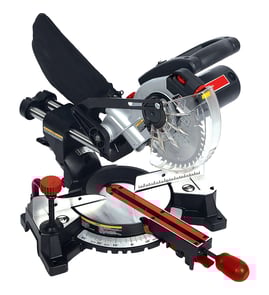

Which mitre saw is the most accurate?
The most accurate miter saw is the one that holds its settings and can be tuned to cut perfectly square and repeatable angles. For a Craftsman 113235200 10-inch miter saw, accuracy comes from correct alignment of the miter indicator, bevel stops, and fence-to-blade squareness as outlined in the 113235200 owner's manual.
What “most accurate” means for a miter saw
Accuracy is mainly about repeatability and calibration, not just brand or price.
- Cuts 90° with no gap when checked with a square
- Miter scale points to true 0° when the table is locked
- Bevel stops hit true 0° and 45° consistently
- Minimal play in the bevel pivot and miter lock
- Fence stays straight and square to the blade path
Quick accuracy checks you can do on the 113235200
Use a reliable combination square or framing square and do these checks with the saw unplugged.
| Check | What you’re looking for | If it’s off |
|---|---|---|
| 90° crosscut squareness | No gap when the square is flipped | Adjust miter scale indicator and verify fence alignment |
| 0° bevel stop | Blade aligns with full length of the square (avoid tooth set) | Adjust the 0° bevel stop and recheck |
| 45° bevel stop | True 45° contact along the square | Adjust the 45° bevel stop and recheck |
| Bevel pivot feel | Smooth movement with no looseness | Tighten or loosen the bevel pivot adjustment |
Adjustments that typically improve accuracy the most
These are the same areas the manual calls out for checking after shipment and for tuning precise cuts.
- Miter scale indicator: loosen the screw, reposition the indicator, retighten
- Bevel stop adjustments (0° and 45°): set the head to the stop, check with a square, then adjust the stop so it indexes correctly
- Bevel indicator: slide it to the correct reading and retighten
- Bevel pivot adjustment: tighten if there is play; loosen if movement is too tight
Why it matters
Even a high-end miter saw will cut inaccurately if the miter lock, bevel lock, stops, or indicators are out of adjustment. Once your 113235200 is tuned, you get tighter joints (trim, baseboard, crown molding) and fewer re-cuts and wasted boards.
Last updated: February 2026
Can a 10inch miter saw cut a 4x4?
Yes. The Craftsman 113235200 10-inch miter saw can cut a dimensional 4x4 (3-1/2 in. x 3-1/2 in. actual) in a single cut when you add an auxiliary fence of the correct thickness, as shown in the 113235200 owner's manual.
What you need for a one-cut 4x4
To make the full-depth cut safely and consistently, set the saw up the way the manual describes.
- Use a straight auxiliary fence that is 7/8-inch thick
- Fasten the auxiliary fence securely to the saw fence with screws
- Keep the workpiece flat on the base and against the fence
- Support long stock so it does not sag; keep your hand 4 inches or more from the blade path
- Make a full-depth test cut in the auxiliary fence to create the blade slot and confirm clearance
Quick setup checklist
| Item | Target | Why it matters |
|---|---|---|
| Actual 4x4 size | 3-1/2 in. x 3-1/2 in. | Confirms the cut capacity you are planning for |
| Auxiliary fence thickness | 7/8 in. | Enables a single-pass cut on a dimensional 4x4 |
| Hand clearance | 4 in. or more | Reduces risk of contact with the blade path |
Safety and material notes (important)
This saw is intended for wood and wood-like products; it can also cut soft metals like aluminum with the right blade and precautions. It is not designed for ferrous metals (steel or iron). Also, prevent accidental starting by keeping the switch OFF before plugging in.
Why it matters
A 10-inch miter saw can handle a 4x4, but the auxiliary fence setup is what makes the cut a true one-pass cut on this model. Proper support and fence contact help prevent binding, shifting, and inaccurate cuts.
Last updated: February 2026
Why is 31.6 on a miter saw?
On the Craftsman 113235200 10-inch miter saw, 31.6° is a preset miter angle used for cutting standard (U.S.) crown molding when the molding is laid flat for a compound cut. It pairs with a 33.8° bevel setting so the crown fits typical 90° wall corners.
What the 31.6° mark is used for
When you cut crown molding lying flat on the table, you are making a compound miter cut (miter plus bevel). The saw includes the 31.6° miter detent because it is one of the standard settings that produces the correct corner geometry for common crown profiles.
Common uses:
- Inside corners and outside corners on crown molding
- Left-side and right-side pieces (the “finished” side changes by cut)
- Repeatable setup without measuring every time
- Faster trim work when corners are close to 90°
Quick setup for standard crown molding (lying flat)
Use these as your starting point for the Craftsman 113235200:
| Crown molding method | Miter setting | Bevel setting | Typical use |
|---|---|---|---|
| Lying flat (compound cut) | 31.6° left or right | 33.8° | Most common crown corner cuts |
| Standing up (nested) | varies by corner | 0° | When using a crown jig or auxiliary fence |
For the exact left/right combinations for inside vs. outside corners, follow the chart in the owner's manual.
Why it matters
Crown molding has to meet cleanly at the corner. The 31.6° miter detent helps you hit a repeatable compound angle quickly, which reduces gaps, re-cuts, and wasted material.
Tips to get better-fitting corners
- Make test cuts on scrap first; small corner errors show up fast on crown
- Keep the molding tight to the fence and table; clamp when possible
- Confirm the corner is actually 90°; adjust if the walls are out of square
- Keep hands out of the blade path and avoid reaching across the blade
Last updated: February 2026
What should you never cut with a miter saw?
For the Craftsman 113235200 10" miter saw, never cut ferrous metals (steel, iron, or iron-based metals) and never cut any workpiece you cannot hold in a solidly braced, fixed position. Also avoid short or tiny pieces that you cannot safely support and keep your hands away from the blade.
Materials you should not cut
The 113235200 owner's manual is clear that this saw is not designed for ferrous metals; those materials can bind, shatter, or create other hazards.
Never cut:
- Steel, iron, or any iron-based metal (ferrous metals)
- Brittle materials that can shatter or chip (common examples: masonry, tile, glass)
- Anything that cannot be secured flat against the fence and table
- Any piece so short/small that your hold-down hand cannot stay a safe distance from the blade
- Any cutoff that would be trapped or “confined” while the blade is spinning
Workpieces and setups to avoid (even with wood)
Many miter saw injuries come from the setup, not the material. Avoid these situations:
- Free-hand cutting (no solid support against the fence)
- Holding the cutoff piece, clamping it, or using a length stop against it while the blade is spinning
- Cutting a warped, twisted, or rocking board that cannot sit stable
- Forcing the saw through the cut (feed too fast, blade bogs down)
Quick safety check before you cut
| Check | Safe target | Why it matters |
|---|---|---|
| Workpiece support | Flat on table, tight to fence | Prevents shifting and kickback |
| Hand position | Stays well away from blade path | Reduces contact risk |
| Cutoff handling | Cutoff is free to move | Prevents binding and ejection |
| Saw behavior | No unusual vibration/noise | Signals a problem that can worsen |
If you cut aluminum or other non-ferrous metal
This model can cut soft metals like aluminum, but only with the right blade and clamping. Follow these rules:
- Use a blade specifically recommended for non-ferrous metal cutting
- Clamp the workpiece; do not hand-hold metal
- Remove wood dust and disconnect any dust bag or hose first (sparks and hot fragments can ignite dust)
Why it matters
Cutting the wrong material or cutting an unsecured/too-small workpiece increases binding and kickback risk; the workpiece can be thrown violently, and hands can drift into the blade path.
Last updated: February 2026