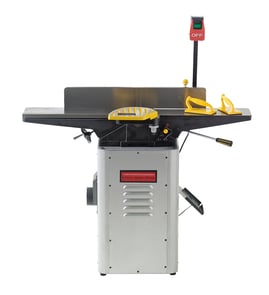

Is a planer worth it without a jointer?
Yes, a planer can still be worth it without a jointer, but it will not flatten a twisted or cupped board by itself. With a Craftsman 10323900 jointer/planer setup, the jointer function is what makes one face flat and one edge square; the planer function then makes the opposite face parallel.
A planer is great when your lumber already has one reasonably flat reference face (or you create one with a jig).
- Bring boards to consistent thickness for cabinet parts and face frames
- Clean up rough-sawn surfaces after you establish a flat reference face
- Make two faces parallel (once one face is flat)
- Match thickness across multiple boards for glue-ups
- Remove minor surface defects (light snipe, saw marks) with shallow passes
A jointer is the fastest, most reliable way to create the two references you need for accurate woodworking: one flat face and one straight, square edge. Without that, a planer tends to copy the board’s existing warp, so you can end up with a board that is uniformly thick but still bowed or twisted.
Flat and square reference surfaces are what make glue joints tight, panels flatter, and assemblies (like boxes and frames) come out square.
You can still get excellent results by creating a flat reference face before planing.
- Use a planer sled with shims/hot glue to stabilize a warped board, then plane one face flat
- Use a table saw with a straight-line rip jig to create one straight edge
- Use a router flattening sled for wide boards or slabs
- Buy S2S/S3S lumber when you need speed and consistency
- Keep passes light (about 1/32 inch) to reduce tear-out and stress on the cutterhead
| Task | Planer only | Planer + jointer (like Craftsman 10323900) |
|---|---|---|
| Make boards the same thickness | Excellent | Excellent |
| Flatten a cupped/twisted board | Possible with sled/jigs | Fast and consistent |
| Straighten and square an edge | Indirect (jigs) | Best tool for it |
| Best for rough lumber workflow | Slower | Most efficient |
If you are maintaining your Craftsman 10323900 jointer/planer (belts, knives, switches, guards), start with the model parts list; for broader model searches and ordering, use Sears PartsDirect.
Last updated: February 2026
What sizes do jointers come in?
Jointers are commonly sized by the maximum board width they can flatten and square; most home-shop jointers are 6-inch or 8-inch, while larger shop machines are often 10-inch, 12-inch, or wider. For Craftsman model 10323900, match size to your typical lumber width and shop space.
- 6-inch jointer: Great for smaller projects and narrower stock; most common entry size.
- 8-inch jointer: Better all-around choice for furniture work; handles wider boards with fewer glue-ups.
- 10-inch and up: For frequent wide stock and higher throughput; typically heavier and more permanent.
- Benchtop vs. floor-standing: Benchtop units prioritize portability; floor models prioritize stability and longer beds.
- Jointer/planer combos: Save space; changeover time is the tradeoff.
| Size class | Typical user | Key advantage | Common tradeoff |
|---|---|---|---|
| 6-inch | DIY, small shop | Lower cost, smaller footprint | More ripping and glue-ups for wide panels |
| 8-inch | Serious hobbyist | Wider capacity, usually longer beds | More space and weight |
| 10-inch+ | Pro or production | Wide stock capability | Higher cost, power and space needs |
- Measure the widest boards you joint most often (not the widest you might use once).
- Prioritize bed length for straighter results on long boards.
- Confirm your available floor space and infeed/outfeed clearance.
- Check your electrical setup (many larger units need 240V).
- Plan for dust collection; jointers make heavy chips.
Choosing the right jointer size reduces extra milling steps (ripping, edge-gluing, re-flattening) and improves accuracy when you’re creating flat faces and square edges for tight joinery.
For model-specific parts and diagrams for Craftsman 10323900, use the parts list on this model page; for broader model searches and ordering, use Sears PartsDirect.
Last updated: February 2026
How do I find the model number on my 10323900?
The model number on your Craftsman jointer/planer is printed on the tool’s model and serial number label (nameplate). On model 10323900, this label is typically on the base/stand area or on the rear or side of the jointer body near the motor.
Check these common nameplate locations first:
- On the back of the jointer body, near the motor housing
- On the side of the base or stand (lower cabinet area)
- Under the infeed or outfeed table edge (along the frame)
- Near the power switch box or cord entry point
- On the underside of the base casting (use a flashlight)
The label usually includes several fields. For parts lookup, we recommend copying them exactly.
| Label item | Example | Why it matters |
|---|---|---|
| Model number | 10323900 | Ensures diagrams and parts match your exact jointer |
| Serial number | Varies | Helps identify production run differences |
| Electrical rating | Volts/amps | Confirms correct switch, cord, or motor specs |
A worn label is common on older power tools. These steps usually make it readable:
- Unplug the jointer before handling the label area
- Wipe dust and oil with a dry rag first, then a lightly damp rag
- Use a flashlight at a low angle to highlight stamped or embossed text
- Take a close-up photo and zoom in to read faint characters
Craftsman tools often have similar-looking versions with different cutterhead, belt, guard, or switch setups. Using the exact model number keeps you from ordering the wrong jointer/planer parts.
For a quick visual guide to locating and understanding model numbers, use [how to find your appliance model number (and what it means for parts)].
Last updated: March 2026