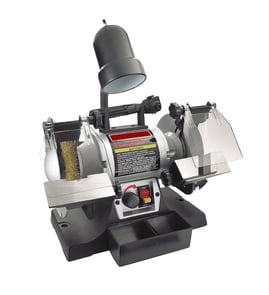

Can I put a wire wheel on a bench grinder?
Yes. You can run a wire wheel on your Craftsman 152211060 bench grinder as long as the wheel fits the arbor correctly, the wheel’s RPM rating meets or exceeds the grinder’s speed, and you use proper guarding and PPE to control wire throw and kickback.
- Arbor (shaft) size: The wire wheel’s center hole must match the grinder arbor, or use the correct bushing set.
- Wheel diameter and thickness: Use a size the grinder can physically guard and support.
- Maximum RPM rating: The wheel’s rated RPM must be at least the grinder’s no-load RPM.
- Mounting hardware: Use the correct flanges and tighten securely (do not overtighten).
- Rotation and clearance: Confirm the wheel spins freely without contacting guards or tool rests.
- Wear a full face shield over safety glasses.
- Wear heavy gloves and long sleeves; wire bristles can break off at speed.
- Stand slightly to one side at startup; let it reach full speed before contacting the work.
- Use light pressure; forcing the work increases wire shedding and grabbing.
- Keep the work below the wheel centerline so the wheel pushes the part down, not up.
| Wheel type | Best for | Notes |
|---|---|---|
| Crimped wire wheel | Light rust, paint, general cleanup | Less aggressive; smoother feel |
| Knotted wire wheel | Heavy rust, scale, weld cleanup | More aggressive; more bite and vibration |
| Wire cup brush (if compatible) | Edges, contours | Often used on one side only; check clearance |
A bench grinder spins fast enough that an underspeed-rated wheel, incorrect arbor fit, or poor guarding can turn a simple rust-removal job into flying-wire hazards, vibration, and loss of control. Correct fit and RPM rating protect both the tool and the operator.
For general DIY safety practices, we recommend reviewing are diy appliance repairs safe.
Last updated: February 2026
What are the 4 important rules for a bench grinder?
For the Craftsman bench grinder model 152211060, four key rules are: wear proper eye protection, keep the tool adjusted and guarded, grind only on the wheel’s face (not the side), and control startup and shutdown (let it reach full speed before grinding and wait for a complete stop before handling). See our general safety guidance in are diy appliance repairs safe.
- Wear the right PPE and secure anything that can catch: safety glasses (and ideally a face shield), no loose sleeves, tie back long hair, remove jewelry.
- Keep guards and rests properly set: keep the wheel guard and spark deflector in place; set the work rest close to the wheel (commonly about 1/8 inch) so the workpiece cannot wedge.
- Grind on the wheel face only: do not grind on the side of a standard bench grinding wheel; side loading can crack the wheel.
- Start and stop safely: stand slightly to one side at startup, let the wheel reach full speed before contacting the work, and wait for the wheel to stop fully before adjusting, cleaning, or walking away.
- Verify the wheel is rated for the grinder’s RPM and is not chipped or cracked.
- Confirm the work rest is secure and close to the wheel.
- Adjust the spark deflector close to the wheel.
- Use light pressure and keep the work moving to avoid overheating.
- Keep the grinding area clear of flammables and clutter.
| Common mistake | Safer alternative |
|---|---|
| Pushing hard to “speed up” grinding | Use light, steady pressure to reduce heat and wheel stress |
| Grinding on the wheel’s side | Grind on the wheel face unless you have a wheel designed for side grinding |
| Adjusting rests while the wheel is moving | Shut off power and wait for a complete stop |
| Wearing gloves that can snag | Use bare hands with good control (or snug-fitting gloves only when appropriate) |
Bench grinders can throw sparks, grab small parts, and fail violently if a wheel is damaged or misused. These four rules reduce the biggest risks: eye injury, kickback, wheel breakage, and loss of control.
Last updated: February 2026
What is a Craftsman bench grinder?
A Craftsman bench grinder (including model 152211060) is a stationary power tool with one or two abrasive wheels used for sharpening, shaping, deburring, and light polishing of metal. It mounts to a workbench for stability and consistent results on hand tools and small parts.
- Sharpening chisels, lawn mower blades, and drill bits (with the right wheel and technique)
- Removing rust, paint, and burrs from metal edges
- Shaping small metal parts and smoothing rough cuts
- Cleaning up welds and grinding down high spots
- Light polishing or buffing (when equipped with the correct accessory)
Most Craftsman bench grinders share a similar layout, even when exact specs vary by model:
| Feature | What it does | Why it helps |
|---|---|---|
| Grinding wheels | Abrasive wheels remove material | Controls how fast and how smooth you grind |
| Tool rests | Supports the workpiece at a set angle | Helps keep sharpening angles consistent |
| Eye shields/spark guards | Deflects sparks and debris | Improves safety and visibility |
| Wheel guards | Covers part of the wheel | Reduces exposure to fragments and sparks |
- Wear eye protection and keep guards in place before powering on.
- Let the grinder reach full speed before contacting the wheel.
- Use light pressure; forcing the work overheats metal and loads the wheel.
- Keep the tool rest close to the wheel (a small gap) to prevent the workpiece from catching.
- Stand slightly to one side at startup in case a wheel is damaged.
A bench grinder is simple, but wheel choice, setup (tool rest and guard position), and safe technique determine whether you get clean sharpening and controlled grinding or overheated metal and uneven results.
For general DIY safety guidance before you start, review are diy appliance repairs safe.
Last updated: February 2026
How to restore a bench grinder?
To restore a Craftsman bench grinder like model 152211060, we focus on safety first, then a full teardown, cleaning, inspection, and careful reassembly with fresh lubrication and correctly adjusted guards and tool rests. Most restorations are successful when bearings, wiring, and wheel condition are addressed early.
- Unplug the grinder and remove the wheels before deep disassembly.
- Wear eye protection and a dust mask; old grinding dust and paint can be hazardous.
- Never reuse a cracked wheel; replace it.
- Keep guards and spark deflectors installed and properly positioned.
- If insulation is brittle or wiring is damaged, repair it before powering on.
- Document and label: Take photos of wiring, spacers, flanges, and guard positions.
- Disassemble: Remove wheel guards, wheels, tool rests, spark deflectors, and end caps.
- Clean and de-rust: Degrease the housing and hardware; remove rust from tool rests and guards.
- Inspect key wear items:
- Bearings (roughness, play, noise)
- Power cord and switch (cracks, heat damage)
- Wheel flanges and blotters (warping, missing parts)
- Motor shaft threads (damage, cross-threading)
- Electrical check: Verify continuity and safe wiring practices before reassembly; use a meter if available.
- Reassemble and adjust: Set tool rests close to the wheel, align guards, and confirm the wheel spins freely.
- Test run safely: Stand to the side on first power-up; let it run 1 to 2 minutes before grinding.
| Item to set | Typical target | Why it matters |
|---|---|---|
| Tool rest gap | 1/16 in. to 1/8 in. | Reduces grab and kickback risk |
| Spark deflector gap | About 1/16 in. | Helps contain sparks and debris |
| Wheel condition | No cracks, chips, or wobble | Prevents wheel failure |
A bench grinder restoration is mostly about preventing vibration, wheel failure, and electrical hazards. Clean parts, smooth bearings, solid wiring, and correct guard and rest adjustments make the grinder safer and more accurate.
For electrical inspection and safe testing during a restoration, we recommend reviewing how to use a multimeter to test electrical parts video.
Last updated: February 2026