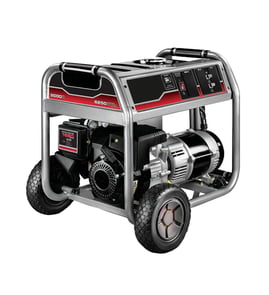

What engine is in a Coleman Powermate PM0301010?
The Coleman Powermate PM0301010 generator is commonly equipped with a Briggs & Stratton 4-cycle engine in the 3 to 3.5 HP range. This is the engine family most often paired with this portable 1,500 running watt class generator.
What to look for on the engine (fast identification)
Check the engine itself, not the generator frame label. On most Briggs & Stratton engines, the ID is stamped or printed on the blower housing or valve cover area.
- Look for Model / Type / Code numbers on the engine shroud
- Confirm it is a 4-cycle (separate oil fill, no 2-cycle mix)
- Note the HP or displacement marking (if shown)
- Match the engine ID when ordering ignition, carburetor, or governor parts
- Record the full engine ID before searching parts
Typical engine specs you will see on this generator
Because we do not have model-specific documentation for PM0301010 here, use these common identifiers to confirm what you have.
| Item to confirm | What you’ll typically see | Why it matters |
|---|---|---|
| Engine brand | Briggs & Stratton | Determines parts families (carb, ignition, governor) |
| Engine cycle | 4-cycle | Oil type and maintenance schedule |
| Power class | ~3 to 3.5 HP | Helps match tune-up and fuel system parts |
| Fuel | Gasoline | Guides storage and starting checks |
Why it matters
The exact engine Model/Type/Code determines the correct carburetor, air filter, spark plug, and ignition parts. Two PM0301010 units can share the same generator model number but use different engine variants over production runs.
Helpful next step
Use our guide: how to find your appliance model number (and what it means for parts) to locate and record the engine identification numbers so you can match the right repair parts the first time.
Last updated: February 2026
What kind of oil do you put in a PM0301010 generator?
For the Coleman PM0301010 generator, we recommend using a high-quality 4-stroke automotive engine oil; SAE 10W-30 is the best all-around choice for most temperatures, while SAE 5W-30 helps with cold starts and SAE 30 is commonly used in consistently warm weather.
Recommended oil viscosity by temperature
Use this as a practical guide when choosing oil for your PM0301010:
| Typical outdoor temperature | Common oil choice | Why it helps |
|---|---|---|
| Below 40°F | SAE 5W-30 | Easier starting and faster lubrication |
| 40°F to 100°F | SAE 10W-30 | Best all-around protection |
| Above 50°F (steady heat) | SAE 30 | Stable viscosity in hot conditions |
What to use (and what to avoid)
- Use detergent motor oil intended for 4-stroke engines.
- Choose an oil that meets common gasoline-engine standards (typical modern API ratings).
- Avoid 2-cycle oil (it is not designed for crankcase lubrication).
- Avoid straight SAE 40 unless you are operating in extreme heat and the engine is known to tolerate it.
- Do not overfill; overfilling can cause smoking, fouled plugs, and hard starting.
Oil change tips that prevent common generator problems
- Check the oil level before every use (portable generators can consume oil).
- Change oil more often under heavy load, dusty conditions, or high heat.
- Warm the engine briefly before draining (oil drains faster and carries out more contaminants).
- Clean around the fill area before opening it to keep dirt out of the crankcase.
- If you suspect an electrical issue after service (no output, tripping breaker), use our guide: how to use a multimeter to test electrical parts video.
Why it matters
Correct oil viscosity protects the PM0301010 engine from accelerated wear during startup and under load. Too-thick oil can make cold starts difficult; too-thin oil can reduce protection when the generator runs hot.
Last updated: February 2026
Why does my Coleman generator keep shutting off?
Your Coleman PM0301010 generator usually shuts off because the engine is losing fuel/air flow, tripping a low-oil shutdown, or overheating under load. The fastest fixes are fresh fuel, a clean air path, correct oil level, and verifying you are not overloading the generator.
Quick checks that fix most shutdowns
- Check oil level first: many portable generators have a low-oil sensor that stops the engine to prevent damage.
- Use fresh gasoline: old fuel and varnish commonly cause surging and stalling.
- Open the fuel cap vent (if equipped): a blocked vent can create vacuum in the tank and starve the carburetor.
- Inspect the air filter: a clogged filter makes the mixture too rich and can cause bogging and shutdown.
- Reduce the electrical load: unplug everything, restart, then add loads back one at a time.
- Look for heat issues: keep the unit in open airflow; clear debris from cooling air inlets.
Most common causes (and what to do)
| Symptom | Likely cause | What we recommend |
|---|---|---|
| Runs 5 to 30 minutes, then dies | Fuel cap venting issue or fuel delivery restriction | Loosen cap briefly to test; check fuel line and filter; switch to fresh fuel |
| Starts, then dies when you plug something in | Overload or failing breaker/outlet | Start with no load; add one device at a time; confirm total watts |
| Dies on slopes or after oil change | Low oil level or oil sensor reacting | Verify oil is at the correct mark on level ground |
| Surges, hunts, then stalls | Dirty carburetor or clogged jets | Drain old fuel; clean carburetor and bowl; replace gaskets if needed |
Why it matters
Repeated shutdowns are usually a protection response (low oil, overload, overheating) or fuel starvation. Fixing the root cause prevents hard starting, carbon buildup, and premature wear on the engine and alternator.
Helpful DIY guidance
If you need to trace a shutdown caused by wiring, a loose connection, or a safety circuit, use a meter and follow a schematic step-by-step; how to use a multimeter to test electrical parts video and using a wiring schematic to trace a current video walk through the process.
Last updated: February 2026
How much does a Coleman PM0301010 generator weigh?
The exact weight for the Coleman PM0301010 generator depends on the specific engine/alternator configuration and frame style used on your unit, but most portable generators in this class typically weigh about 150 to 220 lb. For safe handling, plan on a two-person lift or use a wheel kit or dolly.
Typical weight range (what to expect)
Portable, open-frame Coleman generators similar to the PM0301010 commonly fall into these ranges:
| Generator style | Typical weight | Notes |
|---|---|---|
| Open-frame, mid-size portable | 150 to 220 lb | Most common for jobsite/home backup use |
| Larger frame or larger fuel tank | 200 to 260 lb | Heavier due to tank and frame mass |
| With wheel kit/handle installed | +5 to 15 lb | Added hardware increases total weight |
How to estimate your PM0301010 weight at home
If you need a practical number for transport or lifting, we recommend:
- Check whether your generator has a wheel kit and folding handle installed.
- Note the engine brand and size (larger engines and alternators add weight).
- Weigh it using a bathroom scale and a board (one end at a time), then add the two readings.
- If you are loading into a truck, assume 200 lb for planning unless you can weigh it.
Why it matters
Weight affects how you move and store the generator, what ramp or lift you need, and whether vibration isolation feet or a wheel kit is required for safer operation and transport.
Helpful DIY reference
For safe electrical troubleshooting while the generator is off and isolated, use a meter and basic wiring checks; our how to use a multimeter to test electrical parts video is a good starting point.
Last updated: February 2026
Is it worth repairing a generator?
Yes, it’s worth repairing a Coleman PM0301010 generator when the problem is a common wear item (fuel, ignition, wiring, or controls) and the total repair cost stays well below the cost of replacing the unit. If the generator has repeated major failures, poor output stability, or hard-to-find components, replacement is the better long-term value.
Quick decision checklist
- Repair when it’s a no-start, surging, no power output, or tripping breaker issue with a clear root cause.
- Repair when the generator has good compression and runs smoothly once started.
- Repair when the fix is maintenance-level (carburetor cleaning, spark plug, fuel line, switch, wiring repair).
- Replace when the generator has burnt windings, severe engine damage, or chronic voltage regulation problems.
- Replace when you need more wattage, cleaner power for electronics, or quieter operation than this unit can provide.
Cost rule of thumb (repair vs. replace)
Use this simple guideline for the PM0301010:
| Situation | Typical recommendation | Why |
|---|---|---|
| Repair estimate is under ~50% of replacement cost | Repair | Best value for a working frame/engine |
| Repair estimate is ~50% to 70% | Decide based on usage | Reliability and downtime risk matter most |
| Repair estimate is over ~70% | Replace | Money is usually better spent on a newer unit |
What to check before spending money
These checks help you avoid replacing parts that are not actually bad:
- Fuel quality: old fuel and varnish cause most small-generator problems.
- Spark: confirm strong spark at the plug.
- Airflow: clogged air filter can cause rich running and surging.
- Output: verify AC voltage at the receptacle with a meter.
- Wiring and connections: look for loose spade terminals, heat damage, or rubbed-through insulation.
A meter-based diagnosis is the fastest way to separate an engine problem from an electrical-output problem; our guide on how to use a multimeter to test electrical parts video walks through the basics.
Why it matters
A generator that runs but produces unstable voltage can damage connected loads, and a generator that won’t start often needs only basic fuel or ignition service. Making the repair vs. replace decision based on failure type, total cost, and reliability prevents repeat downtime.
Last updated: February 2026