
What is the 4 inch rule for drill press?
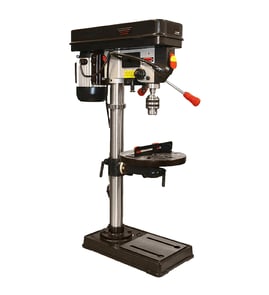
The 4-inch rule for a drill press is a safety guideline: when using your Craftsman 14923970 32" radial drill press, keep your hands and fingers at least 4 inches away from the rotating drill bit, chuck, and spindle area to prevent accidental contact.
- Clamp the workpiece; do not hold small parts by hand near the bit.
- Use a drill press vise, V-block, or a clamp and fence to control the material.
- Use a scrap backer board to support small pieces instead of getting your fingers close.
- Stop the machine before clearing chips; use a brush, not your fingers.
- Remove the chuck key immediately after tightening the chuck.
| Task | What to do | Why it helps |
|---|---|---|
| Secure the work | Clamp or use a vise | Keeps hands away from the bit |
| Set speed | Use the correct pulley/belt speed for the bit size | Reduces grabbing and chatter |
| Set depth | Use the depth stop for repeat holes | Prevents sudden breakthrough |
| Control chips | Brush chips away after stopping | Avoids cuts and entanglement |
A drill press can pull material upward or spin it if the bit grabs. The 4-inch rule forces you to rely on workholding (vise, clamps, fences) instead of your hands, which is the biggest step toward preventing injuries and improving hole accuracy.
If you are troubleshooting power, switches, or wiring on a drill press, we recommend reviewing how to use a multimeter to test electrical parts video.
For parts lookups by model number and diagrams, search by model on Sears PartsDirect.
Last updated: February 2026
How to repair a drill press spindle?
On the Craftsman 14923970 32" radial drill press, spindle repair usually means removing the quill assembly, separating the spindle from the quill, replacing worn bearings, then reassembling and checking runout and chuck fit. We recommend inspecting the spindle taper and bearings before ordering parts through Sears PartsDirect.
- Unplug the drill press and remove the key from the chuck.
- Lower the table and support the head or quill so nothing drops.
- Take photos as you disassemble; note washer and spacer order.
- Mark the quill orientation to the head so it goes back the same way.
- Wear eye protection; snap rings and springs can release suddenly.
- Remove the chuck: Use the correct wedge/key for your arbor style, or lower the quill and tap the drift key into the slot if equipped.
- Access the quill: Remove the quill return spring cover (control the spring tension) and any depth stop hardware.
- Remove the quill retaining hardware: Take off the quill retaining ring or snap ring (if used on your version).
- Separate quill and spindle: Slide the quill out, then press or drive the spindle out of the quill as designed.
- Replace bearings: Remove the spindle bearings; install new bearings squarely (press on the correct race).
- Reassemble and test: Reinstall the spindle into the quill, reinstall the retaining ring, reset spring tension, then verify smooth travel.
| Check | What you’re looking for | What it causes |
|---|---|---|
| Spindle bearings | Roughness, play, noise | Wobble, chatter, poor hole accuracy |
| Spindle taper/arbor | Rust, scoring, bell-mouthing | Chuck falls off, runout |
| Quill bore | Galling, debris | Sticky quill, uneven feed |
| Return spring | Weak or broken coil | Quill won’t retract |
A worn spindle or bearing set is one of the most common reasons a drill press develops runout, vibration, and oversized holes. Fixing the spindle assembly restores accuracy and reduces stress on the motor and pulleys.
- Match parts by model number 14923970 and the exact diagram callout.
- Replace bearings as a set when possible to keep fit and preload consistent.
- If the chuck keeps slipping off after repair, clean the taper and arbor, then reseat the chuck firmly.
For model-based part lookup and diagrams, search by model number on Sears PartsDirect.
Last updated: February 2026
How much does a Craftsman 14923970 drill press weigh?
The exact weight for the Craftsman 14923970 32" radial drill press varies by configuration (stand, motor, table, and accessories). Most drill presses in this size class weigh roughly 150 to 250 lb assembled, so plan to move it with help and proper lifting equipment. For parts and diagrams, start with the model page, or search by model on Sears PartsDirect.
If you are relocating the drill press or loading it into a vehicle, the “move weight” is often less than the fully assembled weight.
- Remove the chuck and any bits from the spindle
- Take off the table and table bracket if practical
- Lower the head as far as it will go and lock it
- If it has a separate stand/base, separate the head/column from the base
- Bag and label fasteners so reassembly is straightforward
These ranges help you plan equipment and manpower when the exact spec is not on hand.
| Drill press type | Typical assembled weight | Typical move plan |
|---|---|---|
| Bench drill press | 40 to 120 lb | 1 to 2 people |
| Floor drill press | 120 to 250 lb | 2+ people, dolly |
| Radial drill press | 150 to 350 lb | 2+ people, heavy-duty dolly |
Weight affects safety and accuracy. A heavier drill press is usually more stable (less vibration), but it also needs a solid floor, secure mounting, and a safe moving plan to prevent tip-over and damage to the column, quill, or motor.
- Unplug the drill press before disassembly or moving
- Use a rated appliance dolly or machinery skates; avoid light hand trucks
- Keep the head low and the column vertical to reduce tipping risk
- Protect the spindle/quill from side impacts during transport
Last updated: February 2026
How to determine the size of a drill press?
A drill press is typically “sized” by its swing: the maximum diameter workpiece you can drill in the center. For your Craftsman model 14923970 (32" radial drill press), measure from the spindle centerline to the column, then double that number.
- Unplug the drill press.
- Find the spindle centerline (center of the chuck/arbor).
- Measure straight back to the center of the column.
- Multiply that distance by 2.
- Example: 8 inches from spindle to column = 16-inch swing
- Swing is about capacity, not motor power
- Swing does not tell you the maximum drilling depth
When customers ask about drill press size, they often mean one of these:
- Throat depth: spindle-to-column distance (half the swing)
- Quill travel (stroke): how far the spindle moves up and down
- Spindle-to-table distance: max height clearance for tall workpieces
- Spindle-to-base distance: clearance when using the base as a table
- Table size: how much support you have for larger stock
| Spec | What it tells you | How to measure |
|---|---|---|
| Swing | Max centered workpiece diameter | (Spindle-to-column) × 2 |
| Throat depth | How far in from an edge you can drill | Spindle-to-column |
| Quill travel | Max drilling depth per plunge | Measure spindle movement |
| Spindle-to-table | Clearance for tall parts | Chuck tip to table |
Choosing the right “size” prevents common problems like the workpiece hitting the column, running out of quill travel mid-hole, or not having enough clearance for a vise, fence, or jig.
When you are matching parts to your Craftsman 14923970, use the full model number to avoid fit issues; you can also search by model on Sears PartsDirect.
Last updated: February 2026
What is a good horsepower for a drill press?
A good horsepower for a drill press depends on what you drill most often. For a Craftsman 14923970 32" radial drill press, 1/2 HP handles most wood and light metal work, while 3/4 HP to 1 HP is a better fit for frequent drilling in thicker steel, larger hole saws, and bigger Forstner bits.
- 1/3 to 1/2 HP: wood, plastics, aluminum, small bits, occasional use
- 3/4 HP: regular metal drilling, larger bits, more consistent torque under load
- 1 HP: frequent heavy drilling, larger hole saws, thicker stock, production-style use
- More HP is not a cure-all: speed control, sharp bits, and proper feed pressure matter just as much
- Radial arm reach matters: a radial drill press can tempt larger, off-center drilling; extra power helps keep the cut stable
| Your typical job | Bit type and size | Good motor range |
|---|---|---|
| Furniture, jigs, general shop drilling | Twist bits up to about 1/2 in. | 1/2 HP |
| Hardwood with larger holes | Forstner bits, circle cutters | 3/4 to 1 HP |
| Steel and thicker metal | Larger twist bits, step bits | 3/4 to 1 HP |
| Repeated large-diameter holes | Hole saws, frequent heavy cuts | 1 HP |
- Speed range: slower speeds for larger bits and metal; faster for small bits in wood
- Quill travel and rigidity: more travel and less flex improves accuracy and reduces chatter
- Chuck and spindle condition: runout makes drilling harder and can mimic “low power”
- Belt and pulley condition: a slipping belt reduces torque even with a strong motor
- Electrical health: weak power, bad switch, or damaged wiring can cause bogging
Choosing the right HP helps prevent stalling, overheating, and bit burning. It also improves hole quality, especially when you use larger bits or drill harder materials where steady torque is the difference between clean cuts and chatter.
For help shopping by model number or exploring repair resources, start with the Craftsman 14923970 parts list and then search by model on Sears PartsDirect.
Last updated: February 2026