Owner’s manual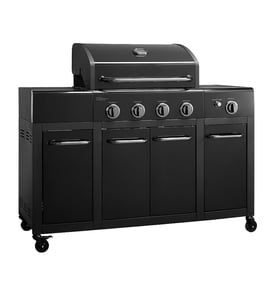



How do I find my Kenmore grill model number?
Your Kenmore grill model number is printed on the grill’s rating label. On model 14634461410, the manual directs you to look at the rating label on the grill (the same label also lists the serial number), so you can record both before ordering parts or requesting service.
Check these common label locations on Kenmore gas grills like 14634461410:
- Back panel of the grill base or cart
- Inside the cabinet area (behind the doors, if equipped)
- Side panel near the LP tank area
- Under a side shelf or near the control panel
- On the firebox exterior (not inside the cookbox)
For the exact label callouts and product record section, use the 14634461410 owner's manual.
Record the details exactly as shown on the label:
- Model number (example: 14634461410)
- Serial number (used to identify production details)
- Date purchased (helpful for warranty and service)
| Item | What it’s used for | Example format |
|---|---|---|
| Model number | Matching the correct parts diagram and parts list | 14634461410 |
| Serial number | Service identification and product record | Letters and numbers |
The model number is the fastest way to ensure you get the right Kenmore gas grill parts (burners, igniter components, hardware, and cabinet pieces) because similar-looking grills can use different part designs.
Last updated: January 2026
How to tell if a regulator is bad on a gas grill?
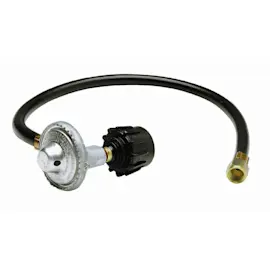
On the Kenmore 14634461410 gas grill, a failing regulator shows up as a sudden drop in gas flow, weak or uneven flames, trouble reaching cooking temperature, or repeated low-flame behavior after lighting. We confirm the issue by doing the manual’s leak test and checking for an “excess flow” trip.
- Turn all control knobs OFF before touching the LP tank connection.
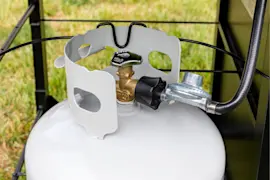
- Confirm the regulator coupling nut is hand-tight and fully seated (do not use tools).
- Open the LP tank valve slowly; opening it too fast can trip the excess flow valve.
- If you hear a strong rushing sound at the connection, shut the tank valve off immediately and correct the connection before using the grill.
- Brush a soapy-water solution on the valve, hose, and regulator connection points and watch for bubbles (leak).
For the exact leak-test steps and the correct way to connect the regulator to the LP tank valve, follow the 14634461410 owner's manual.
| What you notice | Most likely cause | What we do next |
|---|---|---|
| Sudden low flame on all burners | Excess flow valve tripped at tank/regulator | Reset connection and leak-test |
| Flames stay low after reset attempts | Regulator not delivering steady pressure | Replace regulator/hose assembly |
| Humming or whistling from regulator | Normal during operation | No repair needed if heat is normal |
| Regulator frosting | LP cylinder problem | Shut off tank immediately and stop using that cylinder |
- Turn burner knobs OFF.
- Turn LP tank valve OFF.
- Disconnect the regulator from the tank.
- Reconnect the regulator straight and hand-tight.
- Leak-test, then open the tank valve slowly; wait about 30 seconds before lighting.
A bad regulator (or a tripped safety device) changes gas pressure. That leads to poor heating, unreliable ignition, and unsafe leaks if connections are not sealed and tested.
Last updated: January 2026
Is it worth fixing a gas grill?
Yes, it’s usually worth fixing a Kenmore gas grill like model 14634461410 when the firebox and frame are still solid and the repair is limited to serviceable items (hardware, shelves, cart pieces, cleaning). Replace the grill when the cookbox has rust-through, the base is warped, or safe operation is compromised.
- Fix it if the grill lights safely, the structure is stable, and you can restore performance with cleaning and a few parts.
- Replace it if you see holes in the firebox, severe structural rust, or repeated gas leaks you cannot stop.
- Pause and inspect if it’s hard to light or you suspect a burner tube blockage; spiders can nest in venturi tubes and cause dangerous flashback.
For model-specific safety and operating guidance, use the 14634461410 owner’s manual.
Most grill repairs are worthwhile when the fix is straightforward and the grill is otherwise safe:
- Deep cleaning (grease tray, cookbox, burner area) to restore heat and reduce flare-ups
- Clearing burner/venturi tubes when ignition is slow or flames are weak
- Replacing worn cart or cabinet components (rails, panels, shelves)
- Tightening or replacing missing fasteners after years of vibration and moving
If you’re rebuilding the cart, a common starting point is matching the correct hardware; the gas grill hardware pack 41600069 can help when original bolts and fasteners are missing.
Safety and structure matter more than age:
- You cannot stop a gas leak after tightening connections and re-testing
- The grill has major rust-through in the cookbox or firebox
- Burners repeatedly “flash back” behind the control panel (often tied to venturi blockage)
- The grill cannot be used with proper clearances or stable LP cylinder positioning
| Situation | Typical effort | Best choice |
|---|---|---|
| Needs cleaning and tune-up | Low | Fix |
| Needs cart hardware or shelves | Low to medium | Fix |
| Persistent leak or unsafe operation | High risk | Replace |
| Rust-through in cookbox/firebox | Not practical | Replace |
A grill that is structurally sound but dirty or slightly worn is usually economical to restore. A grill with leak issues or venturi-related flashback risk is a safety problem first, not a value decision.
Last updated: January 2026