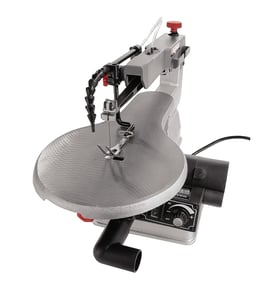

What are some common scroll saw mistakes?
Common mistakes on a Craftsman scroll saw like model 572247202 include incorrect blade tension, using the wrong blade for the wood thickness, pushing the workpiece too fast, and cutting with a table that is not square to the blade. These issues cause broken blades, burning, rough edges, and drifting cuts.
- Blade tension too loose or too tight: Tension the blade so it cuts without fluttering; recheck after a few minutes of running.
- Wrong blade for the job: Match blade size and tooth pattern to material thickness and hardness (fine blades for thin stock, coarser blades for thicker stock).
- Feeding the wood too aggressively: Let the blade do the work; steady, light pressure improves control and reduces breakage.
- Not keeping the work flat on the table: Lifting or twisting the piece makes the blade wander and can snap it.
- Skipping test cuts: Always test on scrap to confirm speed, blade choice, and cut quality.
- Poor dust control and visibility: Clear dust often so you can follow the line accurately.
| Symptom | Most likely mistake | Best fix |
|---|---|---|
| Blades keep breaking | Too much feed pressure, side-loading the blade, wrong blade | Slow feed, keep work straight, switch blade type |
| Cut drifts off the line | Twisting the work, dull blade | Guide gently, replace blade |
| Burn marks | Feeding too slowly with a dull blade, wrong blade | Replace blade, adjust feed rate |
| Beveled edges | Table not square, work not flat | Square the table, keep stock flat |
- Unplug the saw before adjustments.
- Confirm the blade is installed correctly and clamped securely.
- Square the table to the blade before precision work.
- Use a hold-down or light hand pressure to keep stock flat.
- Use hearing and eye protection; add a dust mask for fine cutting.
Scroll saw blades are thin and designed for controlled, straight up-and-down cutting. Most “mystery” problems come from side pressure, incorrect tension, or a blade that does not match the material.
For parts and diagrams for your Craftsman 572247202, start with the model parts list, or search by model number on Sears PartsDirect. You can also review safe DIY habits in are diy appliance repairs safe.
Last updated: February 2026
How do I know which scroll saw blade to use?
For your Craftsman 572247202 motorized scroll saw, pick a blade based on the material type, thickness, and the kind of cut you want. Smaller blade sizes and finer teeth handle tight curves and thin stock; larger sizes cut thicker wood faster with less deflection.
- Match blade size to thickness: thin stock uses smaller blades; thicker stock needs larger blades for stability.
- Match teeth to finish: finer teeth leave a smoother edge; coarser teeth cut faster.
- Choose tooth style for the job: skip-tooth for faster clearing; reverse-tooth to reduce bottom tear-out.
- Use the narrowest blade that still tracks straight for your cut; narrow blades turn tighter.
- Slow down for hardwoods and plastics to reduce burning and melting.
| Blade type | Best for | What you will notice |
|---|---|---|
| Skip-tooth | General cutting, faster feed | Clears sawdust well; rougher edge than fine-tooth |
| Double skip-tooth | Thicker wood, faster cutting | Even better chip clearing; can be more aggressive |
| Reverse-tooth | Plywood, veneered stock | Cleaner bottom edge; slightly slower cutting |
| Spiral | Cutting in any direction | Great for inside work; wider kerf and rougher finish |
- #2 to #3 blades: fretwork, tight curves, thin wood.
- #5 to #7 blades: everyday scrolling in typical craft wood thicknesses.
- #9 to #12 blades: thicker stock and straighter cuts where you want stiffness.
The right scroll saw blade tracks straighter, cuts cooler, and leaves a cleaner edge. That means fewer broken blades, less sanding, and better control on detailed patterns.
If you are not sure which blade style fits your project, start by confirming the exact model number on the saw’s label, then search by model and part category on Sears PartsDirect.
Last updated: February 2026
Are all scroll saw blades universal?
No. Scroll saw blades are not universal; blade fit depends on the saw’s blade-end style and clamp design. For the Craftsman model 572247202, use 3-inch pinned scroll saw blades (pin-end blades); plain-end (pinless) blades will not mount correctly.
Scroll saws generally accept one blade-end style, not both. The key fitment point is how the blade attaches at the top and bottom holders.
- Pinned (pin-end) blades: small cross pins at each end; common on entry-level saws
- Plain-end (pinless) blades: no pins; require a different clamp system
- Specialty tooth patterns (reverse-tooth, skip-tooth, spiral): still must match the correct end style
Once you’ve confirmed you need 3-inch pinned blades for model 572247202, choose based on material and finish quality.
- Higher TPI for thin wood and smoother edges
- Lower TPI for thicker stock and faster cutting
- Reverse-tooth to reduce bottom splintering on plywood
- Skip-tooth for better chip clearing in thicker wood
- Bi-metal or hardened blades for plastics and non-ferrous metals
| Material | Typical TPI range | Best-use note |
|---|---|---|
| Thin softwood | 15 to 20 | Smooth cuts, slower feed rate |
| Hardwood (thicker) | 10 to 15 | Faster cutting, more sanding |
| Plywood | 15 to 20 (reverse-tooth) | Less tear-out underneath |
| Plastic, aluminum | 10 to 18 (hardened/bi-metal) | Reduces melting and grabbing |
Using the wrong blade-end style can cause poor clamping, blade slippage, breakage, and inaccurate cuts. Matching the correct 3-inch pinned format first gives you safer control; then tooth style and TPI fine-tune cut quality.
To shop compatible blades and other replacement items by model number, search on Sears PartsDirect.
Last updated: February 2026
Should I get pinless or pinned scroll saw blades?
For the Craftsman 572247202 scroll saw, choose pinned (pin-end) scroll saw blades. This saw is designed to use 3-inch pinned blades; pinless (plain-end) blades do not fit the stock blade holders, so they are not the right choice unless the saw is modified with different clamps.
| Feature | Pinned (pin-end) blades | Pinless (plain-end) blades |
|---|---|---|
| Fit on Craftsman 572247202 | Yes (standard) | No (without clamp changes) |
| Best for | General cutting, thicker stock, quick changes | Fretwork, tight inside cuts, fine detail |
| Inside cuts | Needs larger entry hole | Fits smaller pilot holes |
| Blade selection | Moderate | Very wide |
- Look for 3-inch pinned scroll saw blades (often labeled “pin-end”).
- Match blade size to material thickness; thicker wood needs a larger, coarser blade.
- Use finer tooth blades for cleaner edges in thin stock.
- Keep a few styles on hand (for example, skip-tooth for general cutting and reverse-tooth to reduce bottom tear-out).
- Unplug the saw before changing blades.
- Set tension so the blade “plucks” with a crisp note; loose blades wander, over-tight blades snap.
- Feed the work slowly and let the blade cut; forcing the wood overheats and bends blades.
- For inside cuts, drill an entry hole large enough for the pinned ends to pass through.
Buying the correct blade type prevents fit problems and wasted time. Pinned blades are the compatible choice for the Craftsman 572247202; pinless blades are mainly for saws with plain-end clamps and are best for very fine fretwork.
To shop by model number and find compatible items, search using your model 572247202 on Sears PartsDirect.
Last updated: February 2026
How thick of wood can I cut with a scroll saw?
Most scroll saws, including Craftsman model 572247202, are intended for thin to medium stock; 3/4 inch to 1-1/2 inches is the practical range for clean, accurate cuts, and up to about 2 inches is possible when you use the right blade and a slow, steady feed rate.
- 1/8 to 3/4 inch: best for tight curves, fretwork, and clean edges
- 3/4 to 1-1/2 inches: very workable; expect slower cutting in hardwood
- 1-1/2 to 2 inches: doable for simpler shapes; blade drift and burning are more likely
- Over 2 inches: not a typical scroll saw job; accuracy drops and blades break more often
- Wood density: pine and poplar cut easier than maple, oak, or exotic hardwoods
- Blade selection: larger, coarser blades clear sawdust better in thick stock
- Blade tension and sharpness: dull blades wander, burn, and snap
- Feed rate: pushing faster does not cut faster; it bends the blade and ruins accuracy
- Pattern detail: tight inside curves get dramatically harder as thickness increases
| Thickness | Best use case | What to watch for |
|---|---|---|
| 1/8 to 3/4 in. | Detailed scrolling | Tear-out on the bottom surface |
| 3/4 to 1-1/2 in. | General projects | Heat, slower feed, mild drift |
| 1-1/2 to 2 in. | Simple curves, straight-ish cuts | Drift, burning, blade breakage |
As stock gets thicker, the blade has more side contact, which increases heat and deflection. That leads to wandering cuts, burn marks, and broken blades, especially in hardwood.
If you need replacement parts for Craftsman 572247202, start with the diagrams and parts list for your model; you can also search by model number on Sears PartsDirect.
For general DIY safety habits before servicing any powered equipment, review are diy appliance repairs safe.
Last updated: February 2026