
How do I tell what year my snowblower is?
To estimate the year of your Craftsman snowblower model 536886800, we use the engine’s manufacture date code (stamped on the engine). That code typically includes a year and date sequence that tells when the engine was built, which is the most reliable way to date the machine.
Where to find the date information
Most snowblowers don’t have a clear “model year” label on the frame. Instead, the best dating clues are on the engine and ID tags.
- Look on the engine shroud, valve cover area, or recoil starter housing for a stamped code or label.
- Check near the spark plug area and blower housing for a metal tag or sticker.
- If the snowblower has an ID plate on the frame, record every number on it (model, serial, and any product ID).
- If the engine was replaced at some point, the engine date will reflect the replacement engine, not the original snowblower.
How to interpret common small-engine date codes
Many small engines use a numeric date code where the first two digits indicate the year, followed by month and day digits.
| Example code pattern | What it usually means | Example result |
|---|---|---|
| YYMMDDxx | Year, month, day, then plant/sequence | 99011556 = Jan 15, 1999 |
| YYMMDD | Year, month, day | 120830 = Aug 30, 2012 |
Quick checks that help confirm the timeframe
Use these clues to sanity-check the engine date against the rest of the machine.
- Compare the engine date to the condition of belts, cables, and decals.
- Check whether the auger uses shear bolts (many do); missing or incorrect bolts can indicate prior repairs.
- Look for parts that commonly get replaced over time, such as the snowblower shear bolt 1501216MA or the belt 3887MA.
Why it matters
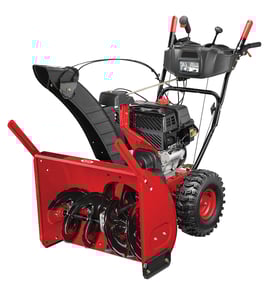
Knowing the approximate year helps us match the correct parts diagrams and avoid ordering the wrong auger hardware, belt routing, or control cable components for your Craftsman 536886800 25" snow blower.
Last updated: January 2026
How many years should a snowblower last?
Most snowblowers, including the Craftsman 536886800 25" snow blower, typically last 10 to 20 years with normal residential use and consistent maintenance. The biggest factors are off-season storage, keeping wear items (belts and shear bolts) in good shape, and fixing small issues before they damage the auger or drive system.
Typical lifespan by type
| Snowblower type | Typical lifespan | Notes |
|---|---|---|
| Gas, mid to heavy duty | 10 to 20 years | Longest life with annual maintenance and proper storage |
| Gas, light duty | 8 to 15 years | More sensitive to neglected belts, cables, and friction drive wear |
| Electric (corded/battery) | 5 to 10 years | Often limited by motor/electronics and battery life |
What makes a snowblower wear out faster
- Hitting hidden objects (curbs, rocks, frozen newspapers) that stress the auger and gearbox
- Running with worn or incorrect shear bolts (can lead to bigger damage)
- Storing with old fuel or moisture in the system (hard starts, carb issues)
- Ignoring belt slip or cable stretch until the drive or auger stops working
- Operating with loose fasteners or misadjusted skid shoes (excess vibration and scraping)
Maintenance that extends life the most
- Replace shear bolts immediately after a break; keep spares on hand like the snowblower shear bolt 1501216MA
- Inspect and replace worn drive/auger belts when you see glazing, cracking, or slipping; a common wear item is the belt 3887MA
- Check control cables and return springs for proper tension and snap-back; the spring 1673MA is one example of a small part that can affect engagement
- End-of-season: stabilize or drain fuel, clean packed snow, and store dry to prevent rust and frozen controls
Why it matters
A snowblower usually does not “wear out” all at once; it loses performance from normal wear parts (belt, cable, shear bolts) first. Replacing those parts on time helps protect expensive components like bearings, gears, and the auger/impeller drive.
Last updated: January 2026
Is it worth fixing a snowblower?
Yes, it’s usually worth fixing a Craftsman snowblower model 536886800 when the problem is a common wear item (belt, shear bolt, cable hardware) and the total repair cost stays well under the price of a comparable new 25-inch snow blower. Replacement makes more sense when the engine or drive system needs major work.
Quick way to decide (cost, age, and what failed)
Use these practical checkpoints before you buy parts:
- Repair cost vs. replacement cost: If parts plus labor approach 50% or more of a new unit, replacement is typically the better value.
- What failed: Wear items (belts, shear bolts, springs) are usually economical; major drivetrain or engine issues are not.
- Overall condition: Rusted auger housing, worn friction surfaces, or multiple failures in one season point toward replacement.
- Parts availability: If the key parts you need are in stock, repair is faster and more predictable.
- How often you use it: Heavy-use machines justify repair more often than occasional-use machines.
Common “worth it” repairs for this model
These are the types of fixes that are typically low-cost and high-impact:
- Replace a broken snowblower shear bolt 1501216MA after an auger jam
- Replace a worn or slipping belt 3887MA if the auger or drive stops pulling under load
- Restore auger clutch feel with the spring 1673MA if the control feels loose or doesn’t return crisply
- Replace a stretched or damaged control cable 1579MA
When replacement is usually the smarter move
Major repairs can exceed the value of an older machine, especially if multiple components are worn.
| Situation | Typical outcome | Best next step |
|---|---|---|
| Engine has low compression or severe internal damage | High cost, uncertain payoff | Replace unit or engine-level service |
| Gearcase or worm gear damage | Parts and labor add up quickly | Price out repair vs. replacement |
| Multiple systems failing (auger, drive, controls) | “Cascade” repairs | Replace to reset reliability |
Why it matters
A snowblower is a safety and time-saving tool. Fixing a simple failure (like a shear bolt or belt) gets you back to reliable snow clearing quickly, while sinking money into major drivetrain work often delays the season and increases total cost.
Last updated: January 2026
What is the most common problem with snow blowers?
The most common problem we see with snow blowers, including the Craftsman 536886800 25" snow blower, is a no-start or hard-start condition caused by old fuel and a dirty carburetor. Next most common are chute clogs and an auger that will not turn because a shear bolt has broken.
Most common issues (and what to check first)
- Won’t start / starts then dies: drain old gas, add fresh fuel, check spark plug, clean the carburetor.
- Chute clogs: clear packed snow and ice; keep the chute clean and avoid overfeeding heavy snow.
- Auger won’t turn: inspect and replace broken shear bolts such as the snowblower shear bolt 1501216MA.
- Drive problems (won’t move or slips): inspect the drive/auger belt for wear or glazing; replace if needed (example: belt 3887MA).
- Controls feel loose or won’t engage: check cable tension and linkage; inspect the clutch cable spring such as the spring 1673MA.
Quick symptom-to-cause guide
| Symptom | Most likely cause | Typical fix |
|---|---|---|
| Engine won’t start | Stale fuel, dirty carburetor, bad spark plug | Fresh fuel, carb clean, new plug |
| Auger stops suddenly | Shear bolt broken after hitting ice/rocks | Replace shear bolt(s) |
| Unit won’t drive | Worn/slipping belt, misadjusted drive cable | Replace belt, adjust cable |
| Poor throwing distance | Chute/impeller packed, wet snow | Clear clog, slow down |
Why it matters
Starting and auger issues are common because snow blowers often sit unused for months. Fuel can degrade in storage, and the auger system is designed to sacrifice a shear bolt to protect the gearbox when you hit a hidden object.
Safety and maintenance tips
- Shut off the engine and remove the key (if equipped) before clearing jams.
- Let moving parts stop completely before inspecting belts or auger hardware.
- Use fresh fuel each season and run the machine dry (or stabilize fuel) before storage.
Last updated: January 2026