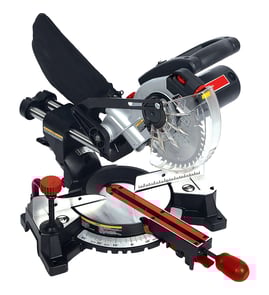

What are the parts of a miter saw?
A Craftsman 137234960 10-inch compound miter saw is made up of a cutting head (motor and blade), angle-setting controls (miter and bevel), and safety/support parts that hold the workpiece steady. Knowing these parts helps you set accurate angles and troubleshoot issues like drifting cuts or binding.
Main parts you will see on most compound miter saws
- Blade and blade guard: The blade does the cutting; the guard covers the blade when the saw is raised.
- Motor and handle/trigger: Powers the blade and controls start/stop.
- Miter table and miter scale: The rotating base that sets left/right miter angles.
- Fence: The vertical back support that keeps the board square to the blade.
- Bevel pivot and bevel scale: Lets the head tilt for bevel cuts.
- Bevel lock lever/knob: Locks the bevel angle so it does not slip during a cut.
- Miter lock knob/lever: Locks the miter table at the selected angle.
Common accessories and small hardware (often included)
- Workpiece clamp: Holds trim or narrow stock against the fence.
- Dust bag or dust port: Helps collect sawdust (collection varies by setup).
- Wrenches/tools (often stored on the saw): Used for blade changes and adjustments.
- Washers and lock nuts: Secure pivots, guards, and adjustment points.
Quick “what it does” reference
| Part | What it controls | When you use it |
|---|---|---|
| Miter lock | Left/right angle | Picture frames, trim corners |
| Bevel lock | Tilt angle | Crown molding, compound cuts |
| Fence | Workpiece alignment | Any cut needing square support |
| Clamp | Workpiece holding | Small pieces, repeat cuts |
Why it matters
When cuts are not accurate, the cause is usually a lock not fully tightened, a fence out of square, or debris on the miter table. Identifying the exact part involved speeds up adjustment and repair.
Helpful DIY reference
For electrical checks (switch, cord, motor), use how to use a multimeter to test electrical parts video.
Last updated: February 2026
What should you never cut with a miter saw?
You should never cut anything on a Craftsman 137234960 10-inch compound miter saw that you cannot hold firmly against the fence and table, or any material the blade is not rated for. The biggest “never” items are tiny loose offcuts, freehand cuts, and metal or masonry without the correct blade and setup.
Never cut these materials or setups
- Small pieces you cannot clamp or hold securely (short, narrow, or awkward offcuts)
- Freehand work (workpiece not tight to the fence and flat on the table)
- Metal, masonry, or tile unless you have the correct blade, guarding, and procedure for that material
- Warped, bowed, twisted, or round stock that will not sit flat and stable
- Stacked pieces (cutting multiple boards at once) unless they are rigidly clamped and fully supported
- Anything with hidden fasteners (nails, screws, staples) in the cut path
Safer alternatives that work better
Use the tool that matches the cut and the material.
| If you need to cut… | Better choice than a miter saw | Why it’s safer/cleaner |
|---|---|---|
| Very small trim pieces | Stop block + clamp, or a hand saw | Prevents the piece from shifting or launching |
| Metal | Metal-cutting saw or abrasive chop saw | Correct speed, blade type, and guarding |
| Long boards | Miter saw with infeed/outfeed support | Keeps the board flat and reduces binding |
| Warped lumber | Table saw/jointer first, or choose straighter stock | Reduces rocking and kickback risk |
Quick safety checks before every cut
- Keep the workpiece flat on the table and tight to the fence.
- Use a clamp whenever your hands would be within about 6 inches of the blade path.
- Let the blade reach full speed; lower smoothly and do not force the cut.
- Wait for the blade to stop completely before lifting the saw head.
- Keep the blade guard working; never tie it up or block it.
Why it matters
A miter saw is designed for controlled crosscuts and miters on stable stock. When the workpiece can move, the blade can bind and throw the material (kickback), which is the most common cause of sudden injury and damaged fences, guards, and blades.
For general DIY safety basics that apply to power tools like this saw, review are diy appliance repairs safe.
Last updated: February 2026
How to unlock an old Craftsman miter saw?
On the Craftsman 137234960 10-inch compound miter saw, “unlocking” usually means releasing the miter table lock or the head (down-lock) so the saw can pivot, slide to an angle, or raise up for cutting. Start by loosening the miter lock knob/handle, then release any head lock pin or latch so the saw head can lift.
Common places the saw is locked
Most older Craftsman compound miter saws use a few simple mechanical locks. Check these areas in order:
- Miter lock knob/handle (front of the base): loosens so the table can rotate left or right.
- Miter detent/override lever (near the miter scale): lets you move off common “click” angles.
- Bevel lock knob/lever (rear or side pivot): loosens so the saw head can tilt for bevel cuts.
- Head down-lock pin or latch (near the pivot): holds the saw head down for storage/transport.
- Slide/rail lock (if equipped): locks the head from sliding in and out.
Quick unlock steps (safe order)
- Unplug the saw and lower the blade guard fully.
- Release the head down-lock: press the handle down slightly, then pull the lock pin out (or flip the latch) so the head rises.
- Unlock the miter: loosen the front miter lock knob/handle, press the detent lever if needed, rotate to the angle, then re-tighten.
- Unlock the bevel (only if you need a bevel cut): loosen the bevel lock, tilt to the bevel angle, then re-tighten.
What “unlocked” should feel like
| Adjustment | When unlocked | When locked |
|---|---|---|
| Miter table | Rotates smoothly; detents click at common angles | Table will not rotate |
| Saw head (down-lock) | Head lifts under spring tension | Head stays down |
| Bevel pivot | Head tilts left/right (model dependent) | Head will not tilt |
Why it matters
If a lock is partially engaged, the saw can bind, drift off angle, or feel “stuck.” Fully releasing the correct lock (miter, bevel, head pin, or slide lock) keeps your cuts accurate and prevents forcing parts.
For more DIY safety and best practices before working on a power tool, review are diy appliance repairs safe.
Last updated: February 2026
Why is 31.6 on a miter saw?
The 31.6° mark on your Craftsman 137234960 10-inch compound miter saw is there to make common crown molding cuts fast and repeatable. It is a standard miter setting used with a matching bevel setting (often 33.9°) to create the compound angles needed for typical 90° room corners.
What the 31.6° setting is used for
Most miter saws include detents (positive stops) for angles people cut all the time. 31.6° is one of those because it is widely used for crown molding when you cut the molding laid flat on the saw table.
Common uses:
- Cutting crown molding for inside corners and outside corners
- Speeding up setup by using a preset detent instead of measuring each time
- Improving consistency when you are making multiple matching pieces
- Reducing math when you need a compound cut (miter + bevel)
Typical crown molding “compound” settings (quick reference)
These are the common reference angles many saws label for crown molding. Your exact settings depend on the molding’s spring angle and how you position it.
| Crown molding spring angle | Typical miter setting | Typical bevel setting |
|---|---|---|
| 38° (common) | 31.6° | 33.9° |
| 45° (common) | 35.3° | 30.0° |
How to use it correctly on a compound miter saw
Use this checklist to avoid upside-down or backwards cuts:
- Decide whether you are cutting an inside or outside corner.
- Keep the molding orientation consistent (same face up each time).
- Set the miter to 31.6° (left or right depending on the corner).
- Set the bevel to the matching angle (often 33.9° for 38° spring angle crown).
- Make a test cut on scrap and confirm the joint closes before cutting finish material.
Why it matters
Crown molding joints are unforgiving; a small angle error leaves visible gaps. The 31.6° detent helps you get to a proven starting point quickly, so you spend less time adjusting and waste less material.
For electrical troubleshooting on a miter saw (switch, cord, motor, or intermittent power), we use the same basic test approach as other power tools; the steps in how to use a multimeter to test electrical parts video apply directly.
Last updated: February 2026
Can you cut a 4x4 with a 12 inch miter saw?
Yes; most 12-inch miter saws can crosscut a 4x4 (actual size about 3-1/2 in. x 3-1/2 in.) in one pass at 90°. That said, your Craftsman model 137234960 is a 10-inch compound miter saw, and 10-inch saws often need a flip-cut to finish a 4x4.
What to expect: 12-inch vs 10-inch capacity
A 12-inch blade usually provides enough vertical cut capacity to clear 3-1/2 inches. A 10-inch saw commonly has less max cut depth, so the blade may not reach through a 4x4 in one pass.
| Saw size/type | Typical result on a 4x4 at 90° | What you do if it won’t clear |
|---|---|---|
| 12-inch compound miter saw | One-pass cut | Clamp and cut normally |
| 12-inch sliding miter saw | One-pass cut (plus wider crosscut) | Same; slide helps width more than height |
| 10-inch compound miter saw (like Craftsman 137234960) | Often not one-pass | Use a flip-cut to finish |
How to cut a 4x4 safely (works for 12-inch and 10-inch)
- Clamp the 4x4 to the fence and table; do not hand-hold tall stock.
- Support both ends with stands so the post stays flat and does not roll.
- Keep the workpiece tight to the fence; gaps reduce accuracy and increase binding.
- Let the blade reach full speed before entering the cut.
- Use a sharp framing or fine-finish blade appropriate for the material.
- Wait for the blade to stop completely before raising the saw head.
If your saw does not cut through in one pass (common on 10-inch saws)
- Make the first cut as deep as the saw allows.
- Mark the kerf line, then rotate the 4x4 180° (keep the same face against the fence) and complete the cut.
- If you see shifting, re-clamp; a stepped cut usually comes from movement during the flip.
Why it matters
A one-pass cut is cleaner, but control is the real safety factor. Clamping and supporting a 4x4 prevents rolling, binding, and kickback, especially on a 10-inch saw like the Craftsman 137234960.
For general DIY safety practices before any repair or project, use are diy appliance repairs safe.
Last updated: February 2026