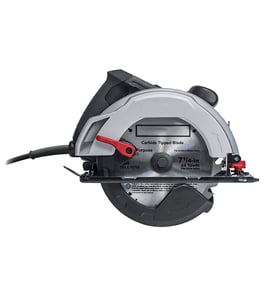

What are the parts of a circular saw machine?
A circular saw like the Craftsman 31527802 is built around a motor that spins a blade, plus controls and guards that help you cut accurately and safely. Most saws share the same core components, even if the exact shapes and names vary by version.
Main parts you will see on most circular saws
- Blade: The cutting disc; chosen by diameter, tooth count, and material (wood, plywood, metal-rated, etc.).
- Blade guard (upper and lower): Covers the blade; the lower guard retracts as you start a cut.
- Shoe (base plate): The flat plate that rides on the workpiece and supports straight, stable cuts.
- Motor and arbor: The motor drives the arbor (shaft) that the blade mounts to.
- Arbor bolt and outer flange (washer): Clamps the blade to the arbor.
- Depth adjustment: Sets how far the blade extends below the shoe.
- Bevel adjustment: Tilts the shoe for angled cuts (commonly up to 45 degrees).
- Handle and trigger: Main grip and on/off control.
- Trigger lock (safety lock-off): Helps prevent accidental starts.
- Front grip (auxiliary handle/knob): Second hand position for control.
Quick “what it does” guide
| Part | What it controls | Common symptom if it’s not right |
|---|---|---|
| Shoe (base plate) | Cut straightness and stability | Wandering cuts, binding |
| Depth adjustment | How deep the blade cuts | Tear-out, kickback risk |
| Bevel adjustment | Angle of cut | Inaccurate miters/bevels |
| Blade guard | Exposure to blade | Guard sticking or not returning |
Why it matters
Knowing the names of the blade guard, shoe, arbor bolt, and adjustments helps you pick the right replacement parts and troubleshoot issues like binding, crooked cuts, or a guard that sticks.
Helpful DIY reference
If you’re diagnosing a switch, cord, or motor issue, we use the same basic electrical checks shown in how to use a multimeter to test electrical parts video.
Last updated: February 2026
What is a lock-off switch on a circular saw?
A lock-off switch on a circular saw is a built-in safety feature that helps prevent the trigger from being pulled accidentally. On your Craftsman 31527802 7-inch electric hand saw, you typically press (or slide) the lock-off first, then squeeze the trigger to start the motor.
What it does (and what it does not do)
- Helps reduce accidental starts when you pick up the saw, set it down, or carry it
- Requires a deliberate two-step action (lock-off plus trigger) to run the tool
- Resets when you release the trigger on most saws
- Does not replace unplugging the saw before blade changes or adjustments
- Does not act like a “parking brake”; the blade can still coast after you release the trigger
How to use it safely
- Grip the main handle firmly.
- Press or slide the lock-off with your thumb.
- While holding the lock-off, squeeze the trigger to start.
- Release the lock-off after the motor is running (most designs allow this).
- To stop, release the trigger and wait for the blade to fully stop before setting the saw down.
Quick troubleshooting if the saw will not start
| Symptom | Common cause | What to check first |
|---|---|---|
| Trigger won’t move | Lock-off not fully pressed | Press lock-off fully, then squeeze trigger |
| Trigger moves, no power | No power at outlet or bad cord | Try a known-good outlet; inspect cord for damage |
| Starts intermittently | Loose wiring or worn switch | Inspect for damaged wires; test with a meter |
Why it matters
Accidental starts are one of the most common circular saw hazards. The lock-off switch adds a simple “intentional start” step that helps protect you during handling, transport, and setup.
For electrical checks (like verifying power through the cord or switch), we recommend using a meter and following safe testing practices in how to use a multimeter to test electrical parts video.
Last updated: February 2026
How to change an old Craftsman circular saw blade?
To change the blade on your Craftsman 31527802 7-inch electric hand saw, unplug the saw, lock the blade, remove the arbor bolt and outer washer, then swap the blade and reassemble in the same order. Always reinstall the blade with the teeth facing the correct cutting direction.
Safety first (do this every time)
- Unplug the saw (do not rely on the trigger lock).
- Wear cut-resistant gloves; carbide teeth are sharp.
- Set the saw on a stable bench with the blade guard closed.
- Use the correct wrench for the arbor bolt.
- Confirm the new blade matches the saw (7-inch diameter, correct arbor size).
Blade change steps (typical for Craftsman 7-inch corded saws)
- Unplug the saw.
- Press and hold the spindle lock (often near the upper blade guard) and rotate the blade by hand until it locks.
- Retract the lower blade guard to access the arbor area.
- Loosen and remove the arbor bolt (some models use a left-hand thread; if it will not loosen normally, try turning the opposite direction).
- Remove the outer washer/flange, then slide the old blade off the arbor.
- Install the new blade, making sure it seats flat on the inner flange.
- Reinstall the outer washer/flange and arbor bolt; tighten firmly while holding the spindle lock.
- Spin the blade by hand to confirm it turns freely and the guard snaps back.
Quick checks before you cut
- Blade is installed with teeth facing the correct direction.
- Washers/flanges are in the same order as removed.
- Guard moves freely and fully returns.
- No wobble; blade sits flat.
Common issues and fixes
| Problem | What it usually means | What to do |
|---|---|---|
| Arbor bolt will not loosen | Left-hand thread or seized threads | Try loosening the opposite direction; apply penetrating oil and retry |
| Blade rubs guard | Blade not seated or wrong size | Reseat blade; confirm 7-inch blade and correct arbor |
| Blade wobbles | Missing/incorrect washer or debris on flange | Clean flanges; reinstall washers in correct order |
Why it matters
A correctly installed blade cuts straighter, reduces kickback risk, and prevents damage to the arbor, washers, and blade guard.
For more DIY safety guidance before working on power tools, review are diy appliance repairs safe.
Last updated: February 2026
Why is my Craftsman circular saw not spinning?
If your Craftsman 31527802 7-inch electric hand saw won’t spin, the most common causes are a power supply issue, worn motor brushes, a failed trigger switch, or a jammed blade/guard. Start with quick external checks, then move to brush and switch testing.
Quick checks first (fastest fixes)
- Unplug the saw; confirm the blade spins freely by hand (with gloves) and the lower blade guard moves smoothly.
- Try a different known-good outlet; avoid long, light-duty extension cords.
- Inspect the power cord for cuts, kinks, melted spots, or a loose strain relief at the handle.
- Check that the blade is installed correctly and the arbor nut is tight (a loose blade can bind).
- Smell for burnt odor from the handle/motor housing; that often points to brushes, switch, or armature issues.
Most likely internal causes
Worn or stuck motor brushes
Motor brushes carry power to the spinning armature. When brushes wear down, chip, or stick in their holders, the motor may not start at all or may start intermittently.
Failed trigger switch or internal wiring
A bad trigger switch, broken wire, or loose connection can stop power from reaching the motor.
Motor or bearing problem
If the blade is hard to turn by hand, the saw may have a seized bearing, debris in the guard area, or internal motor damage.
What to test (safe, practical approach)
- Blade/guard movement: blade should rotate smoothly; guard should not rub the blade.
- Cord condition: flex the cord gently near the handle; if the saw cuts in and out, the cord or connection is failing.
- Electrical checks (unplugged): use a multimeter to check continuity through the cord and switch.
- Brush inspection: remove and inspect brushes for heavy wear, burning, or cracking.
| Symptom | Most common cause | What to do next |
|---|---|---|
| No sound, no movement | Cord, outlet, trigger switch | Verify outlet, inspect cord, test switch |
| Hums but won’t spin | Jammed blade, seized bearing | Check blade/guard, inspect for binding |
| Starts only sometimes | Worn brushes, loose wiring | Inspect brushes, check connections |
| Strong burning smell | Brushes, switch, motor damage | Stop using; inspect before powering again |
Why it matters
A saw that won’t spin is often an electrical interruption (brushes, switch, cord). Fixing the root cause prevents repeated overheating, arcing at the brushes, and damage to the armature.
For electrical testing basics, we recommend how to use a multimeter to test electrical parts video.
Last updated: February 2026
