Owner’s manual



What are common problems with Goodman air conditioners?
Common problems we see with Goodman air conditioners (including the CK30-1D outdoor unit) include not cooling well, weak airflow, outdoor unit not starting, icing, and unusual noises; the most frequent root causes are maintenance issues (dirty coils, restricted airflow) or electrical component failures such as a weak run capacitor.
Most common symptoms and likely causes
- Not cooling or cooling poorly: dirty condenser coil, low airflow across the indoor coil, refrigerant issue, failing compressor
- Outdoor unit will not start: failed run capacitor, contactor problem, tripped breaker, loose wiring
- Short cycling (turns on and off quickly): dirty coil, incorrect airflow, electrical control issue
- Ice on lines or coil: clogged filter/return, blower/airflow problem, refrigerant charge issue
- Buzzing, rattling, or humming: loose panels, fan motor issues, failing capacitor, debris in the condenser
Quick checks we recommend (safe homeowner steps)
Turn power off at the disconnect and breaker before inspecting anything.
- Confirm the thermostat is calling for cooling and set to COOL
- Replace/clean the indoor air filter and make sure supply/return vents are open
- Clear leaves and debris from around the outdoor condenser; keep at least 2 feet of clearance
- Gently rinse the outdoor coil from the outside in (no pressure washer)
- Listen for a brief hum with no fan start; that often points to a weak capacitor
Parts that commonly fail on outdoor units
If your CK30-1D condenser hums, struggles to start, or the fan will not run, the run capacitor is a common suspect. We list a compatible capacitor as capacitor 12972.
| Symptom | Common outdoor-unit culprit | What you may notice |
|---|---|---|
| Hums but will not start | Run capacitor | Fan blade does not spin, breaker may trip |
| Starts then shuts off | Capacitor or control issue | Short cycling, warm air indoors |
| Rattling | Loose hardware or debris | Noise changes with wind/fan speed |
Why it matters
Airflow and coil cleanliness directly affect head pressure, energy use, and compressor life. Catching a weak capacitor early can prevent repeated hard starts that stress the compressor.
Where to confirm model-specific details
For wiring diagrams, electrical ratings, and service clearances specific to Goodman CK30-1D, use the owner's manual.
Last updated: February 2026
How to check AC model number?
For a Goodman CK30-1D outdoor air conditioner or heat pump unit, the model number is printed on the unit’s rating plate (data label). Look for a sticker or metal plate on the outside cabinet near the service panel or where the refrigerant lines enter; copy the full model number and serial number exactly as shown.
Where to look on a Goodman outdoor unit
Most Goodman condenser-style outdoor units place the rating plate in one of these spots:
- On the exterior cabinet side panel
- Near the electrical service access panel (where the contactor and capacitor are)
- Near the refrigerant line set connection area
- Inside the service panel (after removing screws)
For diagrams and label references specific to this model family, use the owner's manual.
What to write down (so you get the right parts)
Record the information exactly, including dashes and letters.
- Model number (example format: CK30-1D)
- Serial number
- Electrical ratings (volts, phase, Hz)
- Refrigerant type (often listed as R-22 or R-410A on older/newer systems)
- Any additional product number or manufacturing code
Quick checklist: model number vs. serial number
| Item | What it tells you | Why we need it |
|---|---|---|
| Model number | The exact unit design and parts breakdown | Matches the correct parts list for CK30-1D |
| Serial number | Production run and date coding | Helps confirm compatible revisions |
| Electrical ratings | Required power specs | Prevents ordering the wrong electrical part |
Why it matters
Outdoor AC/heat pump units often have multiple revisions that look identical. Using the exact model number from the rating plate helps ensure you order the correct replacement parts (for example, a run capacitor like capacitor 12972 when your unit uses that configuration).
Last updated: February 2026
How many square feet can Goodman 2.5 ton cover?
A 2.5-ton Goodman air conditioner typically cools about 1,200 to 1,600 sq. ft. in an average, well-insulated home. Actual coverage depends on insulation, ceiling height, sun exposure, duct condition, and your local climate; use the sizing guidance in the owner's manual for the best match.
Typical coverage for 2.5-ton cooling
Most 2.5-ton systems are sized around 30,000 BTU/hr of cooling. A common rule of thumb is about 20 to 25 BTU per sq. ft., which lands in the 1,200 to 1,600 sq. ft. range.
- Tighter, newer homes: often closer to the high end of the range
- Older or leaky homes: often closer to the low end of the range
- High ceilings: reduces effective coverage
- Hot, sunny exposures: reduces effective coverage
- Undersized ducts or poor airflow: reduces effective coverage
Quick sizing table (rule-of-thumb)
| Home conditions | Approx. BTU per sq. ft. | 2.5-ton estimated coverage |
|---|---|---|
| Well insulated, shaded, average ceilings | 18 to 22 | 1,350 to 1,650 sq. ft. |
| Average insulation, typical sun | 20 to 25 | 1,200 to 1,500 sq. ft. |
| Poor insulation, high sun load, high ceilings | 25 to 30 | 1,000 to 1,200 sq. ft. |
How to tell if your system is the wrong size
- Short cycling (turns on and off frequently): often oversized
- Runs constantly and still feels warm: often undersized
- High humidity indoors even when cool: can indicate oversizing or airflow issues
- Hot and cold rooms: duct leakage, restrictions, or balancing problems
Why it matters
Correct sizing helps your Goodman CK30-1D outdoor unit cool evenly, control humidity, and avoid unnecessary wear on key electrical parts like the run capacitor. If you are troubleshooting a no-start or weak cooling issue, checking electrical components such as the capacitor 12972 can be part of a safe diagnostic process.
Last updated: February 2026
What is the average lifespan of a Goodman AC unit?
A Goodman central AC outdoor unit like the CK30-1D typically lasts 12 to 15 years. With correct sizing, solid installation, and consistent maintenance (clean coils, good airflow, and healthy electrical components), it commonly reaches 15 to 20 years.
Typical lifespan ranges
Most split-system outdoor condensers fall into these real-world ranges:
| Condition | Typical lifespan | What it usually looks like |
|---|---|---|
| Well maintained | 15 to 20 years | Stable cooling, fewer breakdowns |
| Average maintenance | 12 to 15 years | Occasional repairs, efficiency slowly drops |
| Neglected or harsh conditions | 8 to 12 years | Frequent service calls, hard starts, noisy operation |
What shortens (or extends) AC life
These are the biggest factors we see affecting outdoor unit longevity:
- Coil cleanliness: dirty condenser coils run hotter and stress the compressor
- Electrical health: weak capacitors and loose wiring cause hard starts and overheating
- Airflow and clearance: blocked discharge air raises head pressure
- Refrigerant charge: chronic undercharge or overcharge reduces efficiency and reliability
- Climate and run time: long cooling seasons and extreme heat increase wear
Maintenance checklist that adds years
Use this as a simple annual baseline for a Goodman CK30-1D outdoor unit:
- Shut off power and rinse debris from the outdoor coil (gentle water, no pressure washer)
- Keep 18 to 24 inches of clearance around the cabinet (typical best practice)
- Replace or clean the indoor air filter regularly (a clogged filter can affect the whole system)
- Inspect the disconnect and wiring for heat damage; repair safely as needed
- Have a technician verify refrigerant charge and overall operation
For model-specific service and safety notes, follow the owner's manual.
When replacement starts to make more sense than repair
A unit near end-of-life often shows patterns like:
- Repeated hard-starting or humming before the fan/compressor starts
- Rising energy bills with no change in thermostat settings
- Multiple refrigerant leak repairs
- Compressor or coil problems combined with age (often the tipping point)
Common part-related symptom example
If the outdoor unit struggles to start or the fan motor sounds strained, a failing run capacitor is a common cause. For this model, the capacitor 12972 is one of the listed replacement parts.
Why it matters
Knowing the expected lifespan helps you plan: you can decide whether to invest in maintenance and targeted repairs (like a capacitor) or budget for replacement before a peak-heat failure.
Last updated: February 2026
What are the 5 main parts of AC?
The 5 main parts that make an air conditioner work are the compressor, condenser coil, metering device (TXV or fixed orifice), evaporator coil, and refrigerant that circulates between them. Your Goodman CK30-1D outdoor unit contains the compressor and condenser side of that cycle; see the owner's manual for model-specific component locations.
The 5 main parts and what each one does
- Compressor: Pumps refrigerant and raises its pressure and temperature.
- Condenser coil (outdoor coil): Releases heat to outside air as refrigerant condenses.
- Metering device (TXV or orifice): Drops refrigerant pressure to control flow into the evaporator.
- Evaporator coil (indoor coil): Absorbs heat from indoor air as refrigerant evaporates.
- Refrigerant: The working fluid that carries heat from indoors to outdoors.
Quick “where it is” guide (typical split system)
| Part | Typical location | What you notice when it fails |
|---|---|---|
| Compressor | Outdoor unit | Hums, trips breaker, poor cooling |
| Condenser coil | Outdoor unit | Hot air not exhausting well, high pressures |
| Metering device | Indoor coil or near it | Icing, poor cooling, odd pressures |
| Evaporator coil | Indoor air handler/furnace | Icing, weak cooling, water leaks |
| Refrigerant | Sealed lineset + coils | Gradual loss of cooling, icing, hissing |
Related parts you may replace during service
Some service issues involve electrical or vibration-isolation parts on the outdoor unit:
- A weak run capacitor can prevent the compressor or fan motor from starting; see capacitor 12972.
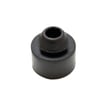
- Worn vibration isolators can cause rubbing or noise; see grommet B1339530.
- Cosmetic touch-ups on the cabinet can be done with appliance spray paint (bahama beige) B260S8291.
Why it matters
Knowing which components are “indoor” versus “outdoor” helps you troubleshoot safely and order the right replacement parts for your Goodman CK30-1D. For example, a no-start symptom often points to electrical components (like a capacitor), while icing often points to airflow or refrigerant-side problems.
Last updated: February 2026