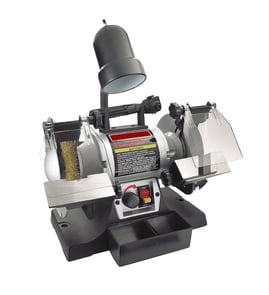

What are the 4 important rules for a bench grinder?
For the Craftsman 152211400 bench grinder leg set and any bench grinder setup, the 4 most important rules are: wear proper eye and clothing protection, keep the work rest and guards correctly adjusted, grind only on the wheel’s face (not the side), and always let the wheel reach full speed before grinding (and stop fully before handling).
The 4 rules (quick checklist)
- Protect yourself: Wear safety glasses (a face shield is even better); tie back hair and avoid loose sleeves, gloves, and jewelry.
- Set the clearances: Keep guards in place; set the work rest close to the wheel (commonly about 1/8 inch) and keep the spark deflector close as well.
- Use the wheel correctly: Never grind on the side of a standard bench grinding wheel; use the front face with light, controlled pressure.
- Control startup and shutdown: Stand slightly to one side at startup, let the wheel reach full speed before contacting the work, and wait for a complete stop before adjusting, measuring, or walking away.
How to apply these rules in real use
| Task | What to do | What to avoid |
|---|---|---|
| Before grinding | Inspect wheel for cracks, confirm guards and rests are secure | Using a damaged wheel or missing guards |
| While grinding | Hold the work firmly on the rest; use light pressure; keep the piece moving | Forcing the work, overheating, or jamming |
| After grinding | Let the wheel coast to a stop; unplug before adjustments | Touching the wheel or making changes while it spins |
Why it matters
Bench grinders can throw sparks, metal fragments, and wheel debris at high speed. Correct PPE, proper rest/guard adjustment, and using the wheel’s face reduce kickback, binding, and wheel failure risk.
Helpful related DIY reading
Last updated: February 2026
What is the best grit for a bench grinder?
For a Craftsman 152211400 bench grinder setup, the “best” grit depends on the job: we use 36 to 46 grit for fast shaping and heavy metal removal, and 60 to 80 grit when we want a smoother finish and less cleanup after grinding.
Quick grit guide (what we use most)
- 36 grit: aggressive stock removal; rough shaping; runs cooler but leaves deep scratches
- 46 grit: best all-around for general grinding and shaping
- 60 grit: lighter shaping; better surface finish; slower material removal
- 80 grit: sharpening touch-ups and finishing; minimal scratch depth
- 120 grit and up: polishing and very light finishing (not ideal for heavy grinding)
Choosing the right grit for your task
| Task | Recommended grit | Why it works |
|---|---|---|
| Remove lots of material fast | 36 to 46 | Cuts quickly; less time on the wheel |
| General-purpose grinding | 46 | Good balance of speed and finish |
| Sharpen tools with less cleanup | 60 to 80 | Shallower scratches; easier to hone |
| Finish before sanding/polishing | 80 to 120 | Reduces follow-up sanding time |
Setup tips that matter as much as grit
- Dress the wheel regularly; a glazed wheel grinds hot and poorly.
- Use light pressure; forcing the tool overheats edges and can blue steel.
- Keep the tool rest close (about 1/16 inch) to reduce grabbing.
- Cool the workpiece often in water when sharpening.
- Match wheel type to material (common bench wheels are for steel; non-ferrous metals often need different abrasives).
Why it matters
A coarser wheel (36 to 46) typically runs cooler and removes metal faster, but it leaves deeper scratches that take longer to refine. A finer wheel (60 to 80) leaves a cleaner edge and surface, but it removes metal slower and can overheat the work if you push too hard.
For more DIY safety and best practices before working on power tools, use our guide: are diy appliance repairs safe.
Last updated: February 2026
Can you run a bench grinder with only one wheel?
Yes, you can run a Craftsman 152211400 bench grinder with only one wheel installed as a temporary setup, as long as the remaining wheel is correctly mounted, guarded, and runs true. Expect faster spin-up and less flywheel effect, so the grinder can bog down sooner under heavy pressure.
Safety checks before you power on
- Unplug the grinder before removing a wheel or guard.
- Keep the wheel guard and spark deflector installed on the side you are using.
- Make sure the wheel is properly seated on the flanges and tightened (snug, not over-tight).
- Verify the tool rest is close to the wheel (typically about 1/8 inch) to reduce snag risk.
- Stand to the side at startup and let it run for about 1 minute with no load.
What changes when one wheel is missing
Running one wheel reduces rotating mass (inertia). That affects how the grinder behaves:
| What you notice | Why it happens | What to do |
|---|---|---|
| Reaches speed faster | Less mass to accelerate | Use light pressure at first |
| Slows down easier when grinding | Less stored energy | Dress the wheel and avoid bearing down |
| More vibration if anything is off | Imbalance or a wheel that is not running true | Re-seat the wheel, check flanges, dress the wheel |
When we do not recommend it
Avoid running with one wheel if any of these apply:
- The grinder vibrates noticeably or “walks” on the bench.
- The remaining wheel is chipped, cracked, or out-of-round.
- You cannot keep guards and rests properly positioned.
- You need heavy stock removal (the grinder will stall easier).
Why it matters
A bench grinder wheel stores a lot of energy. With only one wheel, the tool can feel different and can be easier to stall, but the bigger risk is running with poor guarding, excessive vibration, or a damaged wheel.
For general DIY safety practices that apply to power tools like grinders, we recommend reviewing are diy appliance repairs safe.
Last updated: February 2026
What is the difference between 6inch and 8inch bench grinder?
An 8-inch bench grinder gives you a larger wheel diameter, which runs cooler at the edge and produces a shallower hollow grind than a 6-inch grinder; that makes 8-inch models better for frequent tool sharpening and heavier grinding. A 6-inch grinder is smaller, usually less expensive, and works well for general DIY grinding and sharpening.
Key differences that affect results
- Wheel diameter and grind shape: 8-inch wheels leave a flatter bevel; 6-inch wheels leave a deeper hollow.
- Heat control: 8-inch wheels typically build heat more slowly at the contact point.
- Working clearance: 8-inch grinders usually provide more room between the wheel and motor housing.
- Power and duty level: many 8-inch units are built for more demanding use, but motor specs vary by model.
- Footprint: 6-inch grinders are more compact for small benches.
Which size should you choose?
Use this as a quick guide for a Craftsman setup like model 152211400 (bench grinder leg set) and typical shop tasks.
| If you mostly do this | Better choice | Why |
|---|---|---|
| Sharpen chisels, plane irons, turning tools often | 8-inch | Cooler grinding and a shallower hollow grind |
| Occasional sharpening, deburring, light metal cleanup | 6-inch | Compact and plenty capable for basic tasks |
| Want the most forgiving sharpening feel | 8-inch | More wheel surface and clearance |
| Tight space or portable bench | 6-inch | Smaller footprint |
Setup tips that matter more than wheel size
- Dress the wheel regularly so it cuts cleanly and runs true.
- Use the right wheel grit (coarse for shaping, finer for sharpening).
- Keep tool rests square and close to the wheel (about 1/8 inch gap).
- Grind lightly and dip the tool often to limit overheating.
- Wear eye protection and keep guards and shields in place.
Why it matters
Wheel diameter changes the bevel geometry and heat buildup, which directly affects edge quality and how quickly you can sharpen without burning steel. For many users, an 8-inch grinder simply feels smoother and more controllable for sharpening.
Related reading: must have tools for appliance repair
Last updated: February 2026
How many HP for a bench grinder?
Most bench grinders used in home shops run about 1/4 to 1/2 HP, with heavier-duty grinders commonly in the 3/4 to 1 HP range. Your Craftsman model 152211400 is a bench grinder leg set, so horsepower is determined by the grinder motor, not the leg set.
Typical bench grinder horsepower by job
- 1/4 to 1/3 HP: sharpening and light grinding in short sessions
- 1/2 HP: general grinding with better torque under moderate pressure
- 3/4 to 1 HP: frequent use, heavier stock removal, less bogging
- Over 1 HP: specialty or industrial grinders (often larger wheels and heavier frames)
Quick selection guide
| What you do most | Typical HP range | What you get |
|---|---|---|
| Touch-ups, chisels, mower blades | 1/4 to 1/3 HP | Adequate power if you use light pressure |
| General shop grinding | 1/3 to 1/2 HP | Better speed recovery under load |
| Heavy grinding, long sessions | 3/4 to 1 HP | Strong torque, cooler running feel |
What matters as much as HP
- Wheel diameter and width: larger wheels load the motor more
- RPM and wheel rating: match the wheel’s max RPM to the grinder speed
- Amps and voltage: higher amp ratings on the nameplate usually mean more usable power
- Extension cord size: undersized cords reduce torque and increase heat
- Technique: let the abrasive cut; forcing the work overheats the motor and the metal
Why it matters
Choosing the right horsepower keeps wheel speed steadier, improves control, and reduces stalling during grinding. The 152211400 leg set mainly affects stability and working height, not motor output.
For safe electrical testing on shop tools, use how to use a multimeter to test electrical parts video.
Last updated: February 2026