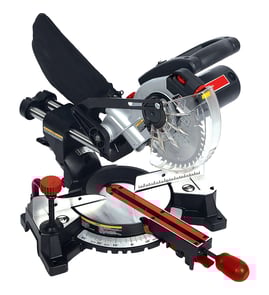

Which Mitre saw is the most accurate?
The most accurate miter saw is the one that holds its settings and cuts square repeatedly after you tune it. In real-world use, premium saws (and well-set midrange saws) can both be extremely accurate; your setup, blade quality, and calibration matter as much as the brand.
What “most accurate” really means
Accuracy is usually a mix of these factors:
- Miter and bevel detents that land exactly on common angles (0°, 45°, 33.9°)
- Fence and table flatness so stock registers consistently
- Low head play (minimal side-to-side movement at full extension on sliders)
- A quality blade matched to the material (fine-tooth for trim, appropriate hook angle)
- Repeatability after transport, temperature changes, and normal use
How to get maximum accuracy from your Craftsman 88136343
Even if you are comparing saws, these steps are what separate “okay” cuts from truly precise ones:
- Verify the blade is square to the fence at 0° miter
- Verify the blade is square to the table at 0° bevel
- Check the fence halves are coplanar (no twist or step)
- Replace a dull, warped, or incorrect blade; use a stiff, fine-finish blade for trim
- Support long stock with stable stands; avoid lifting the workpiece during the cut
Quick comparison: what typically drives accuracy by saw type
| Saw type | Typical accuracy strengths | Typical accuracy risks |
|---|---|---|
| Non-sliding compound | Very rigid head, consistent crosscuts | Limited cut capacity |
| Sliding compound | Wider crosscut capacity | Rail or glide play can reduce repeatability |
| Dual-bevel | Faster compound setups | More pivots to keep calibrated |
Why it matters
If you are building cabinets, trim, or picture frames, a tiny out-of-square error compounds fast. A saw that is easy to calibrate and stays locked in saves time, reduces waste, and improves joint fit.
Finding the right saw (and parts) by model
If you are shopping for upgrades (blade, clamp, fence hardware) or replacing worn components on your Craftsman 88136343, use your exact model number to match parts correctly. Our guide, how to find your appliance model number (and what it means for parts), shows where to locate the ID and why it matters for fit.
Last updated: February 2026
What's the difference between a compound miter saw and a dual-bevel miter saw?
A compound miter saw can miter (left/right) and bevel (tilt) to make compound cuts, but it typically bevels in only one direction. A dual-bevel miter saw does the same cuts and bevels both left and right, so you can match angles without flipping the workpiece.
Quick comparison
| Feature | Compound miter saw | Dual-bevel miter saw |
|---|---|---|
| Miter cuts | Yes (left/right) | Yes (left/right) |
| Bevel cuts | Yes | Yes |
| Bevel direction | Usually one side only | Both sides (left and right) |
| When you need to flip the board | More often | Less often |
| Best for | Occasional compound cuts | Repeated compound cuts, trim work |
What this means in real use
On a Craftsman miter saw like model 88136343, the practical difference is workflow:
- Compound miter saw: if your bevel only tilts one way, you often flip or rotate the board to cut the opposite bevel.
- Dual-bevel miter saw: you tilt the head the other direction instead, keeping the board in the same position.
- Dual-bevel designs usually reduce setup time and help keep your cut orientation consistent.
Why it matters
Flipping a workpiece can change how it sits against the fence and table, which can affect repeatability on crown molding, baseboards, and picture-frame miters. Dual-bevel capability mainly improves speed and consistency, not cut quality by itself.
Tips when choosing or troubleshooting cut accuracy
- Confirm your miter detents and bevel stops are hitting true 0°, 45°, etc.
- Check the fence alignment and that the workpiece is fully supported.
- Use a reliable square to verify the blade is 90° to the table at bevel 0°.
- If the saw will not hold settings, inspect common wear points like pivots, locks, and fasteners.
For model-specific diagrams and replacement components, use the parts list for Craftsman 88136343, or search by model on Sears PartsDirect.
Last updated: February 2026
How to get a miter saw to lift up?
To lift the head on your Craftsman 88136343 miter saw, unlock the transport latch first: press the saw head down slightly to remove tension, then pull the lock pin or release lever out so the spring can raise the head.
Quick unlock steps (most Craftsman miter saws)
- Unplug the saw before touching any lock, trigger, or guard area.
- Push the handle down 1 to 2 inches to take pressure off the latch.
- Pull the transport lock pin out (some models use a lever you pull outward).
- Slowly let the head rise; keep one hand on the handle so it does not snap up.
- If it sticks, press down again and re-pull the pin; the latch often needs the tension relieved.
If it still will not lift
A miter saw head that will not raise is usually being held by a lock, binding at the pivot, or blocked by the guard.
- Check for a second lock: Some saws have both a transport lock and a bevel lock or head lock.
- Inspect the pivot area: Packed sawdust can bind the hinge; brush or vacuum around the pivot and spring.
- Look for bent or damaged hardware: A bent pin, cracked handle, or misaligned linkage can keep the latch from releasing.
- Verify the lower blade guard moves freely: A stuck guard can interfere with head movement.
- Do not force it upward: Forcing can damage the pivot, return spring, or guard linkage.
What you should feel when it is working
| Action | What you do | What should happen |
|---|---|---|
| Relieve latch tension | Press head down slightly | Pin/lever moves more easily |
| Release transport lock | Pull pin/lever outward | Head becomes free to rise |
| Controlled rise | Guide handle upward | Head lifts smoothly under spring tension |
Why it matters
The transport lock is designed to keep the saw head down for carrying. Releasing it under tension can make the pin feel stuck; pressing down first protects the latch parts and helps the head lift smoothly.
Helpful DIY reference
If you are troubleshooting a stuck lock or suspect a wiring issue after a drop or handle damage, use our DIY guides like how to repair broken or damaged wires video to follow safe inspection habits.
Last updated: February 2026
Can you cut a 4x4 with a 10 inch sliding miter saw?
Yes; most 10-inch sliding miter saws can cut a 4x4 (actual size about 3-1/2 in. x 3-1/2 in.) at 90 degrees, but one-pass success depends on the saw’s maximum cut depth and how the stock sits against the fence. Use a safe two-pass method if it does not cut through cleanly.
What determines whether it’s a one-pass cut
Even with a 10-inch blade and sliding rails, these factors control real crosscut capacity:
- Maximum cut depth at 90 degrees (varies by saw design)
- Fence height and shape (can prevent the 4x4 from sitting fully upright)
- Bevel and miter settings (capacity drops quickly off 0 degrees)
- Blade condition and type (dull blade increases burning and binding)
- Rail travel and alignment (reduced travel limits the cut)
Safe method to cut a 4x4 on a sliding miter saw
We use this approach to avoid binding and keep the cut square:
- Support the 4x4 flat and tight to the fence; keep the table clear.
- Clamp the workpiece whenever possible; do not hand-hold short pieces.
- Start the saw, let it reach full speed, then lower smoothly into the cut.
- If the blade does not fully sever the stock, raise the head, reposition slightly, and complete the cut with a second pass.
- Let the blade stop completely before lifting the head or moving the wood.
One-pass vs. two-pass: quick comparison
| Method | Best use | Result |
|---|---|---|
| One-pass cut | Saw has full 3-1/2 in. depth at 90 degrees | Fastest when it cleanly cuts through |
| Two-pass cut | Saw is slightly short on depth or fence limits positioning | Reliable completion with less risk of forcing |
Why it matters
Forcing a cut that exceeds capacity can cause blade binding, burning, or kickback. Using proper support, clamping, and a two-pass technique protects the saw and improves safety.
For general safety guidance before adjustments or repairs, review are diy appliance repairs safe.
Last updated: February 2026
Why is 31.6 on a miter saw?
The 31.6° mark on a miter saw is a built-in shortcut for cutting crown molding using the “laid flat” method. On a Craftsman 88136343 miter saw, it’s used to quickly set a common compound-cut angle for standard 90° corners without doing trigonometry.
What the 31.6° setting is for
Most miter saws that show 31.6° are referencing crown molding cuts for a common spring angle (often 38°) when the molding is placed flat on the table.
- Speeds up inside and outside corner cuts
- Makes repeat cuts consistent across multiple pieces
- Works as part of a compound cut (miter plus bevel)
- Reduces measuring and math errors on trim jobs
- Helps when you cannot safely “nest” crown against the fence
Typical companion setting (laid-flat method)
Many saws pair 31.6° miter with a bevel setting around 33.9° for common crown molding corner cuts.
| Crown cutting method | Miter setting | Bevel setting | When it’s useful |
|---|---|---|---|
| Laid flat on table | 31.6° | 33.9° (typical) | Fast, repeatable compound cuts |
| Nested against fence | 45° (typical) | 0° | When the crown can be held securely |
Tips for accurate crown molding cuts
- Verify your crown’s spring angle (38° and 45° are common); presets match only certain profiles.
- Make test cuts on scrap and label them (inside left/right, outside left/right).
- Keep the molding tight to the fence and table; any gap changes the angle.
- Support long stock so it does not twist during the cut.
- Fine-tune a degree if corners are not true 90°.
Why it matters
Crown molding joints show even small angle errors. The 31.6° mark is there to help you set up your Craftsman 88136343 quickly and get cleaner, more repeatable corner fits.
If you need help identifying the exact model number before ordering parts or looking up diagrams, use how to find your appliance model number (and what it means for parts).
Last updated: February 2026