Owner’s manual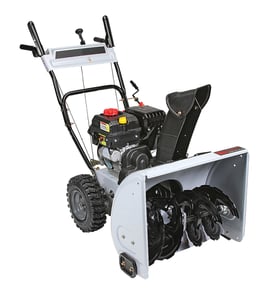



What is the typical lifespan of a gas snowblower?
A gas snowblower like the Briggs & Stratton 1696614-04 typically lasts 10 to 15 years with normal residential use and consistent maintenance. With excellent off-season storage and timely wear-part replacement, many units reach 15 to 20 years of service.
What most affects lifespan
A snowblower’s life is usually limited by engine wear, corrosion, and drivetrain wear (belts, pulleys, gearbox, auger components). We recommend following the maintenance intervals in the 1696614-04 owner’s manual.
- Regular oil changes and correct oil level
- Fresh fuel practices (stabilizer, draining for storage)
- Keeping the auger and chute clear of packed snow and debris
- Preventing rust (cleaning, drying, touch-up paint)
- Replacing wear items before they damage bigger components
Maintenance checklist that extends service life
Use this as a simple annual routine for the 1696614-04:
- Before season: inspect belts, cables, skid shoes, scraper blade; check tire condition
- During season: check oil level, tighten loose hardware, clear packed snow after use
- After season: run fuel system dry or stabilize fuel, clean and dry the housing, store covered
Wear parts to watch on this model
These parts are designed to wear first; replacing them on time helps protect expensive assemblies.
| Wear item | What it does | When it shortens lifespan |
|---|---|---|
| Shear pins | Protect auger/gearbox when you hit an obstruction | Running with missing or incorrect pins can damage auger/gearbox |
| Scraper blade and skid shoes | Protect housing and set scraping height | Worn parts increase vibration and housing wear |
| Drive belts | Transfer power to auger and traction systems | Slipping belts overheat and strain pulleys and bearings |
If you frequently break shear pins, start by using the correct kit for this model, such as the Briggs & stratton snowblower shear pin kit, auger 84003702.
Why it matters
A longer-lasting snowblower costs less per season and is more reliable during heavy snowfall. Preventive maintenance also reduces sudden failures like belt breakage, auger jams, and traction loss.
Last updated: January 2026
How to find snowblower model number?
For your Briggs & Stratton snowthrower model 1696614-04, the model number is typically printed on a product ID label (often called a model and serial tag). On many snowblowers, that label is located on the rear of the unit near the wheels or on the frame behind the engine.
Where to look on model 1696614-04
Check these common label locations first:
- Rear of the snowblower frame between the wheels
- Back of the housing near the axle area
- Side of the frame rail (left or right)
- Behind the engine on the main frame plate
- Near the handle support brackets
If the label is dirty or faded, wipe it with a damp rag and use a flashlight at an angle to make the print easier to read.
What the label usually shows (and what to write down)
For ordering parts and matching diagrams, we recommend recording:
- Model number (example format: 1696614-04)
- Serial number (helps confirm production run)
- Any type/code numbers if shown
Quick ID guide
| Label item | Why it matters | Use it for |
|---|---|---|
| Model number | Identifies the exact machine version | Parts lookup, diagrams |
| Serial number | Identifies the build range | Correct revisions/updates |
| Type/code (if present) | Narrows down engine or sub-assembly | Engine-related parts |
Why it matters
Small differences in a snowblower’s model number can change the auger drive belt, shear pins, chute hardware, or traction components that fit. Using the exact model number helps us match the correct parts the first time.
If you are replacing common wear items, confirm the model number first, then match the part to the diagram. For example, auger protection parts like the Briggs & stratton snowblower shear pin kit, auger 84003702 are model-specific.
For diagrams and label-location details, use the 1696614-04 manual.
Last updated: January 2026
Can I use 5W30 instead of SAE 30 in my snowblower?
Yes; for the Briggs 1696614-04 gas snowblower, 5W-30 is commonly an acceptable substitute for SAE 30 and is usually the better choice for cold-weather starting. We recommend confirming the exact viscosity and temperature guidance in your 1696614-04 manual before you change oil.
What to use and when
In most snowblower conditions, multi-viscosity oil helps with easier pull starts and faster lubrication on cold starts.
- Use 5W-30 when you operate in consistently cold temperatures.
- Use SAE 30 when you operate in warmer temperatures (above freezing most of the time).
- Consider synthetic 5W-30 if you want the best cold-start performance.
- Do not mix different oil types in the crankcase; drain and refill instead.
- Check oil level on a level surface before each use.
Quick comparison
| Oil type | Cold starting | Warm running protection | Best use case |
|---|---|---|---|
| 5W-30 | Better | Good | Typical snow season use |
| SAE 30 | Poorer | Good | Mild weather, above-freezing use |
| Synthetic 5W-30 | Best | Good to excellent | Very cold starts, wide temperature swings |
How to switch from SAE 30 to 5W-30
- Run the engine a few minutes to warm the oil (if safe to do so).
- Shut off the engine and let it cool briefly.
- Drain the oil completely and reinstall the drain plug.
- Refill with the correct amount; then recheck the dipstick.
- Start the engine and check for leaks.
Why it matters
Snowblower engines see heavy load in cold air; the right viscosity reduces wear during the first seconds after startup and can make starting noticeably easier.
Last updated: January 2026
Is it worth fixing an old snowblower?
Yes, it’s usually worth fixing a Briggs & Stratton snowblower like model 1696614-04 when the problem is a wear item or adjustment (belts, shear pins, skid shoes, scraper blade). If the repair involves major drivetrain damage and the cost approaches about half the price of a comparable replacement, replacement is typically the better value.
Quick decision checklist
- The engine starts and runs smoothly after basic tune-up steps.
- The auger or drive issue points to a belt, cable, or shear pin (common, affordable fixes).
- The housing is solid (no major rust-through or cracked frame).
- You can still get key wear parts for your model.
- The repair is mostly labor and a few parts, not a gearbox or major transmission rebuild.
Common “worth fixing” repairs on model 1696614-04
These are the types of repairs that often restore performance without turning into a big project:
- Replace broken auger shear pins: Briggs & stratton snowblower shear pin kit, auger 84003702
- Replace worn skid shoes: Briggs & stratton snowblower skid shoe 84003710
- Replace a worn scraper blade: Briggs & stratton snowblower scraper blade 84003707
- Replace a slipping auger belt: snowblower auger drive belt 707584
- Replace a slipping traction belt: Briggs & stratton snowblower traction drive belt 707585
When replacement is usually the smarter move
If your 1696614-04 has one or more of these issues, repairs can get expensive fast:
- Gearbox damage or persistent oil leakage at the auger gearbox
- Repeated belt failures caused by bent pulleys, misalignment, or worn idlers
- Severe rust on the auger housing or impeller area
- Multiple systems failing at once (drive, auger, chute rotation)
Cost-to-value guide
| Situation | Typical recommendation |
|---|---|
| Wear parts only (belts, shear pins, skid shoes, scraper) | Fix it |
| One moderate repair plus tune-up | Usually fix it |
| Major drivetrain repair and high parts/labor cost | Consider replacing |
| Repair estimate near 50% of replacement cost | Usually replace |
Why it matters
A snowblower’s value is mostly in reliable starting and strong snow-moving performance. On older machines, small wear parts can make it feel “worn out” even when the engine and core structure are still good. Using the correct procedures and specs from the 1696614-04 manual helps you avoid repeat failures and choose the right repair path.
Last updated: January 2026