Installation guide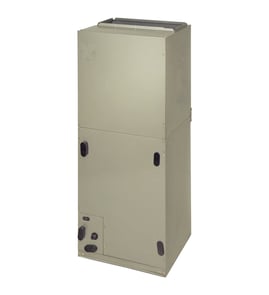


How many cfm is a 4 ton air handler?
A 4-ton air handler is typically set up to move about 1,400 to 1,600 CFM (cubic feet per minute), depending on the comfort/efficiency mode and airflow tap settings. For the Carrier FV4BNB006000 fan coil, the exact target CFM depends on the Easy Select airflow settings in the installation guide.
Typical CFM for 4 tons (what we use in the field)
Most systems are designed around these common airflow targets:
- 350 CFM per ton: good humidity removal in cooling
- 400 CFM per ton: common “rule of thumb” cooling airflow
- 315 CFM per ton (heating comfort mode): warmer supply air feel in heat pump heating
That translates to this for 4 tons:
| Airflow target | CFM per ton | 4-ton total CFM |
|---|---|---|
| Heat pump comfort heating | 315 | 1,260 |
| Heat pump efficiency (heat/cool match) | 350 | 1,400 |
| Typical cooling rule of thumb | 400 | 1,600 |
What changes the CFM on the Carrier FV4BNB006000
This model uses selectable airflow profiles (system type and airflow adjust). The installation instructions describe:
- System type selection (AC vs. heat pump modes)
- Heat pump comfort vs. efficiency airflow profiles
- AC/HP CFM adjust settings (nominal, high, low)
- Dehumidification mode that can run at about 80% of nominal cooling airflow
- Static pressure and ductwork effects (dirty filter, restrictive returns, undersized ducts)
Quick way to estimate your current setting
We use this simple math to sanity-check airflow before measuring:
- CFM = tons × target CFM/ton
- Example: 4 × 350 = 1,400 CFM
- Example: 4 × 400 = 1,600 CFM
Why it matters
Airflow that is too low can cause coil icing, poor comfort, and longer run times; airflow that is too high can reduce dehumidification and feel drafty. Setting the correct CFM helps your Carrier fan coil match the outdoor unit capacity and deliver stable heating and cooling.
Parts that can affect airflow
If airflow is inconsistent, the control setup and blower operation matter. A common control-related replacement on this model is the board circ HK61EA005. For ordering model-correct parts, we list them on the model parts list and on Sears PartsDirect.
Last updated: February 2026
What's the average cost of an air handler?
Most air handlers (fan coils) cost $1,000 to $4,200 for the unit and $1,800 to $3,500+ installed. For a Carrier FV4BNB006000, the biggest price drivers are capacity (tonnage), blower type (ECM/variable speed vs. standard), and installation complexity; details in the installation guide can affect labor time.
What drives the price up or down
- Capacity and airflow requirements (larger systems cost more)
- Blower motor type (ECM/variable speed typically costs more)
- Electric heat kit (adds parts cost and electrical labor)
- Ductwork, drain, or return-air changes (common add-ons)
- Controls and electronics (boards/modules can be a major expense)
- Access and location (attic, tight closet, or difficult service access)
Typical cost breakdown
| Cost item | Typical range | What it includes |
|---|---|---|
| Air handler unit | $1,000 to $4,200 | Equipment only (varies by size and features) |
| Labor and materials | $800 to $2,000+ | Set-up, fittings, drain work, electrical, start-up checks |
| Total installed | $1,800 to $3,500+ | Higher with major duct/electrical modifications |
FV4BNB006000 setup items that can affect labor
Your FV4B-series air handler can require commissioning steps that add time, such as:
- Selecting system type (AC vs. heat pump)
- Setting AC/HP CFM adjust (NOM, HI at +15% airflow, LO at -10% airflow)
- Confirming airflow targets using CFM tables
Those configuration steps are covered in the installation guide.
Repair vs. replace: a quick way to think about it
| If the issue is mainly... | Typical direction |
|---|---|
| Airflow setup, wiring, loose connections | Repair/adjust first |
| Major electronics failure | Compare repair cost to replacement |
| Multiple age-related problems | Replacement often makes more sense |
Why it matters
Correct sizing and airflow setup improve comfort, humidity control, and efficiency. Paying for proper installation helps prevent noise, poor cooling, and premature wear on the blower and control components.
For broader part and model lookups beyond the parts list for FV4BNB006000, use Sears PartsDirect.
Last updated: February 2026
How to tell if an air handler is bad?
If your Carrier FV4BNB006000 fan coil has weak airflow, short cycling, unusual noises, or inconsistent heating and cooling, the air handler (or a control, wiring, or blower component inside it) is failing. Use the diagnostic steps in the installation guide to separate a true air handler failure from a thermostat or wiring issue.
Quick signs the air handler is failing
- Weak or uneven airflow from supply vents
- Frequent on and off cycling (short cycling)
- No heat or no cool air even when the outdoor unit is running
- Musty odors near the return or air handler cabinet
- New rattling, buzzing, or humming from the blower area
- Higher energy use with no thermostat changes
Checks to do before replacing parts
Disconnect power before removing panels.
- Air filter and return airflow: A clogged filter is the most common cause of low airflow and coil icing.
- Drain pan and condensate drain: Blockages can cause water issues and can stop operation.
- Thermostat call and wiring: If the blower runs in some calls but not others, focus on wiring, harness connections, and control signals.
- ECM blower motor system: FV4BNB006000 uses an ECM motor with a control module and motor winding section; a no-start condition can be caused by control signals, not just a bad motor.
What the symptoms usually point to
| What you observe | Most likely area to check | Typical next step |
|---|---|---|
| Blower never runs | Power, board, harness, ECM module | Verify signals and connections per guide |
| Blower runs in some modes only | Harness or control board | Inspect plugs, pins, and board outputs |
| Correct signals present but no blower | ECM module or motor winding | Test motor winding resistance |
If testing points to a failed control board, the board circ HK61EA005 is the listed control board for this model.
Why it matters
“Bad air handler” symptoms often come from a simple restriction (filter) or an electrical issue (harness, board, ECM module). Isolating the cause prevents unnecessary part replacement and restores proper airflow.
You can order parts from the model parts list, or search by model number on Sears PartsDirect.
Last updated: February 2026
How to tell the tonnage of a carrier air handler?
For the Carrier FV4BNB006000 fan coil (air handler), we tell tonnage by identifying the system size the unit is set up for and confirming it with airflow targets. The setup tables use CFM-per-ton guidance (about 315 to 350 CFM per ton); see the installation guide.
Fast ways to identify tonnage
- Check the unit nameplate and the matched outdoor condenser or heat pump rating (BTU/hr); 12,000 BTU/hr equals 1 ton.
- Verify the AC/HP size selection on the control board; the guide instructs selecting the installed system size so airflow stays in range.
- Use airflow as a confirmation: measured CFM divided by about 350 CFM per ton estimates nominal tons.
- Compare your measured airflow to the airflow tables by unit size and mode in the guide.
Airflow-to-tonnage cheat sheet (rule of thumb)
| Airflow (approx.) | Estimated tons (at ~350 CFM/ton) |
|---|---|
| 700 CFM | 2 tons |
| 1050 CFM | 3 tons |
| 1400 CFM | 4 tons |
| 1750 CFM | 5 tons |
What settings affect the “effective” tonnage
These selections change delivered airflow and comfort performance:
- System type (AC vs. heat pump comfort vs. heat pump efficiency)
- AC/HP size selection (installed system size)
- AC/HP CFM adjust (NOM, HI, LO; HI is about +15%, LO is about -10%)
Why it matters
Correct tonnage and airflow protect comfort and equipment; too much airflow can reduce humidity removal, and too little airflow can contribute to coil icing and poor cooling.
If airflow seems wrong after verifying settings and wiring, the control board can be involved; this model lists the board circ HK61EA005. You can also search more parts by model on Sears PartsDirect.
Last updated: February 2026