
Can I use a 7 1/4 blade on a 10 miter saw?
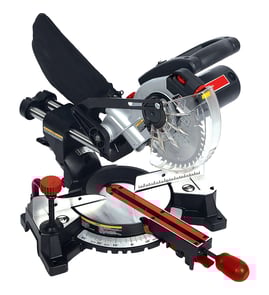
Yes, you can use a 7-1/4 inch blade on a 10 inch miter saw like the Craftsman 113235280 as long as the arbor (bore) size matches and the blade is rated for the saw’s RPM; expect reduced cutting capacity and possible guard or fence clearance issues.
What must match for it to be safe
- Arbor size: The blade’s center hole must match the saw’s arbor (common sizes are 5/8 inch or 1 inch).
- Blade speed rating: The blade must be rated at or above the saw’s no-load RPM.
- Blade type: Use a miter-saw or crosscut-rated blade (not a thin kerf blade intended only for handheld saws if it flexes).
- Kerf and plate thickness: Too-thick plates can rub; too-thin plates can deflect.
- Guard clearance: The lower guard must fully close and move freely through the full range of motion.
What changes when you downsize the blade
A smaller blade sits higher relative to the table and fence, so you lose depth and width of cut.
| Blade size | Typical max cut depth at 90° | Typical use case |
|---|---|---|
| 10 inch (standard) | Deeper cuts | 2x lumber, wider trim |
| 7-1/4 inch (downsized) | Shallower cuts | Thin trim, small stock |
Tips to get cleaner, more complete cuts
- Use a zero-clearance insert or backer board to reduce tear-out.
- If you need a little more depth, place the work on a flat sacrificial board (this can help support fibers, but it does not increase blade reach).
- Verify the blade does not contact the throat plate, fence, or table at full bevel and miter.
- Make a slow test cut in scrap first.
Why it matters
Using the wrong arbor size or an under-rated blade can cause wobble, poor cut quality, binding, or kickback. Matching the arbor and RPM rating keeps the Craftsman 113235280 cutting predictably and helps the guard work correctly.
For general DIY safety basics before changing blades or testing cuts, use our guide: are diy appliance repairs safe.
Last updated: February 2026
Which mitre saw is the most accurate?
The most accurate miter saw is the one that holds its settings and cuts square repeatedly after you tune it. For a 10-inch compound miter saw like the Craftsman 113235280, accuracy comes primarily from calibration (fence, bevel, and miter detents), a sharp blade, and zero play in the pivot and slide mechanisms.
What “most accurate” really means
Accuracy is a mix of setup and repeatability, not just brand. We look for:
- Square cuts at 90 degrees (no gap when you flip and rejoin a test cut)
- Repeatable miter detents (common angles land the same every time)
- Stable bevel stops (0 and 45 degrees return precisely)
- Minimal head deflection when you lower the blade
- A fence that stays straight and coplanar
Quick accuracy checklist for the Craftsman 113235280
Use this sequence to get the biggest improvement fast:
- Install a new, high-quality crosscut blade (fine tooth count for trim work)
- Clean pitch from the blade and table; debris causes out-of-square cuts
- Verify the fence is straight and both halves align
- Set miter to 0; square the blade to the fence with a reliable square
- Set bevel to 0; square the blade to the table
- Check for play in the pivot, arm, and any sliding rails; tighten/adjust if applicable
Feature comparison: what tends to cut most precisely
| Saw type / feature | Typical accuracy advantage | Best for |
|---|---|---|
| Non-sliding compound miter saw | Fewer moving parts, less flex | Highest repeatability on narrower stock |
| Sliding compound miter saw | Wider crosscut capacity | Wider boards, but needs rail alignment |
| Shadow line / laser guide | Helps line up the cut | Speed and consistency, not true calibration |
| Tall, rigid fence | Better support for crown/trim | Finish carpentry |
Why it matters
Even a premium saw will cut inaccurately if the fence is out of alignment or the blade is dull. Once your Craftsman 113235280 is tuned, you get tighter miters, cleaner trim joints, and less rework.
For safe electrical troubleshooting on corded saws (switch, cord, or intermittent power), use how to use a multimeter to test electrical parts video.
Last updated: February 2026
Why is 31.6 on a miter saw?
The 31.6° mark on a miter saw (including the Craftsman 113235280 10-inch compound miter saw) is there to make common crown molding cuts faster and repeatable. It is a standard preset angle used for compound cuts when crown molding is cut using typical spring-angle geometry.
What 31.6° is used for
On many compound miter saws, 31.6° is a “shortcut” setting for crown molding so you do not have to calculate angles every time.
Common uses include:
- Cutting crown molding for 90° inside corners and 90° outside corners
- Making repeatable cuts using a detent or marked scale
- Pairing with a typical bevel setting (often around 33.9° on saws that include both references)
- Speeding up trim work when you are doing multiple rooms
- Reducing setup errors compared to eyeballing the miter scale
Typical crown molding angle pairs (quick reference)
These are the common “flat on the table” compound settings you will see referenced for standard crown molding spring angles.
| Crown spring angle | Typical miter setting | Typical bevel setting |
|---|---|---|
| 38° (common) | 31.6° | 33.9° |
| 45° (less common) | 35.3° | 30.0° |
Why it matters
Crown molding is tricky because it meets the wall and ceiling at an angle. The 31.6° marking helps you get accurate joints without doing trigonometry on every cut, especially when you are switching between left and right corner pieces.
Tips to get clean, accurate crown cuts
- Confirm your crown’s spring angle (38° vs 45°) before trusting the preset
- Make a couple of test cuts on scrap and check the corner fit
- Keep the fence square and the workpiece tight to the table and fence
- Use a sharp blade designed for trim (higher tooth count)
- If the saw is not landing exactly on the detent, check for dust buildup or a slightly loose miter lock
Helpful related DIY reading
For general repair and electrical testing techniques that also apply to power tools (switches, cords, connections), use how to use a multimeter to test electrical parts video.
Last updated: February 2026
What should you never cut with a miter saw?
You should never cut anything you cannot hold firmly and safely against the fence and table on your Craftsman 113235280 10" compound miter saw. Avoid tiny offcuts, unstable stock, and materials the blade is not rated for; these situations commonly cause binding, kickback, or the workpiece getting launched.
Never cut these materials or setups
- Very small pieces that put your fingers close to the blade (use a stop block, clamp, or a different tool).
- Freehand cuts where the workpiece is not tight to the fence and flat on the table.
- Warped, bowed, twisted, or round stock that rocks or cannot sit flat (it will shift mid-cut).
- Metal, masonry, or tile unless you have the correct saw setup and a blade specifically rated for that material.
- Pressure-treated or dirty lumber with embedded grit, staples, or nails (it can damage teeth and increase kickback risk).
- Stacked pieces (cutting multiple boards at once) unless they are clamped so nothing can move.
Quick safety checks before every cut
- Keep the blade guard working freely; never tie it up or defeat it.
- Clamp the work when possible; keep hands at least 6 inches from the blade path.
- Let the blade reach full speed, then cut smoothly; do not force the cut.
- Wait for the blade to stop completely before lifting the saw head.
- Use the right blade for the job (crosscut/finish blade for trim, general-purpose for framing).
Common “don’t do this” examples (and what to do instead)
| Risky situation | Why it’s unsafe | Safer approach |
|---|---|---|
| Cutting a 1-inch-long offcut | Fingers too close; piece can eject | Use a longer sacrificial board, clamp, or a different tool |
| Cutting a bowed 2x4 | Stock shifts; blade can bind | Joint/straighten first or choose straighter stock |
| Cutting aluminum with a wood blade | Wrong tooth geometry; grabbing | Use a blade rated for non-ferrous metal and proper clamping |
Why it matters
Most miter saw injuries happen when the workpiece moves or the operator reaches too close. Keeping the stock flat, tight to the fence, and properly supported reduces binding and kickback and helps you get accurate miters and bevels.
For general DIY safety habits that apply to power tools, review are diy appliance repairs safe.
Last updated: February 2026
Is it worth getting a double bevel mitre saw?
Yes, a double bevel (dual-bevel) compound miter saw is worth it when you regularly make mirrored bevel cuts for trim, crown molding, or cabinetry because you can bevel left and right without flipping the workpiece. For basic crosscuts and occasional miters, a single-bevel saw like the Craftsman 113235280 is the better value.
When a double bevel is the right upgrade
A dual-bevel design pays off when speed and repeatability matter on opposing angles.
- You cut crown molding or detailed trim with frequent left and right bevels
- You build cabinets or furniture with lots of compound cuts
- You want fewer re-clamps and fewer chances to introduce a setup error
- You do higher-volume projects where time savings add up
- You want to keep the same face of the board against the fence for consistency
When a single bevel is enough (and still accurate)
Flipping the board for the opposite bevel is a normal, reliable workflow for many DIY jobs.
- Mostly 90 degree crosscuts in framing lumber
- Picture frames, basic baseboard, and occasional trim
- Bevel cuts are infrequent
- You prefer a simpler tool with fewer adjustments to maintain
Quick comparison
| Feature | Single bevel compound miter saw | Double bevel compound miter saw |
|---|---|---|
| Bevel direction | One side | Both sides |
| Opposite bevel cuts | Flip and re-reference the workpiece | Tilt the head the other way, keep workpiece orientation |
| Best fit | General DIY, framing, occasional trim | Frequent trim, crown, cabinetry |
Why it matters
The real advantage is workflow: double bevel reduces handling steps on mirrored cuts, which saves time and helps keep reference faces consistent. With the Craftsman 113235280, you can still get highly accurate mirrored cuts by using a repeatable flip-and-cut method.
Practical buying and setup tips
- Choose based on the cuts you do weekly, not the hardest cut you might do once
- Use a sharp blade matched to the material (fine-tooth for trim, fewer teeth for framing)
- Mark a consistent “fence side” and “table side” on your stock before flipping
- Verify the fence and table are square after transporting or bumping the saw
- Use stop blocks for repeat lengths; it improves speed and consistency on either saw type
For general DIY safety practices before taking on tool adjustments, see are diy appliance repairs safe.
Last updated: February 2026