 Owner’s manual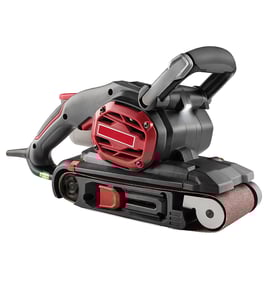

How to tell what size belt for belt sander?
For the Craftsman 4-inch belt sander model 31511782, the sanding belt size is 4" x 24". You can also confirm the exact belt size and the correct installation direction in the 31511782 owner's manual.
Quick ways to confirm belt size
- Check the old belt for printed size (often shown as width x length).
- Measure the belt width across the back: it should be about 4 inches.
- Confirm the belt length by laying the belt flat and measuring end-to-end (do not stretch it).
- If the belt is broken, wrap a string around both pulleys (rollers), mark the overlap, then measure the string.
- Match the belt to the tool’s spec: this model uses 4" x 24" sanding belts.
How to measure a belt (width x length)
| What to measure | How to measure it | What you should get for 31511782 |
|---|---|---|
| Width | Measure across the belt’s back | 4 inches |
| Length | Measure around the full loop (or string method) | 24 inches |
Installing the belt correctly (so it tracks straight)
The manual notes the belt has a direction arrow. Install it so the arrow matches the sander’s rotation (clockwise when looking into the open side).
- Release the tension lever to create slack.
- Slide the belt over both pulleys.
- Align the belt direction arrow correctly.
- Re-tension the belt with the lever.
- Test tracking briefly; adjust the tracking screw until the belt runs centered.
Why it matters
Using the correct 4" x 24" belt prevents slipping, poor dust pickup, and edge damage to the belt and wear plate. Correct direction and tracking also extend belt life and improves finish quality.
To shop by model number and find compatible supplies, search using 31511782 on Sears PartsDirect.
Last updated: February 2026
Is a 4x36 belt sander good for knife making?
A 4x36 belt sander can work for knife making, but it is best for rough shaping and cleanup, not fast stock removal or precision grinding. With the Craftsman 31511782 (a 4-inch belt sander), you will get better results by using the right belt grit, light pressure, and solid workholding.
What a 4x36 belt sander does well for knives
- Rough profiling and smoothing after cutting a blank
- Cleaning up forge scale and surface rust
- Rounding edges and blending bevel transitions
- Handle shaping (wood, micarta, some plastics)
- Light metal sanding with the correct abrasive belt
Where it struggles (and why)
Knife grinding is demanding because you need consistent belt speed, good tracking, and controlled pressure. The 31511782 is designed for general sanding and includes dust pickup; it is suitable for sanding wood, metals, and plastics, but it is not built as a dedicated knife grinder.
Key limitations you will notice:
- Slower material removal compared to a 2x72 grinder
- More heat buildup if you push too hard
- Less control for crisp plunge lines and even bevels
Setup tips that make a big difference
Follow the operating guidance in the 31511782 owner's manual and use these best practices:
- Clamp the workpiece; do not freehand heavy grinding
- Start the sander off the work, then ease it onto the blade
- Let the tool’s weight do the work; extra pressure causes uneven grinding and can overheat the motor
- Spend a few seconds dialing in belt tracking to extend belt life
- Use coarse grit to shape, then medium and fine to refine
Quick grit guide for knife work
| Task | Typical belt type | Typical grit range |
|---|---|---|
| Heavy shaping | Ceramic or zirconia (metal-rated) | 36 to 60 |
| Bevel refinement | Zirconia or aluminum oxide | 80 to 120 |
| Pre-finish | Aluminum oxide | 180 to 320 |
Why it matters
Using the correct belt and light, controlled passes prevents gouges, reduces heat (protecting temper), and avoids bogging the motor. That is the difference between “it takes forever” and steady, predictable progress.
You can look up diagrams and replacement items for the Craftsman 31511782 on the model parts list, or search by model number on Sears PartsDirect.
Last updated: February 2026
Should I use a belt sander or orbital sander for deck?
For a deck, we use a belt sander (like the Craftsman 31511782 4-inch belt sander) for fast leveling and removing old finish on large, flat boards; we use a random orbital sander for smoother final sanding with fewer swirl marks. Many deck jobs use both.
Best choice by task
- Heavy removal, cupped boards, ridges, old stain: belt sander
- Final smoothing before stain or sealer: random orbital sander
- Edges, corners, tight spots: hand sanding or a detail sander
- Stairs and broad treads: belt sander first, orbital to finish
- Spot repairs: orbital sander to blend without gouging
How to use a belt sander on a deck (31511782 tips)
Your Craftsman 31511782 is designed for coarse to fine sanding and works best when you let the tool’s weight do the cutting. Extra pressure can create uneven spots, clog belts, and overheat the motor.
- Clamp or secure loose boards before sanding
- Start the sander off the surface, then lower it with a slight forward motion
- Keep it moving; pausing in one spot creates dips
- Use two hands (main handle to control, front handle to guide)
- Step through grits: coarse to level, then medium, then fine
Grit progression (typical deck workflow)
| Goal | Belt sander grit | Orbital grit |
|---|---|---|
| Strip and flatten | 36 to 60 | Not ideal |
| Remove scratches | 80 | 80 to 100 |
| Prep for stain/sealer | 100 | 100 to 120 |
Why it matters
Deck boards are large and often uneven; a belt sander removes material quickly but can gouge if you linger. An orbital sander is slower but leaves a more uniform surface for stain adhesion and a consistent look.
Parts and documentation
For operating steps, belt direction, and belt tracking adjustment, follow the 31511782 owner's manual. For replacement parts and diagrams for this model, search by model number on Sears PartsDirect.
Last updated: February 2026
How to install belt on Craftsman belt sander?
To install a sanding belt on your Craftsman 31511782 4-inch belt sander, release belt tension, slip the belt over both pulleys with the arrow facing the correct direction, then reapply tension and adjust tracking so the belt runs centered. See the 31511782 owner's manual for the exact lever and tracking screw locations.
Step-by-step: install and track the sanding belt
- Unplug the power cord before touching the belt or pulleys.
- Release belt tension by pushing the front pulley squarely against the top or edge of a workbench; it locks back and creates slack.
- Remove the old belt (if installed).
- Install the new belt over both pulleys.
- Align belt direction: the arrow on the inside of the belt must match rotation (clockwise when looking into the open side of the sander).
- Keep fingers clear, then pull the tension lever until the pulley releases and the belt tightens.
- Stand the sander on end, briefly squeeze and release the trigger, and watch belt tracking.
- If the belt walks outward, turn the tracking screw clockwise; if it walks inward, turn it counterclockwise.
- Run the sander and fine-adjust tracking until the belt stabilizes; the belt’s outer edge should be even with the outer edge of the wear plate.
Quick reference: what each control does
| Item | What it does | When you use it |
|---|---|---|
| Front pulley push-back | Releases and locks tension off | Removing/installing the belt |
| Tension lever | Reapplies belt tension | After the belt is on both pulleys |
| Tracking screw | Centers the belt on the pulleys | After belt install and during test run |
Why it matters
Correct belt direction and tracking prevent the belt from rubbing the housing or contacting the rub strip, and they extend belt life. Proper tracking also helps the sander cut evenly without gouging.
Safety and service notes
- This tool uses double insulation; internal servicing requires extra care and should be handled by a qualified technician.
- Use original factory replacement parts when servicing.
- For parts lookup by model number and ordering, start with the parts list for Craftsman 31511782 or search on Sears PartsDirect.
Last updated: February 2026
Where can I buy Craftsman replacement parts?
You can buy replacement parts for your Craftsman 4" belt sander model 31511782 by using the model-based parts lookup and diagrams on our site, then ordering the exact part you need by part number and description. For model-specific part identification, use the 31511782 owner's manual.
Best way to buy the correct part (and avoid returns)
We recommend matching parts by model number + part number, not by tool name alone.
- Find the model plate on the base of the sander (the manual notes the model number is on a plate attached to the base)
- Use the parts list/diagram to identify the exact component name (example: idler pulley, yoke and slide assembly, switch parts)
- Order using:
- model number (31511782)
- part number
- part description
- If you are buying parts for multiple Craftsman tools, keep a list of each model number
- For broader model searches across Craftsman tools, use Sears PartsDirect
What information you should have before ordering
The manual’s ordering guidance is straightforward: provide the key identifiers so the correct part is pulled.
| What to collect | Example for this tool | Why it matters |
|---|---|---|
| Model number | 31511782 | Ensures the diagram and parts list match your sander |
| Part number | From the parts list | Identifies the exact replacement |
| Part description | From the parts list | Prevents mix-ups between similar items |
| Item name | Belt sander | Confirms the product type |
Why it matters
Craftsman parts often look similar across belt sanders, but small differences in pulleys, bearings, or housings can affect belt tracking, safety, and fit. Using the model-specific parts list helps you get the right component the first time.
Last updated: February 2026