 Owner’s manual

Are Craftsman tool chests made in the USA?
Some Craftsman tool chests are made in the USA, but it depends on the specific series and model. For your Craftsman rolling tool cart model 706136200, the most reliable way to confirm the country of origin is to check the product labeling and the documentation in the owner's manual.
What “made in the USA” usually means for tool storage
Craftsman uses different sourcing for different tool chests and carts. You may see:
- Made in USA: built in the U.S. with qualifying domestic content
- Made in USA with global materials: assembled in the U.S. using a mix of U.S. and imported components
- Imported: manufactured outside the U.S.
How to verify it on your 706136200 tool cart
Use these quick checks to get an accurate answer for your exact unit:
- Look for a data label on the back, inside a drawer area, or near the caster frame
- Check the packaging (if you still have it) for origin statements
- Review the specifications and product identification section in the owner's manual
- If you are comparing similar-looking carts, match by full model number 706136200 (not just the series name)
Common places to find the origin statement
| Where to look | What you might see |
|---|---|
| Product label/sticker | Country of origin, factory code, date code |
| Cart frame near casters | Stamped or printed origin text |
| Manual/spec page | Model identification details |
Why it matters
Country-of-origin details can affect expectations for finish, drawer slide style, replacement hardware compatibility, and how you match parts or accessories to the correct Craftsman model number.
Last updated: February 2026
Does a Craftsman toolbox have a lifetime warranty?
Yes, many Craftsman toolboxes and tool storage products are sold with a “lifetime” warranty, but the exact coverage depends on the specific product line and what failed (for example, drawer slides, casters, locks, or finish). For your Craftsman 706136200 rolling tool cart, we use the warranty terms listed in the product documentation.
What “lifetime warranty” usually means for tool storage
Tool storage warranties are typically limited to defects in materials or workmanship under normal use; they often exclude wear items and damage from misuse, overloading, corrosion, or modifications.
Commonly covered vs. commonly excluded items:
| Item on a rolling tool cart | Often covered | Often excluded |
|---|---|---|
| Cabinet frame and drawer bodies | Yes | Rarely |
| Drawer slides and bearings | Sometimes | Wear, contamination |
| Casters and wheels | Sometimes | Flat spots, abuse |
| Locks/keys | Sometimes | Lost keys, forced entry |
| Paint/finish | Sometimes | Scratches, rust from environment |
How to confirm the warranty for model 706136200
The fastest way is to match the warranty statement to your exact model and serial information.
- Check the warranty section in the owner's manual.
- Compare the model number on the label to ensure it matches 706136200.
- Note what part failed (caster, drawer slide, handle, lock) and whether it’s a wear item.
- Look for any stated limits (original owner only, proof of purchase, non-commercial use).
- If the cart was used in a shop environment, confirm whether commercial use changes coverage.
Why it matters
Warranty terms determine whether you should pursue a warranty remedy or go straight to a repair. On rolling tool carts, the most common issues are caster wear, drawer slide binding, and lock problems; each can be treated differently under warranty language.
Last updated: February 2026
Who makes Craftsman toolboxes?
Craftsman toolboxes (including the Craftsman rolling tool cart model 706136200) are made under the Craftsman brand, which is owned by Stanley Black & Decker. Manufacturing can vary by product line and production run, so the most reliable identifier for your specific cart is the model and label information in the owner's manual.
What “Craftsman” means for tool storage
Craftsman is a brand name used across tools and tool storage (tool chests, rolling tool carts, and cabinets). For parts and fit, what matters most is:
- The exact model number: 706136200
- The product type: rolling tool cart (tool chest category)
- The cart’s configuration (drawer count, slide style, caster style)
- The ID label details (often includes additional production codes)
How to identify the maker details on your specific cart
Use these quick checks to match the right parts and hardware:
- Look for the model/serial label on the back, side panel, or inside a drawer area
- Compare the label details to the diagrams and notes in the owner's manual
- Match drawer slide style (ball-bearing vs. friction) before ordering replacements
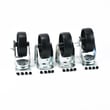
- Confirm caster mounting pattern and wheel size if you are replacing casters
Common label locations (quick reference)
| Location | What you may find | Why it helps |
|---|---|---|
| Back panel | Model and production codes | Best for parts matching |
| Inside top drawer area | Model label | Easy to access |
| Side panel near handle | Model info | Helps confirm configuration |
Why it matters
Tool carts often share a similar look across different production runs, but drawer slides, locks, keys, and casters can differ. Using the 706136200 model identification prevents ordering hardware that does not fit.
Last updated: February 2026
Where can I find the Craftsman toolbox model number?
On a Craftsman tool chest or rolling tool cart, the model number is printed on the product ID label (rating label). For Craftsman model 706136200, check the inside surfaces first; the label is commonly placed inside the top drawer area or on the cabinet frame near the upper right.
Most common label locations to check
- Inside the top drawer (often on a side wall or back panel)
- Inside the top right drawer (a very common spot)
- On the inside of the top lid (if your tool chest has a lid)
- On the cabinet frame just behind the drawer front (open a drawer and look up/sideways)
- On the back panel near the top edge
- Near the caster mounting area on the lower rear frame (less common, but worth checking)
What the label looks like (and what to write down)
The label is usually a sticker or metal tag. Record these items so you can match parts correctly:
| Label item | What it’s used for |
|---|---|
| Model number | Identifies the exact tool storage design |
| Serial number | Helps distinguish production runs |
| Manufacturing code/date (if shown) | Useful when finishes or hardware changed |
Tips if the sticker is missing or unreadable
- Use a flashlight and look for adhesive residue where a label used to be
- Check the back panel for a second label
- If the label is scuffed, take a photo and zoom in to read faint print
- Avoid using solvents; they can remove remaining ink
Why it matters
Tool storage parts like drawer slides, casters, locks, and handle hardware can vary by model. Using the correct model number (like 706136200) helps ensure you get parts that fit and align correctly.
For model-specific identification notes and documentation, use the owner's manual.
Last updated: February 2026
How do I choose a rolling toolbox?
Choose a rolling toolbox based on how you work: match the size, drawer layout, and mobility features to your tool collection and where you roll it. For a Craftsman rolling tool cart like model 706136200, prioritize stable casters, a secure drawer latch, and enough drawer depth for your largest tools; confirm capacity and setup details in the owner's manual.
What to look for (quick checklist)
- Storage capacity: count drawers and check that you have at least one deep drawer for power tools
- Drawer slides: ball-bearing slides feel smoother and handle heavier loads better
- Caster setup: 2 fixed plus 2 swivel casters (with locks) improves tracking and parking
- Security: keyed lock or latch system to keep drawers closed while moving
- Top surface: a sturdy work top (mat or tray) helps prevent parts from rolling off
- Footprint: measure your garage bay or shop aisle so the cart fits where you actually use it
Size and layout: pick the cart that fits your tools
Most rolling tool carts work best when you plan around your biggest items first (impact wrench, drill, sockets, pry bars), then fill in with organizers.
| Tool type | Best drawer style | Why it helps |
|---|---|---|
| Sockets and ratchets | Shallow drawers | Keeps sets visible and easy to grab |
| Power tools | Deep drawers | Prevents stacking and cord damage |
| Wrenches and pliers | Medium drawers | Better separation and less tangling |
| Small parts | Top tray or shallow drawer with dividers | Reduces lost fasteners |
Mobility and durability tips
A rolling toolbox fails early when it is overloaded or rolled on rough floors with small casters.
- Choose larger casters if you cross expansion joints or roll outdoors
- Look for wide stance and caster locks to reduce tipping
- Keep heavy tools low (bottom drawers) to improve stability
Why it matters
The right rolling toolbox protects your tools, saves time during repairs, and prevents drawer slide wear from overloading. A stable cart also reduces tip-over risk when you open multiple drawers.
Last updated: February 2026