

How do I find my lawn mower model number?
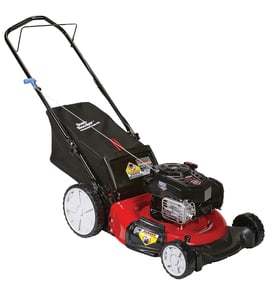
For Craftsman model 13191463 (20" rotary lawn mower) and similar walk-behind mowers, the model number is printed on the mower’s ID label, not on the engine. Once you locate and record that full model number, we can match the correct mower deck, blade, wheels, and handle parts.
Where to look on a walk-behind mower
Check these common ID-label locations (clean off grass and dirt first):
- Rear of the mower deck near the discharge chute
- Top of the deck near the engine mounting area
- Back of the deck behind the bagger door
- On the handle bracket or height-adjuster area
- Under the rear flap (tilt the mower safely if needed)
What to write down (so parts match)
Model labels often include multiple identifiers. Capture everything exactly as shown:
- Model number (primary identifier)
- Product number or stock number (if listed)
- Serial number (helps confirm production run)
- Any prefix/suffix letters or dashes
Quick checklist
| Item on label | Why it matters |
|---|---|
| Model number | Matches the correct parts diagrams |
| Serial number | Helps avoid version mismatches |
| Prefix/suffix | Can change blade, wheel, or cable fit |
Tips if the label is hard to read
- Wipe with a damp rag, then dry; avoid scraping off the print.
- Use a flashlight at an angle to make faint text stand out.
- Take a close-up photo and zoom in.
- If the label is missing, check your purchase paperwork or any registration card.
Why it matters
On walk-behind mowers, the engine model helps with engine parts, but the mower model number is what ensures the correct fit for deck and control parts like the blade adapter, drive belt (if self-propelled), and control cable.
For more help identifying the correct number format, use how to find your appliance model number (and what it means for parts).
Last updated: January 2026
How much does a 48 inch walk-behind mower weigh?
A 48-inch walk-behind mower typically weighs about 450 to 650 lb depending on whether it is a commercial hydro-drive unit, the engine size, and whether it has a sulky or accessories installed. Your Craftsman model 13191463 is a 20-inch rotary lawn mower, so this 48-inch weight range does not apply to it.
Typical weight ranges (48-inch walk-behind)
Most 48-inch commercial walk-behind mowers fall into these ranges:
- Belt-drive or gear-drive: ~350 to 500 lb
- Hydrostatic drive: ~450 to 650 lb
- With sulky/rider attachment: add ~40 to 80 lb
- With larger engine, heavier frame, or larger fuel tank: add ~20 to 60 lb
Quick comparison: 48-inch vs 20-inch walk-behind
| Mower type | Deck size | Typical use | Typical weight |
|---|---|---|---|
| Commercial walk-behind | 48 in. | Large properties, pro mowing | 450 to 650 lb |
| Craftsman walk-behind (model 13191463) | 20 in. | Residential mowing | Often ~55 to 90 lb |
How to get the most accurate weight for your mower
Use these practical checks to pin down the correct spec for the exact machine you have:
- Confirm the model number on the mower housing or rear deck area
- Check whether it is self-propelled (adds weight vs push)
- Note the engine brand and displacement (larger engines weigh more)
- Remove bagger, mulch plug, or accessories and weigh the mower if needed
- If you are shopping parts, match by model first using how to find your appliance model number (and what it means for parts)
Why it matters
Weight affects how you load and transport the mower (ramps, tie-down points, trailer rating) and how it handles on slopes. It also helps you choose the right replacement wheels, drive components, and deck hardware for safe operation.
Last updated: January 2026
Will a 42 inch mower fit through a gate?
A “42-inch mower” usually refers to a 42-inch deck riding mower, and it needs more than 42 inches of real clearance to pass through a gate. Your Craftsman model 13191463 is a 20-inch rotary walk-behind mower, so it fits through most standard gates; measure the widest point (often the wheels or handle ends) to be sure.
Measure the right way (gate and mower)
- Measure the clear opening between gate posts at the narrowest point.
- Measure the mower at its widest point (often wheel-to-wheel, not deck width).
- If the handle flares out, measure handle end-to-end at the height it passes the latch.
- Allow 2 to 4 inches of extra clearance for steering corrections and uneven ground.
- Remove or fold anything that sticks out (bagger, accessories) before measuring.
Quick fit guide
| What you are moving | Typical overall width to plan for | Gate opening that works best |
|---|---|---|
| 20-inch walk-behind mower (like Craftsman 13191463) | About 22 to 26 inches | 30 inches or wider |
| 42-inch deck riding mower | About 44 to 50 inches | 48 inches or wider |
Why it matters
Deck size is not the same as overall width. Wheels, handle ends, and attachments can add several inches, and a tight gate opening increases the chance of scraping the mower, bending hardware, or getting stuck mid-pass.
Helpful next step
If you are comparing different mowers or shopping parts, confirm the exact model number from the ID tag first: how to find your appliance model number (and what it means for parts).
Last updated: January 2026