 Owner’s manual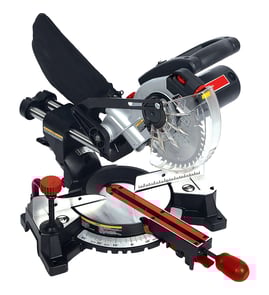

Will a 12 inch miter saw cut a 4x4?
A 12-inch miter saw can cut a 4x4 in one pass in many setups, but the Craftsman 137212940 is an 8-1/2-inch sliding compound miter saw, so a 4x4 cut-through in a single pass is not guaranteed. We use the saw’s published cutting capacity and recommend a dry-run check before powering on (see the 137212940 owner's manual).
Your model’s manual lists these maximum cutting capacities (at common miter and bevel settings):
| Saw setting | Max capacity (height x width) |
|---|---|
| 0° miter, 0° bevel | 2-5/8 in. x 12 in. |
| 45° miter, 0° bevel | 2-5/8 in. x 8-1/2 in. |
| 0° miter, 45° bevel | 1-3/4 in. x 12 in. |
| 45° miter, 45° bevel | 1-3/4 in. x 8-1/2 in. |
A standard 4x4 is about 3-1/2 inches thick, which is taller than the 2-5/8-inch straight-cut height capacity listed above.
We handle this safely by confirming clearance and support first, then choosing a method that keeps the work clamped and stable.
- Do a dry run with the saw unplugged to confirm the blade path clears the fence and the workpiece
- Clamp the workpiece tight to the fence and table; never cut freehand
- Keep the saw head pushed back at the start of a sliding cut; do not pull the saw toward you during the cut
- If the cut will not go through, finish with a controlled flip cut (rotate the 4x4 and complete the cut from the opposite side)
- Use an appropriate sharp 8-1/2-inch wood blade (your manual prohibits other blade sizes)
Trying to force a cut beyond the saw’s capacity increases the chance of binding, climbing, or loss of control. Staying within the published cutting capacity and using the clamp and fence correctly gives cleaner cuts and safer operation.
For diagrams, adjustments, and safe operating steps for the Craftsman 137212940, use the parts list and documentation on this model page, or search by model number on Sears PartsDirect.
Last updated: February 2026
What are the parts of a miter saw?
On the Craftsman 137212940 miter saw, the main parts include the motor and power switch, the blade and blade guard, and the miter system (turntable, degree scale, and miter lock) that lets us set common cutting angles accurately. For diagrams and names, use the 137212940 owner's manual.
- Motor and power cord/plug: Drives the blade; this saw is factory-wired for 120V use.
- Power switch/trigger: Starts and stops the motor.
- Saw blade (often carbide-tipped): Does the cutting; inspect for cracks, missing tips, or damage before use.
- Blade guard: Covers the blade; we do not operate without the proper guard in place.
- Miter system: Turntable plus degree scale and miter lock handle for left/right miter angles.
- Fence and table insert: Supports the workpiece and helps keep cuts stable.
- Support bracket/extension supports (if equipped): Helps prevent tipping and supports longer stock.
The miter cut controls are designed to make repeatable angle changes. Many saws, including this style, use positive stops for common angles.
| Part | What it does | Why you use it |
|---|---|---|
| Degree scale | Shows the selected miter angle | Confirms the angle setting before cutting |
| Turntable | Rotates left/right | Sets the cut direction |
| Miter lock handle | Locks/unlocks the table | Keeps the angle from shifting during the cut |
| Positive stops | “Click” points at common angles | Speeds setup and improves consistency |
Knowing the part names helps us troubleshoot faster (vibration, inaccurate angles, hard-to-move head) and order the correct replacement items by model. It also supports safer operation, especially around the blade guard, power cord, and locking controls.
- Use a 120V, 15-amp circuit with proper protection (time-delay fuse or circuit breaker).
- Replace a worn or damaged power cord immediately.
- This saw is double insulated; when servicing, use identical replacement parts.
- Unplug the saw before adjustments, maintenance, or inspections.
To look up diagrams and order replacement parts by model number, start with the parts list for 137212940 or search on Sears PartsDirect.
Last updated: February 2026
Which way should the teeth face on a miter saw?
On the Craftsman 137212940 miter saw, the blade teeth should point downward at the front of the saw. Match the rotation arrow on the blade to the rotation arrow on the guard, then tighten the arbor screw so the blade is secured correctly.
Use these checks every time you install or change a blade:
- Unplug the saw before changing the blade.
- Compare the rotation arrow on the blade to the rotation arrow on the guard.
- Confirm the teeth point down at the front (the side facing you).
- Tighten the arbor screw firmly.
- Tighten the cover plate stop screw (if equipped).
For the exact blade-change steps and safety notes for this model, follow the 137212940 owner's manual.
Correct tooth direction helps the blade cut cleanly and keeps the saw from grabbing or climbing on the workpiece. With a sliding miter saw, proper direction also supports the correct cutting motion: start with the saw out over the front edge of the workpiece, then push the blade down and back toward the rear to complete the cut.
A backward blade often shows up as poor cutting performance and unsafe behavior:
- Slow cutting or burning the wood
- Excessive tear-out or splintering
- The saw wants to “walk” or grab the workpiece
- More vibration than normal
- The cut feels like it requires too much force
We recommend these basics any time you change a blade or adjust setup:
| Step | What to do | Why it helps |
|---|---|---|
| Power off | Unplug the saw | Prevents accidental starting |
| Dry run | Lower the head with power off | Confirms blade path and clearance |
| Secure work | Use the hold-down clamp when possible | Reduces movement and kickback risk |
| Hand position | Keep hands at least 6-1/2 inches from the blade path | Protects fingers and hands |
If you need replacement parts for your Craftsman 137212940 miter saw, start with the parts list for this model; you can also search by model number on Sears PartsDirect.
Last updated: February 2026
What should you never cut with a miter saw?
You should never cut metal or masonry with your Craftsman 137212940 miter saw, and you should never do freehand cuts or try to cut short pieces that you cannot safely support. These materials and setups can bind, shatter, or pull your hands too close to the blade; follow the 137212940 owner's manual safety rules.
The manual is clear that this saw is designed for wood and woodlike products only.
- Ferrous metals (iron, steel)
- Any metal stock (unless your manual specifically approves it and you have the correct blade and setup)
- Masonry products (brick, tile, concrete, stone)
- Workpieces with nails, screws, or other embedded fasteners
These are the most common unsafe situations that lead to loss of control or kickback.
- Do not cut short pieces you cannot properly support while keeping your hold-down hand a safe distance from the blade
- Do not cut freehand; always hold the work firmly against the fence and table
- Do not reach around the blade at any time
- Do not pull the saw toward you during a cut (on sliding cuts, the blade can climb and lunge)
- Do not start the saw with the blade touching the workpiece
Use the built-in fence and a clamp to control the workpiece, and plan the cut before you power on.
| If you need to do this | Use this safer approach |
|---|---|
| Cut a small/short piece | Clamp it securely and use a longer support board as a carrier when possible |
| Cut questionable lumber | Inspect for nails/foreign objects; clamp and do a dry run with power off |
| Make a sliding cut | Start with the saw forward, then push down and back toward the fence (do not pull toward you) |
A miter saw spins a large blade at high speed; metal, masonry, or an unsupported workpiece can bind or shatter and can also force your hands into the cutting path. Keeping the work clamped to the fence and table is what prevents sudden movement.
If you are replacing worn or damaged components (guards, clamps, switches, wiring), start with the model-specific diagrams and parts list for Craftsman 137212940. For broader parts searching by model number, use Sears PartsDirect.
Last updated: February 2026
Why is 31.6 on a miter saw?
On the Craftsman 137212940 miter saw, 31.6° is a built-in positive miter stop on the miter scale. It is one of the most common preset angles used for repeatable cuts, especially for trim and compound-angle work where you want the turntable to “click” into a consistent setting (see the 137212940 owner's manual).
The miter scale on this model includes positive stop index points at several common angles, including 31.6°.
- Lets you quickly set the turntable to a repeatable angle without hunting on the scale
- Helps speed up production cuts for trim and molding
- Reduces setup errors when you need the same angle on multiple pieces
- Works with the miter lock handle and miter spring lock to hold the table at the chosen angle
These are the positive miter stops called out for this model:
| Preset miter stop | Typical use (examples) |
|---|---|
| 0° | Straight crosscuts |
| 15° | Light angle cuts, trim returns |
| 22.5° | Octagon-like layouts, decorative trim |
| 31.6° | Common trim and compound-angle setups |
| 45° | Picture frames, miters, corner trim |
| 60° right | Steeper angle cuts (right side only) |
We set the miter angle using the lock handle and spring lock so the table seats fully in the stop.
- Unplug the saw before adjusting angles.
- Turn the miter lock handle counterclockwise to unlock the table.
- Lift and hold the miter spring lock.
- Rotate the turntable until it drops into the 31.6° stop.
- Release the spring lock, then tighten the miter lock handle firmly.
A positive stop like 31.6° is there to make accurate, repeatable miter setups faster. When you are cutting multiple pieces (for example, trim runs), consistent angle indexing helps joints fit better and reduces wasted material.
- Clamp the workpiece tight against the fence or base; do not cut freehand.
- Do not pull the saw toward you during a cut; push down and back through the work.
- Let the motor reach full speed before starting the cut.
For replacement parts and diagrams for this model, start with the parts list for Craftsman 137212940; you can also search by model number on Sears PartsDirect.
Last updated: February 2026