 Owner’s manual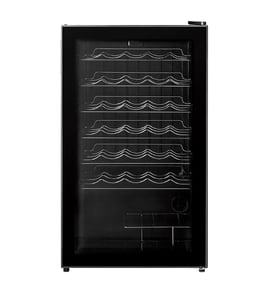

What is the difference between a wine cooler and a beverage cooler?
A wine cooler is designed to hold wine at steady serving and short-term storage temperatures, while a beverage cooler is designed to chill a wide mix of drinks colder and handle frequent door openings. Your Franklin HDC36SS is a wine cellar style unit with wine-focused temperature guidance.
- Temperature goals: Wine is typically kept in the mid-50s to low-60s °F; beverages are often preferred in the mid-30s to mid-40s °F.
- Temperature stability: Wine storage prioritizes steady temperatures; beverage storage prioritizes fast cool-down after restocking.
- Interior layout: Wine coolers commonly use bottle racks; beverage coolers commonly use flatter, adjustable shelves for cans and bottles.
- Door use pattern: Beverage coolers assume frequent openings; wine coolers assume longer closed-door periods.
- Vibration sensitivity: Wine benefits from lower vibration over time; beverage storage is less sensitive.
The HDC36SS is described as a two-compartment wine cellar with separate controls, which is useful when you want different temperatures for different wines. The manual also provides practical wine temperature guidance:
| Beverage type | Typical target temperature | What it’s for |
|---|---|---|
| Wine storage (general) | 56 to 58°F | Balanced short-term storage |
| Red wine (serving) | 60 to 62°F | Ready-to-drink reds |
| White wine (serving) | 54 to 55°F | Chilled whites |
| Soda/beer (typical preference) | 35 to 45°F | Colder refreshment |
Using a wine-focused cooler like the HDC36SS helps prevent over-chilling wine and reduces temperature swings that can affect flavor and aroma. If you store beer or soda, plan for warmer temps than a dedicated beverage fridge.
- Leave at least 3 inches of clearance at the sides and back.
- Keep the front vents unobstructed.
- Level the cabinet using the leveling legs.
- Wait 24 hours after placement before plugging it in.
For the exact control layout and recommended operating steps, use the HDC36SS owner's manual. For parts lookup by model, use Sears PartsDirect.
Last updated: February 2026
What is the life expectancy of a wine cooler?
A wine cooler typically lasts 10 to 15 years. For a Franklin HDC36SS wine and beverage cooler, consistent ventilation, clean condenser airflow, stable room temperature, and correct temperature settings do the most to reach that lifespan (or longer). See the HDC36SS owner's manual for model-specific care and operating details.
- Ventilation and airflow: keep the front vent area clear; built-in units still need airflow.
- Heat and location: avoid placing the cooler next to ovens, direct sun, or other heat sources.
- Door seal condition: a weak gasket makes the compressor run longer and wear faster.
- Cleaning routine: dust buildup reduces cooling efficiency and increases run time.
- Power quality: use a properly grounded outlet; avoid damaged cords.
- Leave about 3 inches of clearance around the sides and back for airflow (common requirement for this style of unit).
- Keep the front vent unblocked and do not push items against it.
- Clean interior spills promptly; keep racks and drip areas dry.
- Open doors briefly and avoid frequent temperature changes.
- If you must use an extension cord, use a 3-wire grounded cord rated for the appliance.
| Symptom | What it usually means | What we recommend |
|---|---|---|
| Runs constantly | Poor airflow, dirty cooling system, weak door seal | Clear vents, clean, check gasket seal |
| Temperature swings | Sensor/control issue or airflow problem | Verify settings, improve ventilation |
| Loud buzzing/clicking | Compressor or fan strain | Inspect for obstructions; service if persistent |
| Moisture or frost buildup | Door not sealing or frequent openings | Check gasket, reduce door openings |
A wine cooler that runs hot or struggles to hold temperature shortens compressor life and can also affect wine storage quality. Keeping airflow clear and settings stable reduces wear and helps the unit maintain consistent compartment temperatures.
We list replacement parts for the Franklin HDC36SS on the model parts page; you can also search by model number on Sears PartsDirect.
Last updated: February 2026
What is the most common problem with wine coolers?
The most common problem with wine coolers is inconsistent cooling (the unit runs but temperatures drift too warm or fluctuate). On the Franklin HDC36SS, the most frequent causes are a door that is not sealing, incorrect temperature settings per compartment, or an alarm condition such as HIGH TEMP, LOW TEMP, or PROBE ERROR shown on the display (all covered in the owner's manual).
- Confirm both compartment doors close fully and the gasket seals all the way around.
- Verify each compartment temperature is set correctly (each side has its own control panel).
- Keep interior lights off when not needed; leaving them on can raise cabinet temperature.
- Make sure the unit is level; vibration and poor door sealing can happen if it is not.
- After moving or installing, wait 24 hours before plugging in so it cools properly.
If the unit beeps or shows an alarm message, use the display text to narrow the problem.
| Display message | What it points to | What we do next |
|---|---|---|
| HIGH TEMP | Cabinet temperature is above the setpoint | Check door seal, settings, and that airflow is not blocked |
| LOW TEMP | Cabinet temperature is below the setpoint | Raise the set temperature and avoid overloading with warm bottles |
| PROBE ERROR (or PROBE ERROR-E) | Thermostatic sensor problem | Plan for sensor diagnosis and replacement by a technician |
Temperature swings speed up aging and can damage flavor and aroma. For typical targets, we set reds around 60 to 62°F and whites around 54 to 55°F, then allow for a small top-to-bottom variation inside the cabinet.
If basic checks do not restore stable temperatures, we use the model number HDC36SS to match the correct replacement parts and diagrams. Start with the parts list for this model, or search by model on Sears PartsDirect.
Last updated: February 2026