 Owner’s manual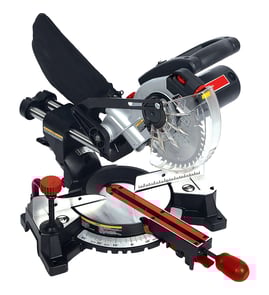

Why is 31.6 on a miter saw?
On the Craftsman miter saw model 137212360, 31.6° is a built-in positive stop on the miter scale to speed up common compound cuts, especially crown molding cuts. Our 137212360 owner's manual shows positive stops at 0°, 15°, 22.5°, 31.6°, and 45°, so you can lock that angle quickly and repeatably.
What 31.6° is used for (most often)
When you cut crown molding laid flat on the saw table (not nested against the fence), 31.6° is commonly paired with a 33.9° bevel to create tight inside and outside corner joints when the wall corner is a true 90°.
Common use cases:
- Cutting crown molding with a compound miter (miter + bevel)
- Making repeatable trim cuts without measuring each time
- Speeding up production work (less trial-and-error)
- Reducing angle mistakes when switching between left and right corners
How the saw “locks in” at 31.6°
Your saw uses a positive stop locking lever and the miter handle to hold the table at preset angles.
Basic steps:
- Turn the miter handle counterclockwise to unlock the table
- Press the positive stop locking lever to disengage/engage the stops
- Rotate to 31.6° on the miter scale
- Release the lever and tighten the miter handle before cutting
Typical crown molding settings (laid flat)
These are the standard compound settings referenced for crown molding when the wall angle is exactly 90°.
| Cut type | Bevel setting | Miter setting |
|---|---|---|
| Crown molding compound cut (typical) | 33.9° | 31.6° |
| Common preset miter stops on this saw | N/A | 0°, 15°, 22.5°, 31.6°, 45° |
Why it matters
31.6° exists because it is a high-value “shortcut” angle: it helps you get accurate, repeatable trim joints faster, and it pairs with common bevel settings for crown molding so you spend less time fine-tuning.
Parts and diagrams
If you are looking up the miter table, positive stop mechanism, or bevel lock components for Craftsman 137212360, start with the model parts diagrams, then expand your search by model number on Sears PartsDirect.
Last updated: February 2026
What should you never cut with a miter saw?
For the Craftsman miter saw model 137212360, never cut masonry products (brick, tile, concrete) or metals that the saw is not designed for; also never cut workpieces so small that your hands would be within 6-3/4 inches of the blade. Follow the safety rules in the 137212360 owner's manual.
Materials you should not cut
These materials create high kickback risk, blade damage, or unsafe debris.
- Masonry products (tile, brick, cement board, stone)
- Ferrous metals (steel, iron, rebar)
- Any metal that must be hand-held (never hold metal by hand while cutting)
- Workpieces that are too small to keep hands at least 6-3/4 inches from the blade
- Unsecured odd-shaped pieces that can roll, twist, or bind (dowels, tubing, some moldings)
What is OK to cut (when set up correctly)
This saw is designed for wood and wood-like products. Some miter saws can cut certain non-ferrous metals (like aluminum) only when the correct blade is used and the work is clamped securely.
| Material | Recommended with this saw? | Key requirement |
|---|---|---|
| Wood, trim, molding | Yes | Hold firmly against fence; support long stock |
| Wood-like products | Yes | Clamp when practical; prevent binding |
| Non-ferrous metal (aluminum) | Sometimes | Use a non-ferrous metal blade; clamp securely; remove dust bag |
| Ferrous metal (steel/iron) | No | Do not cut |
| Masonry | No | Do not cut |
Setup rules that prevent dangerous cuts
Use these practices any time you cut on a miter saw.
- Clamp the workpiece when practical; only the workpiece should be on the saw table.
- Support long boards on both sides so they cannot tip.
- Keep hands out of the marked “no-hands zone”; plan the cut so your fingers stay 6-3/4 inches away.
- Lower the blade to the workpiece with the switch OFF to preview the cut path.
- After the cut, release the trigger and wait for the blade to stop before raising the saw or moving the work.
Why it matters
A miter saw can grab, bind, or throw material if the blade is wrong for the material or the workpiece is too small or unstable. Avoiding prohibited materials and keeping proper hand distance reduces kickback and severe injury risk.
If you need replacement parts for your Craftsman 137212360 miter saw, start with the model parts list, or search by model number on Sears PartsDirect.
Last updated: February 2026
What are the parts of a miter saw?
On the Craftsman miter saw model 137212360, the main parts include the miter scale and miter lock for setting angles, the bevel lock for tilting the head, the ON/OFF trigger switch in the handle, and safety and guarding components like the safety lock-off button and lower blade guard. For diagrams and names, use the 137212360 owner's manual.
Key parts you will see on this miter saw
These are commonly referenced in the manual and are the parts most customers use for setup and cutting:
- Miter scale (0° to 45° left and right): shows the miter angle setting
- Miter lock handle: locks the table at your selected miter angle
- Positive stop locking lever: locks into preset miter stops for repeatable angles
- Bevel lock handle: locks the bevel (tilt) angle for bevel and compound cuts
- ON/OFF trigger switch (in the switch handle): starts and stops the saw
- Safety lock-off button: helps prevent accidental starts
- Lower blade guard: covers the blade as the saw returns to the up position
- Stop latch: locks the saw in the lowered position for storage/transport
- Mounting holes (in the base): used to bolt the saw to a stable work surface
What each control does (quick reference)
| Part | What it controls | When you use it |
|---|---|---|
| Miter lock handle | Left/right table rotation | Any miter cut |
| Positive stop locking lever | Preset miter detents | Fast, repeatable angles |
| Bevel lock handle | Head tilt | Bevel and compound cuts |
| Trigger switch | Motor power | Starting and stopping cuts |
| Stop latch | Head down lock | Carrying and storage |
Why it matters
Knowing the correct names helps you set angles accurately, lock the saw securely, and troubleshoot issues like a saw that will not stay at a miter stop, a bevel that slips, or a guard that does not fully close.
Helpful tips when identifying parts
- Unplug the saw before inspecting controls, guards, or wiring.
- Confirm the miter angle pointer lines up with the miter scale before cutting.
- Keep the lower guard moving freely; it should fully close when the handle is released.
- Use the mounting holes to bolt or clamp the saw down for stability.
- When you need replacement parts by model number, search using 137212360 on Sears PartsDirect.
Last updated: February 2026
Is it worth getting a double bevel mitre saw?
Yes, a double bevel miter saw is worth it when you regularly cut crown molding, complex trim, or lots of opposing bevels because it lets you bevel left and right without flipping the workpiece. For the Craftsman 137212360 specifically, the bevel range is 0° to 45° left (single bevel), so a double bevel upgrade mainly buys speed and fewer setup errors.
When a double bevel saw pays off
A dual bevel design reduces handling and re-measuring, especially on finish work.
- You cut crown molding nested or “upside down and backwards” often
- You do repetitive left and right bevel cuts (baseboard returns, picture frames, casing)
- You want fewer chances to shift the fence contact or change reference faces
- You work with longer stock where flipping is awkward or unsafe
- You value faster workflow more than the added tool cost
When your current single bevel is enough
The 137212360 has positive bevel stops at 0° and 45° left, plus common miter detents (0°, 15°, 22.5°, 31.6°, 45° right and left). That covers a lot of DIY and jobsite needs.
- You mostly make square crosscuts and standard miters
- You only bevel occasionally (and flipping the board is not a big deal)
- Your projects are smaller, and setup time is not the bottleneck
- You prefer simpler mechanisms and fewer adjustments
Quick comparison
| Feature | Single bevel (like 137212360) | Double bevel |
|---|---|---|
| Bevel direction | Left only (0° to 45°) | Left and right |
| Opposing bevel cuts | Flip workpiece | Tilt saw both ways |
| Speed on trim/crown | Moderate | Faster |
| Setup error risk | Higher (more handling) | Lower |
Why it matters
Every time you flip a workpiece, you introduce a new reference face and a new chance for a small alignment mistake. On trim and crown, those small errors show up as open joints. A double bevel saw mainly improves consistency and efficiency.
Tips to get the best results from the Craftsman 137212360
- Use the bevel lock handle and miter lock handle firmly before every cut
- Confirm the blade is aligned at 45° to the table when beveling (adjust per the owner's manual)
- Use the correct 10-inch blade for the material; keep it sharp and undamaged
- Unplug the saw before blade changes or adjustments; use the arbor lock for blade service
If you decide to upgrade, use your model number (137212360) to compare parts and accessories, and search by tool type on Sears PartsDirect.
Last updated: February 2026
Is a 10 or 12-inch miter saw better?
A 10-inch miter saw is the better all-around choice for most DIY and trim work because it’s lighter, easier to move, and blades typically cost less. A 12-inch miter saw is better when you regularly need maximum cut capacity for wider or taller stock. For Craftsman model 137212360, the 137212360 owner's manual specifies using 10-inch blades, so it’s built around the 10-inch class.
Quick comparison: 10-inch vs 12-inch
| Feature | 10-inch miter saw (like 137212360) | 12-inch miter saw |
|---|---|---|
| Portability | Easier to carry and store | Heavier and bulkier |
| Blade cost | Typically lower | Typically higher |
| Cut capacity | Great for most trim and common lumber | Best for wide boards and tall crown |
| Best fit | DIY, remodeling, general carpentry | Frequent large-stock cutting |
How we recommend choosing
Pick a 10-inch saw when you want:
- A lighter saw for jobsite moves or a small shop
- More blade options at lower cost (crosscut and finish blades)
- Strong performance for baseboard, casing, and typical dimensional lumber
Pick a 12-inch saw when you need:
- More capacity for wide shelving, thick stock, or tall crown molding
- Fewer flip cuts on wider boards
- A saw that stays set up in one place most of the time
Why it matters (capacity and safety)
The right blade size reduces awkward setups that can lead to binding, vibration, or unstable work support. Our Craftsman 137212360 manual also emphasizes core safe-use habits: keep hands out of the marked no-hands zone, support long workpieces, and wait for the blade to stop before raising the saw head.
Blade and accessory notes for Craftsman 137212360
- Use 10-inch blades that meet the saw’s requirements
- Use only recommended accessories; avoid prohibited accessories such as dado sets and abrasive wheels
- If the saw makes an unfamiliar noise or vibrates, turn it off, unplug it, then correct the cause before restarting
- For replacement parts and model-matched diagrams, start with the model parts list, or search by model number on Sears PartsDirect
Last updated: February 2026