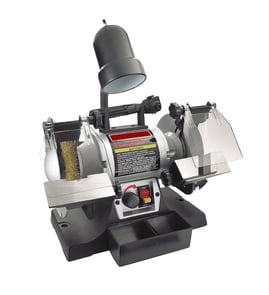

What is a Craftsman bench grinder?
A Craftsman bench grinder is a stationary power tool (like the Craftsman model 319190630) that spins abrasive wheels to sharpen tools, shape metal, remove rust, and smooth rough edges. It is designed to mount to a workbench for stable, controlled grinding.
What you typically use it for
- Sharpening blades and cutting tools (chisels, mower blades, axes)
- Deburring metal after cutting or drilling
- Cleaning up welds and smoothing rough edges
- Removing light rust or paint (with the correct wheel or accessory)
- Shaping small metal parts for fit and finish
Key parts and features you will see on most bench grinders
Even without model-specific documentation for 319190630, most Craftsman bench grinders share these common components:
| Feature | What it does | Why it helps |
|---|---|---|
| Grinding wheels | Abrade metal to sharpen or shape | Controls how fast and how smooth material is removed |
| Wheel guards | Cover the wheel sides and contain debris | Improves safety and keeps sparks directed |
| Tool rests | Support the workpiece near the wheel | Helps keep angles consistent while sharpening |
| Eye shields/spark deflectors | Block debris and redirect sparks | Protects your face and improves visibility |
| On/off switch and power cord | Controls power to the motor | Enables quick shutoff when needed |
Safe, effective basics (what we recommend)
- Mount the grinder securely to a solid bench before use.
- Use the correct wheel type and grit for the material and task.
- Keep the tool rest close to the wheel (a small gap) so workpieces cannot wedge.
- Let the wheel do the work; avoid forcing the metal into the wheel.
- Inspect wheels for cracks and damage before grinding.
Why it matters
A bench grinder is one of the most useful shop tools because it restores sharp edges and cleans up metal quickly. Using the right setup and technique improves results and reduces the chance of wheel damage or kickback.
For general DIY safety guidance before working on power tools, review are diy appliance repairs safe.
Last updated: February 2026
Can you run a bench grinder with only one wheel?
Yes, you can run the Craftsman 319190630 bench grinder with only one wheel installed, as long as the remaining wheel is mounted correctly and the guards and tool rests are secure. Expect faster spin-up and less flywheel effect, so the grinder can bog down sooner under heavy pressure.
What changes when you remove one wheel
Running with one wheel mainly changes how the grinder behaves, not whether it will run.
- Less rotating mass (inertia): it reaches full speed faster.
- Less momentum under load: it slows down faster if you push hard.
- Different feel at startup and shutdown: coasts for a shorter time.
- More temptation to overuse one side: the remaining wheel can wear faster.
- Higher importance of correct mounting: a poorly seated wheel can vibrate and crack.
Safety checks before you power it on
A bench grinder wheel can fail violently, so setup matters more than “can it run.”
- Unplug the grinder before changing wheels.
- Confirm the wheel is the correct diameter, thickness, and arbor size for the grinder.
- Make sure flanges/washers are installed in the correct order and fully seated.
- Set the tool rest gap close (typically about 1/8 inch) so workpieces cannot wedge.
- Set the spark guard/tongue guard close (typically about 1/4 inch) to limit kickback.
- Stand to one side at startup and let it run about a minute before grinding.
Quick comparison: one wheel vs. two wheels
| Setup | Best for | Tradeoff |
|---|---|---|
| One wheel installed | Temporary use while replacing a damaged wheel | Less momentum; easier to stall under pressure |
| Two wheels installed | Normal grinding and balancing left/right tasks | Slower spin-up; more stored energy |
Why it matters
If one wheel is damaged, removing it is safer than running it “just to finish a job.” A cracked or out-of-round wheel can cause severe vibration, poor grinding results, and wheel failure.
For help finding the correct replacement wheel size and other parts for model 319190630, use Sears PartsDirect.
Last updated: February 2026
What are the 4 important rules for a bench grinder?
For the Craftsman 319190630 bench grinder, the 4 most important rules are: wear proper eye and face protection, keep guards and tool rests correctly adjusted, use the correct grinding wheel and speed rating, and keep hands, clothing, and hair safely away from the wheel at all times.
The 4 rules (with the key details that make them work)
- Protect your eyes and face every time: wear safety glasses plus a face shield; grinding wheels can throw sparks, grit, and fragments.
- Set the guards and tool rest before you start: keep the work rest close to the wheel (commonly about 1/8 inch) and keep the spark guard close as well so the work cannot get pulled into a gap.
- Match the wheel to the grinder: only use a wheel that is rated at or above the grinder’s RPM, and use the correct wheel type for the material (typical choices are aluminum oxide for steel and silicon carbide for masonry).
- Control entanglement and hand safety: no loose sleeves, gloves, jewelry, or dangling cords near the wheel; tie back long hair and keep a stable stance with both hands controlling the workpiece.
Quick pre-start checklist (bench grinder safety)
- Unplug the grinder before adjusting guards, tool rests, or wheels.
- Inspect the wheel for chips or cracks; replace damaged wheels immediately.
- Confirm the wheel is tight and runs true; start the grinder and let it reach full speed.
- Stand slightly to one side at startup (not directly in front of the wheel).
- Grind on the face of the wheel (not the side) unless the wheel is specifically designed for side grinding.
Common settings and limits (typical guidance)
| Item | Typical safe target | Why it matters |
|---|---|---|
| Tool rest gap | ~1/8 in. | Reduces the chance the workpiece wedges and kicks back |
| Wheel RPM rating | Grinder RPM or higher | Prevents wheel overspeed failure |
| Startup position | Off to the side | Lowers risk if a wheel fails at startup |
Why it matters
A bench grinder spins an abrasive wheel at high speed; small setup errors (a wide tool-rest gap, wrong wheel rating, or loose clothing) can turn a routine sharpening job into a sudden kickback or wheel failure.
For more general DIY safety guidance before you start, review are diy appliance repairs safe.
Last updated: February 2026
How many HP for a bench grinder?
Most bench grinders run in the 1/3 HP to 1 HP range. For the Craftsman 319190630 bench grinder, use the motor nameplate (amps, volts, RPM) to determine the exact horsepower; many 6-inch Craftsman grinders are in the light-duty 1/3 HP class.
Typical HP ranges (what to expect)
- 1/3 HP: sharpening, deburring, light grinding with short passes
- 1/2 HP: general-purpose grinding with moderate pressure
- 3/4 HP to 1 HP: frequent grinding, heavier stock removal, less bogging
- Over 1 HP: specialty or industrial use (larger wheels, long duty cycles)
How to confirm HP on model 319190630
The most accurate way is to read the motor plate and convert from electrical ratings.
- Look for amps (A) and volts (V) on the motor label
- Note whether it is 120V or 240V
- Record RPM (helps confirm you are reading the correct label)
- Use the grinder as intended; higher pressure does not equal faster grinding
| What you have | What it tells you | What to do next |
|---|---|---|
| HP listed on label | Exact horsepower | Use that value for comparisons |
| Only amps and volts listed | Lets you estimate motor size | Compare to typical 1/3 HP to 1 HP ranges |
| Grinder bogs down easily | Load exceeds motor capability | Use lighter passes, dress wheel, consider higher-HP grinder for heavy work |
Why it matters
Horsepower is what keeps wheel speed from dropping under load. Matching HP to your grinding style reduces stalling, overheating, and excessive wheel glazing.
For safe electrical checks (like verifying power, switch, or cord issues), use our guide: how to use a multimeter to test electrical parts video.
Last updated: February 2026