 Owner’s manual
 Error Codes
Is it worth repairing a chest freezer?
Yes, repairing a GE FCM7 chest freezer is worth it when the problem is a simple electrical or usage issue (power, control setting, lid sealing, airflow) and the cabinet is in good shape; those fixes restore safe food storage and avoid the cost of replacement.
- If the freezer will not run, first confirm it is plugged in and the temperature control is not set to OFF.
- If it runs too much, check for a lid left open or packages holding the lid open.
- If food is thawing, verify the control setting, power at the outlet, and that the lid is closing fully.
- If it is noisy or vibrating, check the floor strength and level placement.
- If you see moisture on the outside, that is normal during high humidity.
Many “needs repair” symptoms are actually setup or power issues listed in the troubleshooting section of the owner's manual.
| Symptom | Most common cause | What to do first |
|---|---|---|
| Freezer does not operate | Control OFF or unplugged | Set control to a colder setting; push plug fully into outlet |
| Food defrosting | Power issue or lid not sealing | Check breaker/fuse; remove packages blocking lid |
| Runs too often | Lid left open or opened frequently | Reduce openings; confirm lid closes fully |
| Noisy/vibrates | Weak floor or not level | Move to solid surface; level and stabilize |
Repair is usually not the best value when the freezer has major sealed-system trouble (compressor or refrigerant system), severe rust-through, or a damaged lid/cabinet that will not seal. Those issues typically cost more than the freezer is worth and can lead to ongoing temperature problems.
A chest freezer that cannot hold a steady, low temperature risks food quality and food safety. Fixing simple causes like power, control settings, and lid sealing often restores normal operation quickly and keeps energy use under control.
Last updated: February 2026
Is the GE chest freezer 7 cu ft any good?
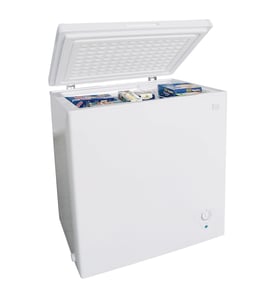
Yes. The GE FCM7 is a 7 cu. ft. manual-defrost chest freezer that’s a strong choice when you want simple, consistent frozen storage and you’re comfortable doing periodic defrosting and basic upkeep as outlined in the owner's manual.
A “good” chest freezer is one that holds safe freezing temperatures, runs predictably, and is easy to maintain. The FCM7 checks those boxes with a straightforward manual-defrost design.
- Manual-defrost cooling system (simple, steady operation)
- Chest-style storage (holds cold well when the lid is closed)
- Temperature control designed to maintain freezing conditions for stored food
- Works best when you manage frost and keep the lid seal clean
Manual-defrost chest freezers perform well, but they require hands-on maintenance.
- Frost buildup is normal; remove frost before it gets thick (the manual calls out not more than 1/2 inch for best efficiency)
- Defrosting is a routine task; frequency depends on humidity, lid openings, and room conditions
- Organization takes planning; baskets and labeled bins help prevent “lost” items
- Lid removal requires caution because chest freezer lids are under spring tension
| What to do | When | Why it matters |
|---|---|---|
| Keep frost at 1/2 inch or less | As needed | Helps efficiency and usable space |
| Defrost safely (no sharp tools) | When frost thickens | Prevents liner and coil damage |
| Let hot foods cool before loading | Every time | Reduces temperature swings |
| Clean and inspect the lid gasket | Monthly | Helps prevent air leaks and frost |
If you want maximum storage in a compact footprint, a chest freezer like the GE FCM7 is a dependable option. The main “cost” is manual defrosting; staying ahead of frost keeps cooling performance and efficiency where you want them.
Last updated: February 2026
What is the most common problem with a GE refrigerator?
The most common service issue customers report on GE cooling appliances is not cooling. Since you are working with a GE FCM7 chest freezer, the most useful way to apply that question is to focus on the FCM7 “not freezing” basics: power, temperature control settings, lid sealing, and airflow. Use the FCM7 owner's manual for model-specific checks.
- Temperature control set incorrectly: set too warm or accidentally set to OFF.
- Power issue: loose plug, tripped breaker, or blown fuse.
- Lid not sealing: gasket gaps, frost, or packages preventing full closure.
- Too many or too-long openings: warm air load overwhelms cooling.
- Poor airflow around the cabinet: insufficient clearance at the top, back, or sides.
- Confirm the freezer is plugged in fully and the outlet has power.
- Make sure the temperature control is not in OFF and is set colder.
- Check for packages holding the lid open; close the lid and confirm it sits flat.
- Inspect the lid gasket for tears, gaps, or heavy frost that prevents sealing.
- Verify you have open space around the cabinet for proper air circulation.
| What you notice | Most likely cause | Best next step |
|---|---|---|
| Food softening or thawing | Control too warm, lid not sealing, frequent openings | Adjust control, check gasket and lid closure |
| Unit seems “dead” | No power or control OFF | Check outlet power, breaker/fuse, control setting |
| Excessive frost | Lid left open, humidity, poor seal | Reduce openings, clear frost, check gasket |
| Warm exterior or compressor noise | Normal heat transfer and compressor operation | Compare to normal characteristics in the manual |
A cooling problem can lead to food thawing, heavy frost buildup, and longer run times. Checking settings, power, and lid sealing first prevents unnecessary downtime and helps you target the right repair.
Last updated: February 2026