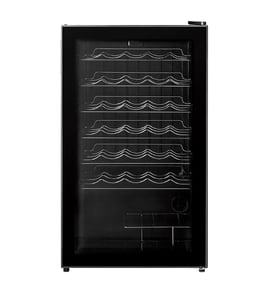



Does GE make wine coolers?
Yes. GE makes wine coolers and wine and beverage coolers (often called beverage centers), including the GE CCP06BP3PBD1 series. If you own a GE unit, we can help you identify the exact model and get the right replacement parts when you need a repair.
How to confirm your GE wine cooler model
The most reliable way to confirm you have a GE wine cooler (and match parts correctly) is to verify the model number on the rating label.
- Look for the model/serial label inside the cabinet (side wall) or near the door opening
- Match the full model number exactly, including any suffix characters
- Use the model number to select compatible parts for cooling, controls, and door hardware
- If your unit has Wi-Fi features, the model number still drives correct control board selection
Common GE wine cooler parts you may need
For GE CCP06BP3PBD1 beverage centers, these are common part categories that come up in troubleshooting and repairs:
| Symptom | Likely part category | Example part on this model page |
|---|---|---|
| Warm temperatures, poor cooling | Airflow or sealed system support | Condenser fan & bracket assembly WR87X34926 |
| Frost buildup, temperature swings | Defrost sensing/control | Refrigerator defrost sensor WR55X29875 |
| Erratic temps or incorrect readings | Temperature sensor | Convertible thermistor WR55X31992 |
| No response, dead display, odd behavior | Electronic control | Main control board WR55X34531 |
Why it matters
Wine coolers are more sensitive to temperature stability than a standard refrigerator. Using the correct GE model number helps ensure you get compatible parts like a thermistor, control board, or condenser fan so the unit holds steady temperatures and avoids unnecessary cycling.
Last updated: February 2026
Why is my GE wine fridge not cooling?
If your GE CCP06BP3PBD1 wine and beverage cooler is not cooling, the most common causes are restricted airflow at the condenser, a door that is not sealing, or a failed sensor, fan, or control. Start with airflow and door checks, then move to component testing.
Quick checks we recommend first
- Confirm the controls respond and the unit is powered.
- Make sure the door closes fully; bottles or racks cannot interfere.
- Set the temperature colder and allow 12 to 24 hours to stabilize.
- Verify ventilation space around the cabinet (especially back and bottom).
- Clean dust from the condenser area; blocked heat rejection raises cabinet temperature.
Parts to inspect next on CCP06BP3PBD1
If the basics look good, these model-relevant parts commonly affect cooling:
- Temperature feedback: A failed thermistor can misread cabinet temperature and shorten compressor run time; check the convertible thermistor WR55X31992.
- Air movement: If the condenser fan is stalled, the compressor can overheat and cooling drops; inspect the condenser fan & bracket assembly WR87X34926.
- Control issues: If the display works but the compressor or fan never runs, inspect connections and consider the main control board WR55X34531.
Symptom guide
| Symptom | Most likely cause | What we do next |
|---|---|---|
| Runs a lot but stays warm | Dirty condenser area or poor ventilation | Clean and improve airflow; recheck in 24 hours |
| No fan noise near back/bottom | Condenser fan problem | Inspect condenser fan & bracket assembly WR87X34926 and wiring |
| Temperature seems inaccurate | Thermistor problem | Test/replace convertible thermistor WR55X31992 |
| Controls on, but no cooling activity | Control or wiring problem | Check harness connections; consider main control board WR55X34531 |
Why it matters
This beverage center depends on steady condenser airflow and accurate temperature sensing. When airflow is restricted or the sensor/control is wrong, the compressor cannot remove heat effectively, so temperatures stall in the mid-50s or warmer.
Helpful DIY skill
For sensor, fan, and control checks, meter testing speeds up diagnosis; use our how to use a multimeter to test electrical parts video for safe, basic steps.
Last updated: February 2026
What is the average lifespan of CCP06BP3PBD1?
A GE beverage center like model CCP06BP3PBD1 typically lasts 10 years with normal home use. Keeping airflow clear, cleaning the condenser area, and fixing fan or temperature-sensor issues quickly helps you reach that lifespan.
What affects lifespan the most
- Ventilation and heat: tight cabinets, blocked toe-kick areas, or high room temps make the compressor work harder.
- Condenser fan performance: a weak or noisy fan can overheat the sealed system.
- Temperature control accuracy: drifting sensors can cause long run times and icing.
- Door seal habits: frequent openings and poor sealing raise humidity and workload.
- Dust and pet hair: buildup around the condenser area reduces heat transfer.
Quick maintenance checklist (5 minutes at a time)
- Keep a few inches of clearance around vents and the back (as your installation allows).
- Vacuum dust from the lower rear and toe-kick area.
- Confirm the door closes squarely and does not bounce open.
- Avoid overpacking; leave space for air circulation between bottles and cans.
- Listen for new noises (rattling, grinding, or a fan that surges).
Parts that commonly extend service life when replaced
If cooling is inconsistent, noisy, or icing up, these model-matched parts are common fixes:
| Symptom | Likely area | Example part for CCP06BP3PBD1 |
|---|---|---|
| Warm temps, hot cabinet sides, loud airflow | Condenser airflow | Condenser fan & bracket assembly WR87X34926 |
| Frost buildup, temperature swings | Temperature sensing/defrost | Refrigerator defrost sensor WR55X29875 |
| Erratic temps or incorrect readings | Cabinet temperature sensing | Convertible thermistor WR55X31992 |
Why it matters
A beverage cooler is a small refrigeration system; when airflow or sensing is off, the compressor runs longer and hotter. That extra stress is the main reason these units wear out early.
Last updated: March 2026