 Owner’s manual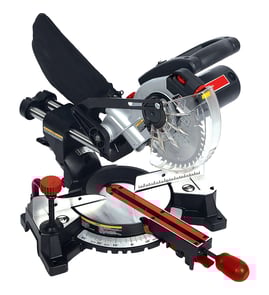

What should you never cut with a miter saw?
You should never make cuts on a miter saw that you cannot control safely, especially on the Craftsman 315235380 10-inch compound miter saw. Never cut freehand, never cut pieces too small to clamp, and never stack multiple workpieces; these situations commonly lead to blade binding, kickback, or hands entering the cutting path (see the owner's manual).
Never cut these materials or setups
- Anything freehand (work must be flat on the table and tight to the fence).
- Small pieces you cannot clamp securely (do not hand-hold tiny offcuts).
- More than one piece at a time (no stacking workpieces).
- A clamped workpiece with a length stop on the free scrap end (the loose end can get caught and kick up).
- Warped, bowed, or twisted stock that will not sit flat against the table and fence.
- Any cut that puts your hands in the “no hands zone” or within about 3 inches of the blade path.
Quick safety rules we follow on model 315235380
Before every cut:
- Lock the miter table and bevel (saw arm) settings.
- Keep the workpiece flush to the fence as a backstop.
- Clamp on one side of the blade only so the other side stays free and the blade does not bind.
- Let the blade stop completely before raising it.
- Avoid rapid on/off switching; if the blade loosens, stop and retighten before using again.
Common “don’t do this” examples
| Situation | Why it’s unsafe | Safer approach |
|---|---|---|
| Cutting a 1-inch-long block | Too small to control; hands get close | Clamp it to a longer carrier board |
| Holding the scrap end while cutting | Scrap can bind and kick back | Support the main piece; let scrap fall free |
| Cutting two boards stacked | Blade can grab and throw material | Cut one board at a time |
| Cutting stock not against the fence | Kerf can close; kickback risk | Reposition flat to table and fence |
Why it matters
Most serious miter saw incidents come from loss of control: the blade binds, the workpiece shifts, or hands drift into the cutting path. Keeping the work flat, clamped, and against the fence prevents kickback and improves cut accuracy.
Last updated: February 2026
How to open Craftsman compound miter saw?
To open (unlock and raise) your Craftsman 315235380 10-inch compound miter saw, pull out the lock pin that holds the saw arm down, then lift the saw arm up to its full height. Use the owner's manual to confirm the exact lock pin location and safe setup steps.
Quick steps to unlock and raise the saw arm
- Unplug the saw before adjusting anything.
- Locate the lock pin that secures the saw arm in the down (transport) position.
- Pull the lock pin out to release the arm.
- Lift the saw arm up to its full height.
- Before cutting, verify the lower blade guard moves freely and retracts as the arm lowers.
If the arm will not lift after pulling the lock pin
These are the most common causes on a compound miter saw like model 315235380:
- The arm is still under tension; press the handle down slightly, then pull the pin and lift.
- The saw is binding because it is not mounted securely; bolt the base to a firm bench.
- Sawdust buildup is restricting movement around the pivot points; clean and recheck.
- A control is over-tightened; confirm the bevel lock knob is not clamping the saw arm.
Controls you might be mixing up (what each one does)
| Control | What it locks | When you use it |
|---|---|---|
| Lock pin | Saw arm down for storage/transport | To open and raise the arm |
| Miter lock handle | Miter table angle | Before making a miter cut |
| Bevel lock knob | Bevel angle (tilt) | Before making a bevel/compound cut |
| Lock-off lever | Trigger safety | To reduce accidental starting |
Why it matters
Opening the saw correctly prevents sudden arm movement and helps keep the self-retracting lower blade guard working as designed. It also reduces the chance of binding when you set miter and bevel angles for accurate cuts.
Last updated: February 2026
Why is 31.6 on a miter saw?
On the Craftsman 315235380 10-inch compound miter saw, 31.6° is a built-in positive stop (detent) mainly used for cutting standard U.S. crown molding laid flat using compound angles. It lets us repeat accurate crown cuts quickly without re-measuring the miter angle each time.
What the 31.6° stop is for on model 315235380
Your saw’s miter table includes positive stops at 0°, 22-1/2°, 31.6°, and 45° (left and right). The 31.6° stop is there because it matches a common crown-molding compound-cut setup when the molding is placed flat on the miter table.
Typical crown-molding “flat on table” settings called out for this style of saw are:
- Bevel: about 33.85°
- Miter: about 31.62° (left or right depending on inside vs outside corner)
For the exact procedure and diagrams for crown molding placement, use the owner's manual.
Quick reference: when you use 31.6°
- Cutting crown molding flat (not nested against the fence)
- Making inside corners and outside corners with repeatable settings
- Using the saw’s miter lock plate to “click” into the detent for speed and consistency
How to use the 31.6° detent correctly
- Unplug the saw before adjusting or checking stops.
- Loosen the miter lock handle.
- Press and hold the miter lock plate.
- Rotate the miter table until it seats into the 31.6° positive stop.
- Tighten the miter lock handle securely before cutting.
- Set bevel to the crown-molding bevel angle specified in the manual, then test-cut scrap.
Common settings overview
| Task | Miter setting | Bevel setting | Notes |
|---|---|---|---|
| Crown molding flat (common U.S. spring angles) | 31.6° L or R | 33.85° | Use manual chart for corner type and molding orientation |
| Basic crosscut | 0° | 0° | General straight cut |
| Picture-frame style miters | 45° L or R | 0° | Typical for 90° corners |
Why it matters
That 31.6° stop saves time and reduces angle errors on trim work. Crown molding is sensitive to small setup changes, and most rooms are not perfectly 90°, so starting from the correct detent and then fine-tuning with test cuts improves fit.
Last updated: February 2026
Does Craftsman make a double bevel miter saw?
Yes. Craftsman makes double bevel (dual bevel) miter saws; they tilt left and right for bevel cuts so you do not have to flip the workpiece. Your Craftsman model 315235380 is a 10-inch compound miter saw that makes bevel cuts from 0° to 45° in a single direction; confirm the bevel setup in the 315235380 owner's manual.
What “double bevel” means
A double bevel (dual bevel) miter saw tilts:
- Left and right for bevel cuts
- Faster for crown molding and repetitive compound cuts
- With fewer workpiece flips, which helps keep reference faces consistent
What your Craftsman 315235380 does
The 315235380 is a 10-inch compound miter saw (it performs miter cuts and bevel cuts). The manual describes bevel cutting with the blade set between 0° and 45°, which indicates a single-direction bevel design.
Quick comparison
| Feature | Single bevel compound miter saw (315235380) | Double bevel miter saw |
|---|---|---|
| Bevel direction | One side | Left and right |
| Flipping the workpiece | More often | Less often |
| Best use | General trim, framing, basic compound cuts | High-volume molding, complex compound setups |
How we recommend confirming before buying accessories
- Check the model tag to match 315235380
- Review the bevel-cut section and bevel scale range (0° to 45°)
- Match blades by diameter; this saw uses a 10-inch blade
- Verify cutting capacities for your common angles in the manual
Why it matters
Double bevel capability changes workflow more than results. With a single bevel saw like the 315235380, you can still make the same joints, but you plan on flipping the board and re-checking your reference faces more often.
Last updated: February 2026
What size is the miter slot on a Craftsman table saw?
Most Craftsman table saws use the standard miter slot size: 3/4 inch wide by 3/8 inch deep. The Craftsman 315235380 is a 10-inch compound miter saw, so it does not use a table saw style miter slot; accessory fit is based on the miter table, fence, and mounting points listed in the owner's manual.
Standard table saw miter slot sizes (what you will usually see)
Use these as the common reference when buying a miter gauge, sled runner, or featherboard hardware for a table saw:
- Width: 3/4 inch
- Depth: 3/8 inch
- Profile: straight slot or T-slot (undercut to capture T-bolts)
- Fit goal: runner slides smoothly with no side-to-side play
| Slot style | Typical width | Typical depth | What it affects |
|---|---|---|---|
| Standard slot | 3/4 in. | 3/8 in. | Fits most miter gauges and sled runners |
| T-slot | 3/4 in. | 3/8 in. | Allows hold-downs/featherboards to lock in the slot |
If you are actually working with model 315235380 (miter saw)
A miter saw like the Craftsman 315235380 uses a miter table and fence, not a miter slot. For jigs and accessories, measure these instead:
- Fence face height and thickness (where a jig registers)
- Distance from fence to blade at 0 degree miter
- Base mounting hole pattern (for extensions or a stand)
- Throat plate opening area (for zero-clearance inserts)
Why it matters
On a table saw, the miter slot controls how accurately a miter gauge or sled tracks; a loose runner causes wobble and poor cuts. On a miter saw, accuracy comes from fence alignment, detents, and clamping the work.
Last updated: February 2026