Owner’s manual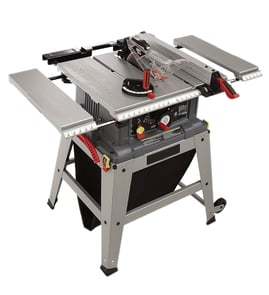

How to date a Craftsman table saw?
For the Craftsman CMXETAX69434502 table saw, the instruction manual does not provide a serial-number date code or a manufacture date, so we can’t reliably “date” this exact model from the model number alone. The most dependable method is to use the serial number on the saw’s rating label and confirm it with Craftsman support.
Where to find the information on CMXETAX69434502
Check the saw for a rating label (often on the cabinet, frame, or near the switch area). Use the manual to confirm what you’re looking at and how the saw is configured: CMXETAX69434502 instruction manual.
Look for these items on the label:
- Model number: CMXETAX69434502
- Serial number (this is the key for dating)
- Electrical rating (this model is 120V, 60Hz, 15A)
- Safety marks and other identifiers
How to estimate the age (best to least reliable)
Because Craftsman serial formats vary by manufacturer and era, we recommend this order:
- Serial number lookup (best)
- Proof of purchase (receipt, order confirmation, warranty registration)
- Feature and spec matching (compare your saw’s features to the manual)
- General “date code” rules from older Craftsman tools (least reliable for modern models)
Quick comparison: model number vs. serial number
| Identifier | What it tells you | Can it date the saw? |
|---|---|---|
| Model number (CMXETAX69434502) | Design and parts family | Not by itself |
| Serial number | Production tracking | Often, yes |
| Receipt/registration | Purchase timing | Yes (purchase date) |
Why it matters
Knowing the approximate manufacture date helps you choose compatible accessories (like blades and dado sets), confirm warranty timing, and avoid mismatches when ordering replacement parts such as the blade guard, rip fence, or table insert.
Helpful related reading
If you’re also verifying what you have or comparing features, these guides can help:
Last updated: January 2026
How do I get rid of an old table saw?
For a Craftsman CMXETAX69434502 table saw, the best way to get rid of it is usually to sell or donate it if it still runs, or recycle it as metal and electrical equipment if it does not. Before it leaves your shop, we recommend disabling it and removing loose accessories for safe handling.
Best disposal options (in order)
- Sell it locally if the motor runs and the rip fence, miter gauge, and blade guard are included.
- Donate it to a community shop, school program, maker space, or reuse charity if it’s safe and complete.
- Recycle it through a scrap-metal recycler; most table saw frames and stands are recyclable.
- Use an e-waste drop-off if your area requires electric motors/switches to be handled as electronic waste.
- Schedule bulky-item pickup with your local waste service if recycling is not available.
Make it safe before you move or dispose of it
Follow the safety and handling guidance in the CMXETAX69434502 instruction manual before transporting or storing the saw.
- Unplug the saw and secure the power cord.
- Lower the blade fully and remove the blade if you’re transporting it.
- Remove and store accessories (rip fence, miter gauge, blade guard, anti-kickback pawls, push stick).
- If you’re discarding it, disable it by cutting off the plug end of the cord (leave enough cord for a recycler to identify it).
- Keep the saw upright; avoid lifting by the fence rails or plastic parts.
What to keep vs. what to recycle
| Item | Keep with saw (sell/donate) | Recycle separately (if required locally) |
|---|---|---|
| Motor, switch, wiring | Yes | Sometimes (e-waste rules vary) |
| Stand/frame/table | Yes | Yes (scrap metal) |
| Blade, wrenches, fence, miter gauge | Yes | Metal recycling if not reusable |
| Dust chute/guards (plastic) | Yes | Depends on local plastics rules |
Why it matters
A table saw is heavy and has sharp components (blade, arbor hardware, guard parts). Making it safe first helps prevent injuries during loading, protects your vehicle, and increases the chance it can be reused instead of landfilled.
For more general table saw ownership tips, see table saw common question.
Last updated: January 2026
Are Craftsman table saws any good?
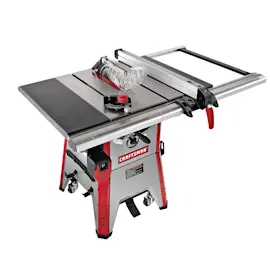
Craftsman table saws can be a good value for DIY and homeowner projects when they’re set up carefully and used within their intended capacity. For the Craftsman CMXETAX69434502 specifically, it’s a portable 10-inch, 15-amp saw designed for common cuts in wood and wood-composite materials, with built-in safety features like a riving knife, blade guard, and anti-kickback pawls.
What “good” means for the CMXETAX69434502
This model is a practical choice when you prioritize portability, basic ripping and crosscutting, and straightforward adjustments over cabinet-saw precision.
Strengths you can expect
- Solid capability for typical home-shop cuts (rip, crosscut, miter, bevel, compound)
- Standard 10-inch blade size and common jobsite-saw format
- Safety system designed around riving knife, blade guard, and anti-kickback pawls
- Dado capability up to 1/2 inch with the correct accessories
Limitations to plan for
- Like many portable saws, accuracy depends heavily on fence alignment and setup
- Lightweight saws can vibrate if not mounted securely
- Best results require routine cleaning and periodic alignment checks
Setup checklist that makes the biggest difference
We see the best performance when owners treat setup and alignment as part of normal use. Use the procedures in the CMXETAX69434502 instruction manual.
- Mount the saw firmly to a stable bench or stand (never operate on the floor)
- Confirm the rip fence is parallel to the blade before ripping
- Verify 0° and 45° bevel stops if cuts are not square
- Set blade height so teeth clear the workpiece about 1/8 to 1/4 inch
- Use dust collection and clean sawdust buildup under the insert and inside the cabinet
Quick “fit check”: is this saw right for your work?
| If you mostly do… | CMXETAX69434502 fit | Why |
|---|---|---|
| DIY shelving, trim, plywood breakdown | Good | Portable power and common cut types |
| Framing lumber and general construction cuts | Good | 15A motor and jobsite format |
| Fine furniture joinery with tight tolerances | Fair | Requires careful tuning and technique |
| Heavy daily production work | Not ideal | Portable saws are not built like cabinet saws |
Why it matters
A table saw’s “goodness” is usually about repeatable accuracy and safe control. On the CMXETAX69434502, keeping the fence aligned, using the riving knife and guard for through-cuts, and preventing kickback are what protect both your cut quality and your hands.
For more safety fundamentals, follow our how to use a table saw safely guide.
Last updated: January 2026