Owner’s manual
 Error Codes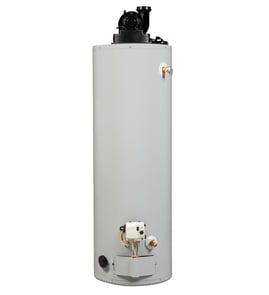



What is the average cost of a 50 gallon gas water heater?
For a 50-gallon natural gas water heater like Kenmore model 153332050, the tank itself typically runs about $600 to $1,200+, and the installed total commonly lands around $900 to $3,100+ depending on venting type, code upgrades, and labor. For model-specific specs (50-gallon, natural gas, 40,000 BTU), see the owner's manual.
- Venting type: power-vented units (like this model family) usually cost more to replace than basic atmospheric-vent models.
- Installation complexity: tight spaces, long vent runs, or condensate routing can add labor.
- Code and safety updates: shutoff valve, sediment trap, expansion tank, drip pan, or seismic strapping (region-dependent).
- Tank quality and warranty tier: longer warranty models generally cost more.
- Disposal and haul-away: often added as a line item.
| Cost item | Common range | What it covers |
|---|---|---|
| Water heater unit (50-gal gas) | $600 to $1,200+ | Tank, gas control, basic fittings included by manufacturer |
| Professional installation | $300 to $1,900+ | Labor, venting adjustments, gas and water connection work |
| Total installed cost | $900 to $3,100+ | Unit plus labor plus common materials and upgrades |
This model is a 50-gallon natural gas unit with a 40,000 BTU/hr input and is part of a power-vented design family; those details can affect replacement cost because venting and blower-related work can add time and materials.
If you are budgeting for repair versus replacement, a few higher-impact parts for this model include the water heater gas valve and temperature control assembly 100110774 and the water heater exhaust vent blower assembly 100109785.
Knowing whether you have a standard-vent or power-vent setup helps you estimate labor and parts more accurately, and it prevents surprises if vent pipe sizing, condensate handling, or gas piping updates are needed.
Last updated: February 2026
How do I tell if my water heater thermostat is bad?
If your Kenmore 153332050 gas water heater has no hot water, water that is suddenly too hot, or temperature swings at the tap, the thermostat or gas valve temperature control can be failing. Use the indicator lights and temperature buttons to confirm the setting, then troubleshoot safely using the steps in the owner's manual.
- Water is scalding hot even when the setting is low.
- Water is too cool or you run out of hot water unusually fast.
- Temperature swings from hot to cold during a shower.
- The heater has slow recovery (takes much longer to reheat).
- You notice condensate dripping on the burner or unusual burner behavior tied to temperature changes.
- The temperature setting seems to change or not respond when you press the buttons.
This model uses a “sleep” mode for the temperature indicators. To verify the thermostat setting:
- Press and hold COOLER and HOTTER together for about 1 second to “wake” the display.
- Press COOLER to lower or HOTTER to raise the setting.
- Remember that point-of-use temperature can vary; the manual notes it can vary by up to about 30°F at the faucet depending on conditions.
| Indicator | Approx. temp | What it means |
|---|---|---|
| WARM | ~80°F | Minimal heating |
| • | ~120°F | Common safer setting |
| A | ~130°F | Hotter water |
| B | ~140°F | Very hot |
| C | ~150°F | Scald risk |
| C (flashing) | ~160°F | Extreme scald risk |
- Set the temperature to a safer level (many homes target about 120°F).
- If the unit will not operate normally, follow the shutdown steps in the manual; do not attempt to light the burner by hand.
- If you suspect overheating, check that the temperature-pressure relief valve discharge is unobstructed and operating correctly; replace it if it will not reset after testing.
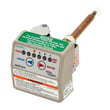
- If replacement is needed, the temperature control is typically part of the gas valve assembly on many gas water heaters; for this model, check the water heater gas valve and temperature control assembly 100110774.
A thermostat problem is not just a comfort issue. Overheating increases scald risk, and poor temperature regulation can waste gas and shorten component life (burner, igniter, and safety controls).
Last updated: February 2026
What is the most common problem with a gas water heater?
The most common gas water heater problem is loss of heat because the burner system is not firing reliably (often tied to ignition or safety shutoff). On Kenmore model 153332050, nuisance shutdowns can also happen if the flammable vapor sensor detects vapors and the heater stops operating; the troubleshooting steps are in the owner's manual.
- No hot water at all
- Hot water runs out faster than normal
- Water temperature swings from hot to lukewarm
- Pilot or ignition will not stay on (or the burner will not light)
- Small drips from the temperature and pressure relief valve
We see these issues most often on gas water heaters like the Kenmore 153332050:
- Ignition or burner issue: dirty burner, restricted air intake, or a failing igniter.
- Safety shutdown from flammable vapors: this model uses a flammable vapor (FV) sensor; if vapors are detected, the unit shuts down until the condition is corrected.
- Thermal expansion or high water pressure: can cause the temperature and pressure relief valve to weep.
- Sediment buildup: reduces efficiency and recovery.
- Vent/condensation concerns: poor venting can cause moisture and performance problems.
| Symptom | Most likely area | Example part for this model |
|---|---|---|
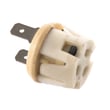
| Burner will not light | Ignition system | Water heater burner igniter assembly 100110771 |
| Weak/rough burner flame | Burner and air/fuel path | Water heater burner 100109206 or water heater burner orifice 100110763 |
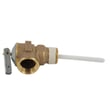
| Drips at relief outlet | Pressure/expansion | Water heater temperature and pressure relief valve 100108279 |
A gas water heater that is not lighting consistently wastes fuel and can leave you without hot water. A relief valve that drips or a shutdown caused by flammable vapors is also a safety signal that the underlying condition (pressure, vapors, venting, or combustion air) needs attention.
- Turn the gas control to OFF before inspecting the burner area.
- Never turn gas ON until the tank is completely full and water flows from a hot faucet.
- Keep gasoline, solvents, and other flammables away from the water heater area.
Last updated: February 2026
What is the average lifespan of a 50 gallon hot water heater?
A 50-gallon gas water heater typically lasts 8 to 12 years. For your Kenmore 153332050, regular maintenance (especially checking the anode rod and safety valve) helps you reach the upper end of that range; details and intervals are in the owner's manual.
Most water heaters fail sooner when corrosion and sediment build up, or when key safety and protection parts are neglected.
Common factors that shorten or extend service life:
- Water chemistry and conductivity (drives corrosion rate)
- How often sediment is flushed from the tank
- Anode rod condition and replacement history
- Temperature setting (higher temps increase stress and scaling)
- Proper combustion air and venting for a gas water heater
The manual for this model calls out two big items that directly impact longevity and safety.
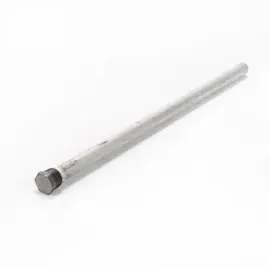
- Inspect and replace the anode rod as needed; replacing a depleted anode rod can extend tank life (the manual recommends at least annual checks after the warranty period, done by a qualified technician).
- Manually operate the temperature-pressure relief valve at least once a year to help confirm it opens and resets properly.
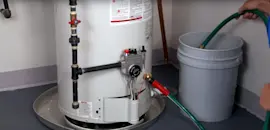
- Flush sediment periodically to reduce rumbling, slow heating, and premature tank wear.
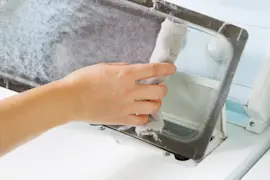
- Keep the air intake screen clean so the burner gets proper airflow.
If you are doing maintenance or troubleshooting, these are common wear items for this model:
| What it does | Part to look for | When it matters |
|---|---|---|
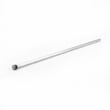
| Protects the tank from corrosion | Anode rod 100108260 | Rusty water, older heater, routine maintenance |
| Prevents dangerous overpressure/overtemperature | Water heater temperature and pressure relief valve 100108279 | Dripping from discharge pipe, annual safety check |
| Helps keep combustion air flowing | Water heater air intake screen 100109216 | Poor combustion, sooting, ignition issues |
Once a tank starts leaking internally, it is not a repairable part. Staying on top of corrosion protection (anode rod) and basic upkeep helps you avoid sudden loss of hot water and unplanned replacement.
Last updated: February 2026
What are the parts on a gas water heater?
On the Kenmore 153332050 gas water heater, the main parts include the tank connections (cold inlet and hot outlet), safety devices (temperature-pressure relief valve), combustion and venting components (burner, igniter, flue, blower), and service parts like the drain valve and anode rod. For the full labeled diagram, use the owner's manual.
These are the most common components called out for Kenmore 153332050 gas models:
- Cold water inlet and inlet dip tube
- Hot water outlet
- Anode rod (corrosion protection)
- Temperature-pressure relief valve (T&P valve)
- Gas valve and thermostat (gas control)
- Burner assembly (burner, burner tube, burner orifice, igniter)
- Flue and flue baffle (heat transfer and venting)
- Blower assembly and vent pipe (on power-vent style units)
- Drain valve (for draining and flushing)
- Air intake screen (combustion air)
If you are troubleshooting leaks, poor heating, ignition problems, or maintenance, these model-matched parts are commonly involved:
- Water heater temperature and pressure relief valve 100108279
- Anode rod 100108260
- Water heater gas valve and temperature control assembly 100110774
- Water heater burner igniter assembly 100110771
- Water heater air intake screen 100109216
| Part | What it does | Common symptom when it fails |
|---|---|---|
| Anode rod | Helps prevent tank corrosion | Rusty water, faster tank wear |
| T&P relief valve | Releases excess pressure/temperature | Dripping or discharge from relief line |
| Gas valve/thermostat | Regulates gas flow and water temp | No heat, unstable temperature |
| Igniter/burner parts | Lights and sustains the flame | No ignition, short cycling |
| Drain valve | Lets you drain/flush sediment | Won’t drain, leaks at valve |
Knowing the major parts helps you match symptoms to the right repair. For example, a steady drip from the discharge pipe points to the T&P relief system, while “no hot water” often involves the gas control, igniter, or burner airflow (air intake screen).
Last updated: February 2026