Error Codes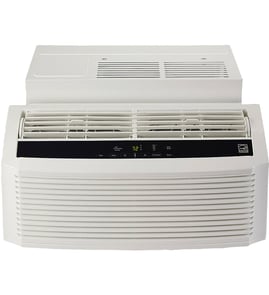




How big of a room will a 12,000 BTU air conditioner cool?
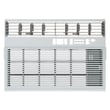
A 12,000 BTU room air conditioner like the GE AHY12LZW2 typically cools about 450 to 550 sq. ft. in average conditions (8 ft ceilings, decent insulation, normal sun exposure). If your space is hotter, sunnier, or poorly insulated, plan for less coverage.
Quick sizing guide (12,000 BTU)
Use this as a practical starting point for most rooms:
- 450 to 550 sq. ft.: typical target range
- 400 to 450 sq. ft.: better fit for very sunny rooms, top-floor rooms, or humid climates
- 550 to 650 sq. ft.: possible only with excellent insulation, shade, and limited heat sources
- Open floor plans: size for the full connected area, not just one section
- High ceilings: treat the room as larger because there is more air volume to cool
What changes the real-world room size
These factors decide whether your AHY12LZW2 feels “just right” or undersized:
| Room condition | What to expect | What to do |
|---|---|---|
| Strong afternoon sun, big windows | Cooling capacity feels smaller | Use blinds/curtains; consider a higher BTU if comfort is poor |
| Poor insulation or air leaks | Longer run times, uneven temps | Seal gaps; close doors; weatherstrip |
| Kitchen nearby or many occupants | Extra heat load | Expect reduced coverage |
| High humidity | Slower comfort, more run time | Use “Cool” with a lower fan speed; keep filter clean |
Why it matters
Right-sizing prevents short cycling (too large) and nonstop running (too small). A properly sized 12,000 BTU unit cools faster, controls humidity better, and reduces strain on the compressor.
Keep performance up (often fixes “not cooling enough”)
Before assuming you need more BTUs, we recommend these basics:
- Clean or replace the air filter; a clogged filter is a top cause of weak airflow (see room air conditioner air filter WJ85X24905).
- Make sure the front grille and intake are not blocked by furniture or curtains.
- Confirm the unit is level and the room is closed off as much as possible.
- Use a reasonable set temperature (for example, 72 to 76°F) and give it time to pull humidity down.
Last updated: February 2026
How much does it cost to run a 12000 BTU air conditioner all day?
Running a 12,000 BTU room air conditioner like the GE AHY12LZW2 for 24 hours typically costs about $2 to $6 per day, depending on the unit’s wattage, how hard it runs (duty cycle), and your electric rate (cents per kWh).
Quick way to estimate your daily cost
Use this formula:
- Daily cost = (Watts ÷ 1000) × Hours × Electric rate ($/kWh)
- If you only know BTUs, a common shortcut is watts ≈ BTU ÷ EER (many window units land around 9 to 12 EER).
Typical examples (12,000 BTU class)
Most 12,000 BTU window units draw roughly 900 to 1,400 watts while the compressor is running.
| Assumption | Example value | 24-hour energy use | Cost at $0.15/kWh |
|---|---|---|---|
| Lower draw | 900 W | 21.6 kWh | $3.24 |
| Higher draw | 1,400 W | 33.6 kWh | $5.04 |
What changes the cost the most
- Duty cycle: On mild days the compressor cycles off; on hot days it can run nearly nonstop.
- Thermostat setting: Lower setpoints increase runtime.
- Dirty air filter: Reduced airflow makes the system run longer and can raise cost.
- Room heat load: Sun exposure, poor insulation, cooking, and extra people add heat.
- Fan speed and mode: “Cool” with high fan often uses more than “Eco” style modes.
Why it matters
A small efficiency issue (like restricted airflow) can add hours of compressor runtime per day, which is usually the biggest driver of operating cost for a room A/C.
A simple cost-saving maintenance step
If airflow seems weak or the unit runs constantly, check and clean or replace the filter. For this model, the correct replacement is the room air conditioner air filter WJ85X24905.
Last updated: February 2026
How do I find the model number on my AHY12LZW2?
The model number for your GE room air conditioner is printed on a rating label on the unit. On AHY12LZW2 models, you will typically find it behind the front grille or on the side of the cabinet near the power cord area.
Where to look on a GE room air conditioner
Check these common label locations (use a flashlight):
- Behind the front panel or intake grille (often near the air filter)
- Along the side of the cabinet, visible when the unit is slid out of the window sleeve
- Near the power cord entry point or on the lower right side of the unit
- On the back of the cabinet (less common for window units)
If you remove the front panel to look, handle the grille tabs gently to avoid cracking the plastic.
What the label should show
Most GE rating labels include several identifiers. Use the model number for parts lookup.
| Label item | What it’s used for | Example you may see |
|---|---|---|
| Model number | Correct parts and diagrams | AHY12LZW2 |
| Serial number | Production run identification | Varies |
| Electrical ratings | Outlet and circuit requirements | Volts/amps |
Why it matters
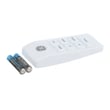
GE can use similar-looking room A/C designs across multiple model numbers, and small differences affect fit and electrical compatibility. Confirming AHY12LZW2 helps ensure you order the right items, such as the room air conditioner air filter WJ85X24905 or the remote contr WJ26X27734.
Quick tips if the label is hard to read
- Wipe dust off the label with a dry cloth first
- Take a close-up photo and zoom in
- Copy the model number exactly, including letters and numbers
Last updated: March 2026