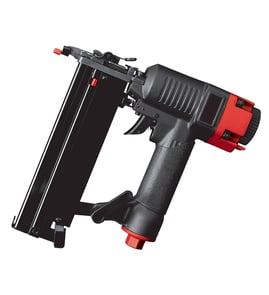

What is better, a brad nailer or a pin nailer?
A brad nailer is better when you need real holding power for trim and light assembly; a pin nailer is better when you need nearly invisible fasteners for delicate work or to hold pieces while glue dries. For the Craftsman 875184020 brad nailer, we recommend brads for most everyday fastening.
Quick comparison (what each tool is best at)
| Tool | Typical fastener | Best for | Holding power | Hole visibility |
|---|---|---|---|---|
| Brad nailer | 18-gauge brads (small head) | Baseboard, casing, small trim, light furniture | Medium | Small hole (usually needs filler) |
| Pin nailer | 23-gauge pins (headless) | Delicate trim, thin moldings, crafts, tacking parts during glue-up | Low | Nearly invisible |
Choose a brad nailer when
- You want the fastener to do most of the holding (not just the glue).
- You are installing trim that can get bumped (door casing, baseboard returns).
- You need better resistance to pull-out than a pin can provide.
- You can fill and touch up small nail holes.
Choose a pin nailer when
- You are working with very thin or fragile pieces that can split.
- You want the smallest possible hole for stain-grade work.
- You are “clamping” parts while wood glue sets.
- You are attaching tiny moldings where a brad head could show.
Why it matters
Using the wrong nailer usually shows up as split trim (too aggressive) or loose joints (not enough holding power). Matching gauge and head style to the material thickness gives cleaner results and fewer callbacks.
Helpful tip for parts and model matching
When you are shopping for nails, nose pieces, or other accessories, match them to your exact model number (Craftsman 875184020) so the gauge and fit are correct. If you need help confirming the model tag location, use how to find your appliance model number (and what it means for parts).
Last updated: February 2026
Why is my pin nailer not firing?
If your Craftsman 875184020 brad nailer runs or clicks but won’t fire a nail, the most common causes are a fastener jam, an empty or misloaded magazine, a safety nose that is not fully depressed, or low power/air supply (depending on your nailer type). Fixing the feed path and safety contact usually restores firing.
Quick checks that solve most no-fire problems
- Remove the battery or disconnect the air hose before inspecting the tool.
- Confirm the magazine is loaded with the correct gauge and length nails, and the strip is seated flat.
- Clear a jam at the nose/driver channel; even a small bent pin can stop the driver.
- Press the contact safety firmly against the workpiece; if it is not fully depressed, the trigger will not fire.
- Check for debris in the magazine rails and nose; clean and re-test.
- If it’s pneumatic, verify adequate air pressure and that the coupler is fully connected.
Step-by-step: clear a jam and restore feed
- Power off (battery out or air disconnected).
- Open the nose/jam-release (if equipped) and remove any bent fastener.
- Slide the magazine open and remove the nail strip.
- Inspect the driver blade area for chips, pitch, or a broken fastener head.
- Re-load nails, close the magazine, then test-fire into scrap.
Why it matters
A jam or a safety contact that is not moving freely prevents the driver blade from completing its stroke. Repeated dry-firing can also accelerate wear on internal seals and the driver assembly.
Symptom-to-cause guide
| What you notice | Most likely cause | What to do |
|---|---|---|
| Motor/click sound, no nail | Jam in nose/driver channel | Clear jam; clean feed path |
| Trigger does nothing | Safety nose not depressed | Check contact safety movement |
| Nails feed inconsistently | Wrong nails or dirty rails | Use correct nails; clean rails |
| Fires once, then stops | Nail strip binding | Re-seat strip; inspect magazine |
If it still won’t fire
At that point, the issue is typically internal (worn driver, damaged safety linkage, leaking seals on pneumatic models, or an electrical fault on cordless models). Use the parts list for model 875184020 to match the correct replacement components, or search by model on Sears PartsDirect.
Last updated: February 2026
Can I use a 16 gauge nailer for trim?
Yes, a 16-gauge finish nailer works well for many trim jobs when you need maximum holding power (thick baseboards, large casing, or hardwood). Your Craftsman model 875184020 is an 18-gauge brad nailer, so it’s intended for lighter trim and smaller nail holes, not 16-gauge nails.
What this means for Craftsman 875184020
An 18-gauge brad nailer like the Craftsman 875184020 is a strong choice for most interior trim where appearance matters.
- Use it for: base shoe, quarter round, smaller casing, light crown, and decorative trim
- Avoid it for: very thick or heavy trim that needs extra bite into framing
- Pair with glue for: small returns and delicate pieces
- Reduce splitting: set depth carefully and keep the nose square to the work
Quick gauge comparison for trim
| Gauge | Typical use | Hole size | Holding power |
|---|---|---|---|
| 16-gauge finish | Thick trim, heavier casing, hardwood | Larger | Highest |
| 18-gauge brad | Most interior trim, lighter moldings | Smaller | Medium |
| 23-gauge pin | Delicate trim, tiny returns (with glue) | Smallest | Lowest |
Nail length guidance
Choose the shortest nail that still grabs solid wood behind the trim.
- Light trim: 1-1/4 in. to 1-1/2 in.
- Standard casing: 1-1/2 in. to 2 in.
- Thick baseboards: often better with 16-gauge and longer nails
Why it matters
Using the right gauge prevents loose trim and reduces visible filling and touch-up. If you already own the Craftsman 875184020, it’s best for clean-looking trim work where smaller holes are the priority.
For general DIY safety practices before tool work, follow are diy appliance repairs safe.
Last updated: February 2026