 Owner’s manual

Are Craftsman tool boxes made in China?
Yes, many Craftsman tool boxes and tool storage products are made in China, and Craftsman also uses other manufacturing locations depending on the specific product line and production run. For your Craftsman rolling tool cart model 706379820, the most reliable way to confirm country of origin is to check the product label and the documentation in the owner's manual.
How to confirm where your 706379820 tool cart was made
Look for the country-of-origin marking in these common places:
- The rating/ID label on the back panel or inside a drawer
- A label near the caster mounting area on the bottom
- The carton label (if you still have the original packaging)
- The assembly hardware bag label (sometimes lists sourcing)
- The first pages of the manual or warranty paperwork
What “made in” can mean for tool storage
Tool storage products often have multiple sourced components (steel body, drawer slides, casters, locks). Because of that, the marking you see may vary.
| Marking you see | What it typically indicates | What to do next |
|---|---|---|
| “Made in China” | Final assembly and manufacturing occurred in China | Match parts and hardware by model 706379820 |
| “Made in USA” | Final assembly occurred in the United States | Still use model 706379820 for parts fit |
| “Assembled in …” | Assembly location is listed; parts may be globally sourced | Use the label plus manual diagrams |
| No clear marking | Label may be on packaging or inside a drawer | Check manual and inspect all panels |
Why it matters
Country of origin does not change which replacement parts fit. The model number (706379820) is what determines correct drawer slide style, lock hardware, caster type, and fastener sizes when you are maintaining or repairing the cart.
Last updated: February 2026
How to identify old Craftsman tools?
To identify old Craftsman tools, we look at the markings stamped into the metal (logos, country of origin, and any code numbers) and compare those to known Craftsman eras. For tools stored in a Craftsman 706379820 rolling tool cart, the cart model does not date the tools; the tool stampings do.
Quick checks that usually date a Craftsman tool
- Logo style: older tools often have distinct logo formats compared to modern laser-etched marks.
- Country of origin: look for “USA” or another country stamp; this is one of the fastest clues.
- Forging and finish details: older wrenches and sockets often show different knurling, panel shapes, and font styles.
- Part or series markings: some lines used lettered series marks (for example, early “C-series” style markings on certain tools).
- Any number code on the tool: some Craftsman tools include a maker or production code that helps narrow the era.
Where to look for the identifying marks
Most Craftsman hand tools hide the best clues in consistent places:
- Wrenches: along the shank (handle), near the open end, or near the box end
- Sockets: on the side wall near the drive end
- Ratchets: on the head, selector area, or handle
- Screwdrivers: on the shaft or molded handle
- Pliers: on one or both handles near the pivot
Common markings and what they typically mean
| Marking you see | What it usually tells us | What to do next |
|---|---|---|
| “USA” stamp | Often indicates older U.S.-made production | Compare logo style and font to narrow the decade |
| Older logo format (stamped/forged) | Typically earlier production than laser etching | Use the logo plus country stamp together |
| Code-like numbers/letters | Can point to the maker or a production run | Record the full code exactly as stamped |
Why it matters
Correctly identifying the era and maker helps you match replacement pieces (like a missing socket size), evaluate compatibility with other sets, and decide whether a tool is worth restoring (cleaning, de-rusting, re-lubricating) versus replacing.
Use the manual for cart-specific identification
If you are trying to identify the rolling tool cart itself (not the tools), use the owner's manual for Craftsman 706379820 to confirm the cart’s assembly details and hardware.
Last updated: February 2026
How to unlock Craftsman tool chest drawers?
On the Craftsman 706379820 rolling tool cart, drawers typically unlock by using the keyed lock (if equipped) and fully releasing the drawer slide latches. If the drawers feel “locked” without a key issue, the slides are usually jammed or the internal latch is not fully resetting; re-seating the drawer fixes it most often. See the owner's manual for your cart’s exact lock and drawer removal steps.
Quick checks before you force anything
- Confirm the lock cylinder is in the unlock position and the key turns fully
- Pull the drawer straight out evenly (don’t lift the handle side)
- Check for a tool or liner edge caught between the drawer and frame
- Try a different drawer; one jammed drawer can make the cabinet feel “locked”
- If the cart has a drawer retention lever, make sure it is not partially engaged
How to free a stuck or “locked” drawer (common method)
- Empty the top drawer (or the drawer that opens) to reduce weight and binding.
- With the drawer centered, pull outward while gently wiggling left to right.
- If it still won’t release, open a neighboring drawer and look along the slide area for a latch tab or lever.
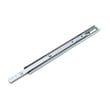
- Press the slide latches (one side usually goes up, the other side goes down) and pull the drawer out.
- Reinstall the drawer by aligning slides and pushing in until both sides click.
Drawer slide latch directions (typical)
| Slide side | Typical latch motion | What it does |
|---|---|---|
| Left slide | Push up | Releases the slide lock |
| Right slide | Push down | Releases the slide lock |
Why it matters
Forcing a jammed drawer can bend the drawer box, damage ball-bearing slides, or knock the cabinet out of square. A quick latch release and re-seat keeps the tool cabinet rolling smoothly and the lock working correctly.
Last updated: February 2026