Error Codes






Do all room air conditioners need to be vented outside?
Most room air conditioners must vent heat outside to actually cool the room. For the GE APWD07JASGG1 portable room A/C, cooling mode requires an exhaust path (typically a window kit and hose); otherwise the unit will recirculate warm air and feel ineffective.
Quick rule: cooling vs. dehumidifying
- Cooling mode: must exhaust hot air outdoors (venting required)
- Dehumidifier (dry) mode: can run without venting, but it typically adds heat to the room
- Fan-only mode: no venting needed, but it does not cool
- Heat pump/heat mode (if equipped): may have different venting needs, but portable units still usually exhaust
What “vented outside” means for portable vs. window units
| A/C type | Needs outside venting to cool? | How it vents | What happens if not vented |
|---|---|---|---|
| Window A/C | Yes | Back of unit dumps heat outdoors | Won’t install or operate correctly |
| Portable A/C (single hose) | Yes | Exhaust hose to window | Room warms up, weak cooling |
| Portable A/C (dual hose) | Yes | One intake hose, one exhaust hose | Poor performance, higher humidity |
Best setup for APWD07JASGG1 portable A/C
For reliable cooling performance, we recommend:
- Install the window venting components and seal gaps around the window panel
- Keep the exhaust hose as short and straight as possible
- Clean or replace filters regularly to maintain airflow
- Use a dedicated outlet (avoid long extension cords)
Helpful parts commonly used for venting and airflow:
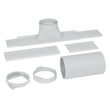
- Portable ac window kit RAP01
- Haier portable ac dual hose kit RAP02
- Upper filter WJ85X27854
- Lower filter WJ85X27855
Why it matters
A portable A/C removes heat from your room and must dump that heat somewhere. If the heat is not exhausted outdoors, the unit ends up fighting itself, which increases run time, reduces comfort, and can raise indoor humidity.
Last updated: January 2026
How many square feet will a 7500 BTU air conditioner cool?
A 7,500 BTU air conditioner typically cools about 250 to 320 square feet in average conditions. For a GE portable unit like model APWD07JASGG1, real coverage depends most on insulation, sun exposure, ceiling height, and how well the exhaust is sealed at the window.
Typical coverage guidelines for 7,500 BTU
Use these as practical targets when sizing a room air conditioner:
- 250 to 320 sq. ft. for an average bedroom or small living room
- Closer to 250 sq. ft. for sunny rooms, poor insulation, or high ceilings
- Closer to 320 sq. ft. for shaded rooms, good insulation, and standard 8 ft ceilings
- Portable A/Cs often feel less “punchy” than window units if the window kit leaks warm air
Quick sizing table
| Room conditions | Expected coverage for 7,500 BTU |
|---|---|
| Shaded, well insulated, 8 ft ceiling | 300 to 320 sq. ft. |
| Average conditions | 270 to 300 sq. ft. |
| Sunny, warm upstairs, or drafty | 230 to 270 sq. ft. |
What to check if it is not cooling the expected area
If your APWD07JASGG1 struggles to keep up, these fixes usually help more than upsizing immediately:
- Clean or replace the air filters (check the upper filter WJ85X27854 and lower filter WJ85X27855)
- Make sure the window kit is tight and sealed so hot outdoor air is not leaking in
- Keep the exhaust hose as short and straight as possible
- Close doors to isolate the space you are cooling
- Use a fan to circulate air and reduce hot spots
Why it matters
Correct BTU sizing prevents constant running, poor humidity removal, and uneven temperatures. A properly sized portable room A/C cools faster, cycles normally, and keeps the room more comfortable.
Last updated: January 2026
Is there any portable AC that doesn't need a window?
A true portable air conditioner like the GE APWD07JASGG1 must vent hot air to the outdoors, so it still needs a window, sliding door, or another exterior opening for an exhaust hose. If you cannot vent outside, the practical alternatives are an evaporative cooler or a dual-hose setup when you do have some way to vent.
What “no window needed” really means
Most products marketed as “windowless portable AC” fall into one of these categories:
- Evaporative cooler (swamp cooler): Uses water to cool air; works best in dry climates.
- Portable air conditioner (compressor-based): Must exhaust heat outdoors through a hose.
- Ventless “air cooler” fan: Moves air but does not remove heat like an AC.
Options if you do not have a standard window
If you can reach any exterior opening, you can usually make a portable AC work:
- Vent through a sliding patio door using a door panel kit
- Vent through a casement window using a custom insert
- Vent through a wall vent (only if you already have a suitable exterior vent)
- Use a dual-hose kit to improve efficiency and reduce negative pressure
For this GE portable unit, the most common venting accessories are the portable ac window kit RAP01 and the haier portable ac dual hose kit RAP02.
Quick comparison
| Cooling option | Needs outdoor venting? | Best use case |
|---|---|---|
| Portable air conditioner | Yes | Humid climates, strong cooling needed |
| Dual-hose portable AC setup | Yes | Better efficiency, steadier cooling |
| Evaporative cooler | No | Dry climates, moderate cooling |
Why it matters
A compressor-based portable AC removes heat from the room and has to dump that heat somewhere. Without venting, the unit will add heat back into the space and performance will drop fast.
Last updated: January 2026