 Owner’s manual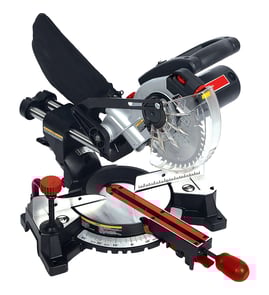

Can I cut a 4x4 with a 10 inch miter saw?
Yes, you can cut a 4x4 (actual size about 3-1/2 in. x 3-1/2 in.) with a 10-inch miter saw like the Hitachi C10FCE2, but whether it cuts in one pass depends on the saw’s max cut capacity and how the board is positioned. For many 10-inch non-sliding saws, a single-pass 90-degree cut on a 4x4 is right at the limit.
A 4x4 is thick enough that some 10-inch miter saws will not fully clear it in one straight chop.
- Best case: one clean pass at 90 degrees with the 4x4 flat on the table and tight to the fence
- Common case: you get close, but a small uncut “hinge” remains at the bottom
- Workaround: flip the 4x4 and finish the cut from the other side (same miter setting)
- If cutting at angles: capacity drops, so a flip-cut is even more likely
- If the wood is wet or twisted: it can pinch the blade and reduce cut quality
We recommend this method when the saw will not fully cut through in one pass.
- Mark your cut line on all four faces of the 4x4.
- Make the first cut slowly, keeping the board firmly against the fence.
- Lift the blade, wait for it to stop, then rotate the 4x4 180 degrees (end-for-end or face-to-face) to align the line.
- Make the second cut to meet the first kerf.
- Use a sharp 10-inch crosscut/finish blade (not a ripping blade)
- Support long stock so it stays flat on the table
- Keep hands well away from the blade path; use clamps when practical
- Let the blade reach full speed before entering the cut
These are typical ranges for 10-inch miter saws; confirm the exact capacity for your saw in the owner's manual.
| Saw type | Typical max cut at 90 degrees | 4x4 in one pass? |
|---|---|---|
| 10-inch non-sliding miter saw | ~3 to 3-1/2 in. | Sometimes, often borderline |
| 10-inch sliding miter saw | Often 3-1/2 in. or more | Usually |
| 12-inch sliding miter saw | Often more than 3-1/2 in. | Yes, with more margin |
Trying to force a too-thick cut can cause burning, wandering cuts, or binding. Using the flip-cut method keeps the board stable and helps you get a square, repeatable cut without overloading the saw.
Last updated: February 2026
How to unlock hitachi C10FCE2 miter saw?
To unlock a Hitachi C10FCE2 miter saw, we release the head-lock (down-lock) pin that holds the saw arm in the lowered position for storage and transport. With the saw unplugged, press the handle down slightly to take pressure off the pin, then pull the pin out and let the head rise slowly.
- Unplug the saw and remove any workpiece from the table.
- Hold the handle and push the saw head down about 1/4 to 1/2 inch.
- Pull the head-lock (down-lock) pin outward.
- Slowly let the saw head lift to the up position under control.
- If the pin will not move, wiggle the handle slightly up and down while pulling the pin.
Most “stuck” lock pins are just under load or have sawdust packed around the mechanism.
- Blow or brush sawdust away from the pivot area and the pin.
- Add a small amount of light machine oil to the pin area, then work the handle up and down.
- Check that the saw is not binding at full down travel (nothing caught between the guard and fence).
- If the pin is bent or the head will not rise smoothly, stop and inspect before forcing it.
| Lock type | What it does | Typical location |
|---|---|---|
| Head-lock (down-lock) pin | Holds the saw head down for storage | Near the hinge/pivot at the rear |
| Miter lock | Locks left/right table rotation | Front of the base |
| Bevel lock | Locks tilt angle | Rear or side of the pivot |
Releasing the head-lock pin correctly prevents sudden spring-up of the saw head and helps avoid damage to the blade guard, pivot, and locking hardware.
For model-specific diagrams and safety notes, follow the procedure shown in the owner's manual.
Last updated: February 2026
What is the rpm of Hitachi C10FCE2?
The Hitachi C10FCE2 miter saw runs at about 5,000 RPM (no-load blade speed). This is the typical rated speed you use for comparing performance; actual cutting speed can vary with blade type, material, and feed rate.
- Crosscuts in framing lumber: Higher RPM helps produce cleaner cuts
- Finish trim and molding: Pair RPM with a sharp, fine-tooth blade for best results
- Hardwoods: Maintain steady feed pressure to avoid bogging the motor
- Blade selection: A dull blade makes the saw feel slower even at the same RPM
| Item | What to expect | Why it changes |
|---|---|---|
| Rated no-load speed | ~5,000 RPM | Factory spec for the motor and gearing |
| Cutting speed under load | Lower than no-load | Dense wood, thick stock, fast feed rate |
| Cut quality | Improves with the right blade | Tooth count, sharpness, and alignment |
We recommend checking the rating label on the saw and the specifications section in the C10FCE2 owner's manual.
- Look for “no-load speed” or “RPM” in the specs
- Confirm you are reading the label for C10FCE2 (not a similar model)
- If you changed blades, verify the blade is rated for the saw’s operating speed
RPM is a key performance spec for a 10-inch compound miter saw because it affects cut smoothness and how easily the saw maintains speed in tougher materials. Matching the blade to the job usually improves results more than chasing a higher RPM number.
Last updated: February 2026