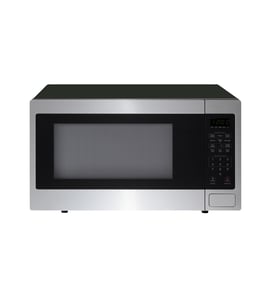

How much clearance for a countertop microwave?
For a Maytag VM12AB countertop microwave, we recommend leaving about 3 inches of clearance on the top and both sides, about 1 inch at the back, and keeping the front edge of the microwave at least 3 inches back from the counter edge. This airflow helps prevent overheating and nuisance shutoffs.
- Top: ~3 in.
- Left side: ~3 in.
- Right side: ~3 in.
- Rear: ~1 in.
- Front placement: set the unit 3 in. or more back from the counter edge to reduce tipping risk
| Area around microwave | Minimum clearance | What it helps prevent |
|---|---|---|
| Top | ~3 in. | Heat buildup, poor venting |
| Sides | ~3 in. | Restricted airflow |
| Back | ~1 in. | Pinched cord, blocked intake/exhaust |
| Front edge to counter edge | 3 in. or more | Accidental tipping |
Countertop microwaves pull cooling air in and exhaust warm air out through cabinet vents. If the vents are blocked by walls, cabinets, or tight shelving, the microwave can run hotter than intended, which can shorten component life and cause intermittent operation.
- Confirm the vents are not blocked by a backsplash, wall, or cabinet trim.
- Avoid placing items (paper towels, cookbooks) on top of the unit.
- Plug directly into a wall outlet (avoid extension cords).
- If the microwave is completely dead after a shutdown, check the internal fuse; the correct replacement for this model is the fuse WPM0805101.
For additional safety tips on placement and use, see never do these things with a microwave.
Last updated: February 2026
What are the parts inside a microwave?
A Maytag countertop microwave like model VM12AB is built from a few main systems: the high-voltage heating circuit (that creates microwave energy), the airflow and safety system, and the cooking cavity and drive parts (that move food and light the interior). For common service items, see parts like the fuse WPM0805101 and microwave bulb 8206232A.
- Magnetron: generates the microwave energy that heats food
- High-voltage section: transformer or inverter (varies by design), high-voltage capacitor, and high-voltage diode
- Cooling fan and air ducts: moves air to keep components from overheating
- Door interlock switches: safety switches that prevent operation with the door open
- Control board and keypad: runs cook programs, timing, and power levels
- Turntable system: turntable motor, coupler, and roller ring (design varies)
- Cavity light and lamp holder: lights the cooking area (service item: microwave bulb 8206232A)
| Part/system | What it does | Common symptom when it fails |
|---|---|---|
| Magnetron + high-voltage parts | Creates heat energy | Runs but does not heat, loud hum |
| Door switches | Safety shutoff | Won’t start, stops when door moves |
| Cooling fan | Prevents overheating | Shuts off mid-cycle, burning smell |
| Fuse | Protects from overload | Completely dead, no display |
Knowing which system is involved helps you avoid replacing the wrong part. For example, a dead unit often points to power supply protection (like a fuse WPM0805101), while “runs but won’t heat” usually points to the high-voltage heating circuit.
Microwaves contain high-voltage components that can store a dangerous charge even when unplugged.
- Unplug the microwave before any inspection
- Do not remove the outer cover unless you are trained
- If you smell burning or see arcing, stop using the unit
For symptom-based help, we use the troubleshooting steps in why is my microwave not heating.
Last updated: February 2026
What is the best brand countertop microwave to buy?
If you want the “best” countertop microwave brand, we recommend choosing based on how you cook: Panasonic is a top pick for even heating (inverter-style cooking), Toshiba is a strong value brand for everyday sensor cooking, and Breville is best when you want premium combo features like convection or air fry. For a Maytag countertop microwave like model VM12AB, the best choice is the one that fits your space, power needs, and daily use.
Focus on the features that change real-world results (not just wattage on the box):
- Even heating: inverter-style power control reduces hot and cold spots
- Sensor cooking/reheat: adjusts time automatically for common foods
- Interior size and turntable fit: matches your plates, bowls, and cookware
- Controls you will actually use: quick-start keys, add-30-seconds, clear display
- Noise and venting: quieter fans matter in open kitchens
- Serviceability: common wear parts (like a light bulb or fuse) should be easy to source
| Brand | Best for | What to look for | Typical tradeoff |
|---|---|---|---|
| Panasonic | Most even heating | Inverter models, strong reheat performance | Often higher price |
| Toshiba | Best overall value | Sensor cook, straightforward controls | Fewer premium build touches |
| Breville | Premium multi-function | Convection, air fry, combo cooking | Larger footprint, higher cost |
| Black+Decker (and similar budget brands) | Basic heating | Simple presets, compact sizes | More uneven heating, fewer sensors |
Match the basics first, then upgrade features:
- Measure your available counter space and clearance
- Choose a capacity that fits your largest dish (common range: 0.7 to 1.6 cu. ft.)
- Pick power that matches your cooking style (common range: 700 to 1200 watts)
- If your old unit had frequent “dead” symptoms, check your outlet and circuit health
“Best brand” usually means “best results for your habits.” Even-heating technology and sensor cooking reduce overcooked edges, cold centers, and repeat reheat cycles, which saves time and improves consistency.
If you are keeping your Maytag VM12AB running, common maintenance parts we see customers replace include the fuse WPM0805101 and microwave bulb 8206232A. For troubleshooting heating performance, our guide why is my microwave not heating helps you narrow down likely causes.
Last updated: February 2026
What is the thing inside a microwave called?
In a Maytag VM12AB countertop microwave, the main “thing inside” that creates microwave energy is the magnetron (a high-voltage vacuum tube). It converts electrical power into microwave radiation that heats food by exciting water molecules.
Depending on what you noticed (noise, light, heat, or a burning smell), customers often mean one of these components:
- Magnetron: generates the microwaves (heating power)
- Waveguide and waveguide cover: directs microwaves into the oven cavity
- Turntable motor and roller: rotates the tray for even heating
- Cooling fan: moves air to prevent overheating
- Cavity light bulb: lights the interior (see microwave bulb 8206232A)
If you are trying to identify a part based on a problem, start here:
| What you see | Most likely area | What we recommend first |
|---|---|---|
| Runs but does not heat | High-voltage system (magnetron, diode, capacitor) | Review why is my microwave not heating and stop using it if heating is inconsistent |
| Completely dead, no display | Power supply or safety fuse | Check the outlet, then inspect/test the fuse WPM0805101 |
| Interior is dark but heats | Light circuit or bulb | Replace the microwave bulb 8206232A |
| Sparks or burn marks | Waveguide cover or cavity damage | Follow how to repair arc or burn marks in a microwave video before running again |
Correctly naming the part helps you troubleshoot safely and order the right replacement for your Maytag VM12AB. For example, “not heating” points to the high-voltage section, while “no power” often points to a fuse or power connection.
Microwaves contain high-voltage components that can store a dangerous charge even when unplugged.
- Unplug the microwave before any inspection
- Do not remove the outer cover unless you are trained for high-voltage service
- If you suspect a high-voltage failure (no heat, burning smell, loud hum), stop using the unit
Last updated: February 2026


