 Owner’s manual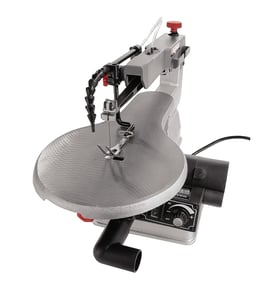

How do I change the blades on a scroll saw?
On the Craftsman 113236150 scroll saw, you change the blade by unplugging the saw, releasing blade tension, removing the blade from the upper and lower blade holders, then installing the new blade with the teeth facing down (it cuts on the downstroke) and re-tensioning it. See the 113236150 owner's manual for the exact steps and diagrams.
Safety first (do this every time)
- Turn the switch OFF.
- Unplug the power cord before touching the blade.
- Wait for all moving parts to stop.
- Keep fingers clear of the blade holders and clamps.
- Use the correct blade type for your setup (pin end vs plain end).
Blade change steps (pin end blades)
- Unplug the saw.
- Loosen blade tension by turning the tension knob counterclockwise about three full turns.
- Remove the blade from the blade holders:
- Push down on the upper arm to help free the blade.
- Release the blade pin from the lower blade holder, then remove it from the upper holder.
- Install the new blade:
- Make sure the teeth point down so it cuts on the downstroke.
- Seat the blade pins fully into the upper and lower holders.
- Re-tension the blade using the tension knob.
- Plug the saw back in and make a short test cut on scrap wood.
Quick checks after installing a new blade
- Blade direction: teeth down
- Blade seated: pins fully captured in both holders
- Tension: firm enough to prevent slipping, not so tight it snaps easily
| Symptom | Most likely cause | Fix |
|---|---|---|
| Blade breaks quickly | Too much tension or twisting the workpiece | Reduce tension slightly; feed slower and keep the cut straight |
| Saw won’t cut well | Teeth installed upside down or blade dull | Reinstall teeth down; replace blade |
| Blade slips out | Pins not seated or tension too loose | Reseat pins; increase tension |
Why it matters
This saw cuts on the downstroke, and scroll saw blades dull fast (often within 1/2 hour to 2 hours of cutting). Correct blade direction and proper tension improve cut quality, reduce burning, and help prevent blade breakage.
Last updated: February 2026
How do I know which scroll saw blade to use?
For the Craftsman 113236150 scroll saw, start by matching the blade to your material thickness and the tightness of the curves you need to cut. This model is set up for 5-inch pin-end blades, and finer, narrower blades are best for thin stock and tight-radius work.
Blade selection rules (what to choose and when)
- Thin material (1/4 inch or less): use a very fine, narrow blade for better control and tighter curves.
- Thicker wood (over 1/4 inch): use a wider blade so it tracks straighter and resists bending.
- Tight curves: choose a narrower blade; it turns in a smaller radius.
- Straighter cuts and larger curves: choose a wider blade; it stays more stable.
- Plywood: expect faster blade wear because plywood is abrasive; keep spare blades on hand.
- Material type: this saw is intended for wood, wood-like products, plastics, and non-ferrous metals; pick a blade designed for that material.
Quick guide: blade width vs. cut quality
| What you need | Blade style to favor | What to expect |
|---|---|---|
| Tight inside cuts, small radius | Narrow, fine-tooth | Best turning control; slower feed rate |
| General scrolling in thicker stock | Wider blade | Straighter tracking; larger turning radius |
| Cleaner bottom surface | Reverse-tooth style (if available in pin-end) | Reduced bottom tear-out |
| Faster sawdust clearing | Skip-tooth style | Smoother progress in softer woods |
Setup and use tips that prevent broken blades
- Install the blade so the teeth cut on the downstroke.
- Guide the work slowly; scroll saw teeth are small and remove material only on the downstroke.
- For best results, cut wood under 1 inch thick; if you cut thicker than 1 inch, feed very, very slowly and avoid twisting the blade.
- Replace blades often; typical sharp life is about 1/2 hour to 2 hours of cutting.
Why it matters
The right blade reduces burning, wandering cuts, and breakage. On the 113236150, choosing the correct blade width for thickness and curve radius is the fastest way to get accurate scroll work and longer blade life.
For blade type, installation, and tensioning details specific to this saw, follow the 113236150 owner's manual.
Last updated: February 2026
How thick of wood can a scroll saw cut through?
On the Craftsman 113236150 scroll saw, we typically get the best results cutting wood under 1 inch thick; it can cut thicker stock up to about 2 inches, but you must feed the work very slowly and use the right 5-inch pin-end blade for the material and curve radius (details are in the owner's manual).
Practical thickness guidelines (what to expect)
- Best quality cuts: under 1 inch thick (smoother cut, less blade deflection)
- Thicker cuts (over 1 inch): possible, but slow feed is required to avoid twisting or bending the blade
- Upper end for this saw: about 2 inches in wood and wood-like products when using an appropriate blade and patient feed rate
- Hardwoods vs. softwoods: hardwoods effectively reduce the “easy” thickness; expect slower cutting and more blade wear
- Blade choice matters: wider blades handle thicker stock better; narrow blades are for thin stock and tight curves
Blade and material notes for model 113236150
This model uses 5-inch long, pin-end type blades only. For safe, predictable cutting:
- Use fine, narrow blades for thin wood (around 1/4 inch or less) and tight-radius scrolling
- Use wider blades when cutting over 1/4 inch thick
- Replace blades often; worn teeth increase burning, wandering cuts, and breakage
- Cut on the downstroke; keep the work flat and guided steadily into the blade
Quick reference table
| Wood thickness | What you’ll see | Best approach |
|---|---|---|
| 1/8" to 1/4" | Tight curves, clean detail | Fine, narrow blade; moderate speed |
| 1/4" to 1" | Most common scroll-saw work | Match blade width to curve size |
| 1" to 2" | Slower cutting, more drift risk | Wider blade; very slow feed; avoid twisting |
Why it matters
Cutting beyond the “sweet spot” thickness increases blade deflection and heat, which leads to inaccurate cuts and frequent blade breakage. Staying under 1 inch when possible gives cleaner results and longer blade life.
Last updated: February 2026
What size blade for 16 scroll saw?
For the Craftsman 16-inch scroll saw model 113236150, use 5-inch long, pin-end scroll saw blades. This model is designed for pin-end blades only, so plain-end blades will not clamp correctly.
How to choose the right blade for your cut
Blade “size” usually means both the blade type (pin-end vs. plain-end) and the tooth pattern/width matched to material thickness.
- Use very fine, narrow blades for thin stock (about 1/4 inch thick or less) and tight curves.
- Use wider blades for thicker wood (over 1/4 inch thick) and straighter cuts.
- Feed thicker material slowly (especially over 1 inch thick) to avoid bending or twisting the blade.
- Replace blades often; dull teeth cause burning, wandering cuts, and breakage.
- Match the blade to the material (wood, plastics, and non-ferrous metals are typical for this saw).
Quick compatibility checklist (113236150)
| Item to match | What this saw needs | What to avoid |
|---|---|---|
| Blade length | 5 inch | Other lengths |
| Blade end type | Pin-end | Plain-end (pinless) |
| Blade width | Narrow for tight curves; wider for thicker stock | Too wide for tight curves |
Why it matters
Using the correct 5-inch pin-end blade helps the blade seat securely in the upper and lower holders, keeps tension stable, and improves cut accuracy. The wrong blade style can slip, break, or damage the blade clamping parts.
Where to confirm blade requirements
The blade type and general blade-selection guidance for model 113236150 are listed in the owner's manual.
Last updated: February 2026