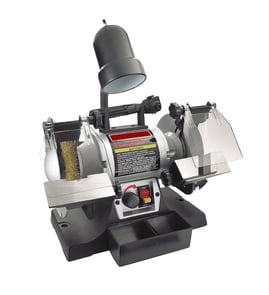

What is a Craftsman bench grinder?
A Craftsman bench grinder (including model 319190631) is a stationary power tool that spins abrasive wheels to grind, sharpen, deburr, and shape metal. It is commonly used for sharpening chisels and mower blades, cleaning up welds, and smoothing rough edges.
What you can do with a bench grinder
- Sharpen hand tools (chisels, plane irons, axes)
- Deburr cut metal after sawing or drilling
- Shape small metal parts and hardware
- Clean rust or scale using a wire wheel (if equipped)
- Touch up edges on lawn and garden tools
Key parts and features to know
Most Craftsman bench grinders share these core components:
| Feature | What it does | Why it matters |
|---|---|---|
| Grinding wheels | Remove material and sharpen edges | Wheel grit affects speed and finish quality |
| Tool rests | Support the workpiece at a stable angle | Helps control bevel angle and reduces chatter |
| Eye shields/spark guards | Deflect sparks and debris | Improves safety and visibility at the wheel |
| Motor and switch | Powers and controls the grinder | A weak motor or bad switch causes slow starts or stalling |
Safe, effective use tips
- Wear eye protection and keep guards adjusted close to the wheel.
- Let the wheel reach full speed before grinding.
- Use light pressure; forcing the tool overheats metal and can glaze the wheel.
- Grind in short passes and cool the workpiece often (especially tool steel).
- Stand slightly to one side at startup in case a wheel is damaged.
Why it matters
A bench grinder is one of the fastest ways to restore cutting edges and clean up metalwork, but it also demands correct setup (guards, tool rest gap, wheel condition) to keep results consistent and reduce risk.
For general DIY safety and what to expect when tackling repairs yourself, use our guide: are diy appliance repairs safe.
Last updated: February 2026
Do you have to bolt down a bench grinder?
You do not have to bolt down a bench grinder, but we strongly recommend mounting your Craftsman 319190631 bench grinder firmly to a solid workbench (or a dedicated stand). A secure mount prevents the tool from walking, improves control, and reduces the chance of the workpiece catching.
When bolting it down is the right choice
Bolting is the best option when you:
- Grind with moderate to heavy pressure
- Use wire wheels or buffing wheels (more vibration and side load)
- Need consistent, accurate bevels and edges
- Want the grinder to stay aligned with your work area
- Use the grinder frequently
If you cannot bolt it down
You can still stabilize the grinder, but treat these as temporary solutions:
- Clamp the base to the bench using two heavy-duty clamps
- Mount it to a thick plywood board, then clamp the board to the bench
- Add a rubber anti-vibration pad under the base (helps vibration, not “walking”)
- Move the grinder to a heavier, sturdier bench surface
Quick mounting checklist
Before you tighten anything, we use this checklist:
- Bench top is solid and does not flex
- Fasteners match the base holes (bolts with washers and lock nuts work best)
- Grinder sits flat with no rocking
- Wheels spin freely without contacting guards or tool rests
- Power cord is routed so it cannot snag the workpiece
Clamp vs bolt: what to expect
| Mounting method | Stability | Best for | Tradeoffs |
|---|---|---|---|
| Bolted to bench/stand | High | Frequent use, heavier grinding | Less portable |
| Clamped to bench | Medium | Occasional use, light grinding | Can shift over time |
| Unmounted | Low | Not recommended | Poor control, more risk |
Why it matters
A bench grinder that moves can pull the workpiece off the tool rest, chatter the wheel, and make it harder to keep a consistent angle. A firm mount improves safety and grinding results.
For more DIY safety guidance, use our are diy appliance repairs safe article.
Last updated: February 2026
What are the 4 important rules for a bench grinder?
For the Craftsman bench grinder model 319190631, the four most important rules are: wear proper eye and face protection, keep the grinder adjusted and guarded (including correct clearances), grind only on the wheel’s face (not the side), and start and stop safely (full speed before grinding; hands off until fully stopped).
The 4 rules (simple and practical)
- Protect yourself: Wear safety glasses plus a face shield; tie back long hair and avoid loose sleeves, gloves, and jewelry.
- Set the grinder up correctly: Keep guards in place; set the tool/work rest to 1/16 inch from the wheel, and set the spark arrestor to 1/8 inch from the wheel.
- Grind on the correct surface: Never grind on the side of a standard bench grinding wheel; use the wheel face unless the wheel is specifically rated for side grinding.
- Start and stop safely: Stand slightly to one side at startup, let the wheel reach full speed before grinding, and wait for the wheel to stop completely before adjusting, measuring, or walking away.
Quick setup checklist before you grind
- Inspect the wheel for cracks or damage before use
- Confirm the eye shield and guards are positioned correctly
- Verify clearances: tool rest 1/16 inch, spark arrestor 1/8 inch
- Use light pressure; let the abrasive do the work
- Keep the workpiece moving to reduce heat buildup and gouging
Common mistakes and the safer alternative
| Common mistake | Why it’s risky | Safer alternative |
|---|---|---|
| Tool rest gap too large | Work can wedge and kick back | Set tool rest to 1/16 inch |
| Spark arrestor too far away | Hot sparks and debris can escape | Set spark arrestor to 1/8 inch |
| Grinding on the wheel side | Can damage the wheel and cause failure | Grind on the wheel face only |
| Touching work while wheel coasts | Fingers can contact the wheel | Wait for a full stop |
Why it matters
Bench grinders remove metal fast. Correct rest and guard clearances reduce the chance of binding, kickback, and wheel damage, and they help control sparks and debris.
For general DIY safety guidance, review are diy appliance repairs safe.
Last updated: February 2026
What is the maximum clearance that the tool rest should be on a bench grinder?
For the Craftsman bench grinder model 319190631, keep the tool rest (work rest) no more than 1/16 inch from the grinding wheel. Also keep the spark arrestor (tongue guard) no more than 1/8 inch from the wheel to reduce the chance of the workpiece getting pulled into the gap.
Correct clearances (quick reference)
| Adjustment point | Maximum clearance | Why it’s set tight |
|---|---|---|
| Tool rest (work rest) | 1/16 in | Supports the workpiece and prevents jamming |
| Spark arrestor (tongue guard) | 1/8 in | Helps contain sparks and limits pinch points |
How we set and maintain the gap
- Unplug the grinder before adjusting the tool rest or guards.
- Loosen the tool rest hardware, slide the rest close to the wheel, then tighten securely.
- Spin the wheel by hand to confirm it clears the rest and guard all the way around.
- Recheck the gap at several points; wheels can be slightly out of round.
- Reset the clearances after dressing the wheel or as the wheel wears down.
Why it matters
A bench grinder wheel can grab an edge if the rest is too far away. Keeping the tool rest at 1/16 inch and the spark arrestor at 1/8 inch improves control, grinding accuracy, and overall safety.
Related DIY help
If you’re diagnosing a grinder that will not power on after adjustments, use how to tell if a fuse is blown and how to use a multimeter to test electrical parts video to check the outlet, cord, and basic continuity.
Last updated: February 2026