Error Codes



Do all room air conditioners need to be vented outside?
Most room air conditioners need a path to move heat outdoors to actually cool the room. For the GE APFD05JASWG1 (a portable-style room air conditioner), you typically vent the hot exhaust outside through a window kit; running without venting is only useful for dehumidifying, not cooling.
When you do and do not need outside venting
- Portable air conditioners (like APFD05JASWG1): Need an exhaust hose to a window (or wall) to cool.
- Window air conditioners: Already vent outdoors through the back of the unit.
- Dehumidifier mode on a portable AC: Can run without venting, but it will not cool the room.
- Fan-only mode: No venting required, but it only circulates air.
Quick mode guide (what to expect)
| Mode on the portable AC | Exhaust hose needed? | What you get in the room |
|---|---|---|
| Cool | Yes | Cooler air (normal operation) |
| Dry (dehumidify) | No (typical) | Drier air; room temperature often rises |
| Fan | No | Air movement only |
If you cannot vent outside, do these instead
- Use Dry mode to reduce humidity and empty the drain as needed.
- Keep doors and windows closed to limit moisture load.
- Clean the air filter regularly; a clogged filter reduces airflow and performance.
- Make sure the unit is level so condensate management works correctly.
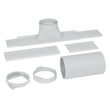
- If your window kit is missing or damaged, replace it with the correct kit for this model.
Parts that can help
- Portable ac window kit RAP01 (exhaust/window venting setup)
- Drain plug WJ01X26226 (helps manage condensate draining)
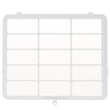
- Filter WJ85X27856 (maintains airflow and cooling efficiency)
Why it matters
Without venting, a portable AC still produces heat at the condenser side; if that heat stays in the room, the unit cannot lower room temperature. Venting is what allows the system to remove heat and deliver real cooling.
Last updated: January 2026
How to determine AC tonnage from model number?
For the GE APFD05JASWG1 room air conditioner, “tonnage” usually is not listed in the model number the way it is on central air systems; instead, capacity is typically expressed in BTUs. To estimate tonnage, find the unit’s BTU rating on the rating label and divide BTUs by 12,000 (12,000 BTU = 1 ton).
How to find the BTU rating on this type of GE unit
Look for a data label on the cabinet (often on the back, side, or near the air inlet). It typically lists cooling capacity in BTU/hr.
Common places to check:
- Rear or side panel rating label
- Near the power cord entry area
- Behind the air filter cover (varies by design)
- Packaging label (if you still have the box)
If your unit is not cooling well, clean the filter first; restricted airflow can make a correctly sized unit feel undersized. The correct replacement for this model is the filter WJ85X27856.
Quick conversion: BTU to tons
Use this formula:
- Tons = BTU/hr ÷ 12,000
| Cooling capacity (BTU/hr) | Approx. tons |
|---|---|
| 6,000 | 0.5 |
| 8,000 | 0.67 |
| 10,000 | 0.83 |
| 12,000 | 1.0 |
| 14,000 | 1.17 |
Why the “divide by 12” model-number trick often does not apply
That shortcut (24, 36, 48 in the model number) is common on central air condensers where the model number embeds thousands of BTUs. Portable and room air conditioners like the GE APFD05JASWG1 often use model numbers that do not encode capacity in a consistent, readable way.
Why it matters
Correct capacity helps with comfort and efficiency. An undersized room air conditioner runs constantly and struggles to dehumidify; an oversized unit can short-cycle and leave the room clammy.
Last updated: January 2026
What is the 20 rule for air conditioning?
The “20-degree rule” is a comfort and efficiency guideline: we recommend setting your GE room air conditioner model APFD05JASWG1 so the indoor temperature is no more than about 20°F cooler than the outdoor temperature. Bigger gaps can mean longer run times, higher energy use, and less comfort.
How to use the 20-degree rule (practical examples)
Use the outdoor temperature as your reference point, then choose a realistic indoor setpoint.
- If it’s 95°F outside, set the AC around 75°F.
- If it’s 88°F outside, set the AC around 68°F to 72°F.
- If it’s 80°F outside, set the AC around 60°F to 65°F (many units will still cool, but humidity and airflow matter).
- If your space still feels warm, lower the setpoint in 1 to 2 degree steps and give it 20 to 30 minutes to stabilize.
Why the “20°F” number is not a hard limit
Portable and room air conditioners are affected by the room’s heat load and airflow. These factors often matter more than the thermostat number.
| What changes performance | What to do | What you’ll notice |
|---|---|---|
| Dirty or restricted filter | Clean or replace the filter | Better airflow, colder supply air |
| Hot air leaks (window kit gaps) | Seal gaps, shorten exhaust run | Faster cooling, less cycling |
| High humidity | Use “Dry” mode if available | Room feels cooler at higher setpoint |
| Oversized room or sun exposure | Close blinds, limit heat sources | More stable temperature |
Quick checks if your room won’t cool within about 20°F
- Make sure the exhaust is installed correctly and not kinked.
- Clean or replace the air filter; for this model, check the filter WJ85X27856.
- Confirm doors and windows are closed and sealed.
- Keep the unit’s intake and outlet clear (no curtains or furniture blocking airflow).
- If the unit shows an error, use the GE error codes guide to interpret the display.
Why it matters
Following this guideline helps your APFD05JASWG1 cool more steadily, control humidity better, and avoid nonstop operation that drives up energy use.
Last updated: January 2026