 Owner’s manual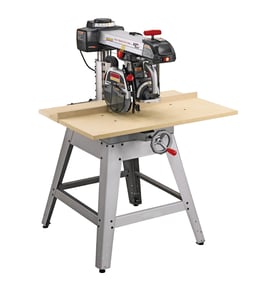

Who makes the best radial arm saws?
Craftsman radial arm saws like model 11319770 are widely regarded because they were produced in very large numbers, have strong parts support, and use proven designs that are straightforward to align and maintain. “Best” ultimately depends on the cuts you need (crosscut, rip, dado) and how well the saw is set up.
A radial arm saw’s real performance comes from accuracy, safety features, and how easily you can keep it tuned.
- Accuracy and repeatability: arm lock, index system, and fence/table condition matter as much as the motor.
- Guarding and kickback control: a complete blade guard and a properly set anti-kickback setup are essential.
- Parts availability: common wear items (bearings, switches, cords, hardware) keep older saws usable.
- Ease of alignment: a saw that locks solidly at 90 degrees and holds settings is the one you will trust.
- Intended work: frequent crosscuts favor a stable carriage; ripping demands careful setup and technique.
Use this checklist before you invest time in restoration.
| Check | What you want to see | Why it matters |
|---|---|---|
| Arm and yoke locks | Locks tighten firmly with minimal play | Reduces drift and out-of-square cuts |
| Carriage travel | Smooth travel, no grinding or binding | Improves control and cut quality |
| Guard and anti-kickback | Present and adjustable | Helps prevent contact and kickback |
| Table and fence | Flat table, straight fence, solid mounting | Supports accurate crosscuts and dados |
For Craftsman 11319770, we follow the operating requirements in the owner's manual and confirm the saw is configured correctly before judging performance.
- Keep the arbor nut tight and the blade guard installed for horizontal cutting.
- Lock the arm control lever before cutting.
- Adjust the anti-kickback pawls so they just clear the workpiece or fence (whichever is higher).
- Hold the work firmly against the table and fence for consistent crosscuts.
Radial arm saws can be extremely capable for crosscutting and repeat work, but only when the arm, carriage, and safety assemblies are complete and properly adjusted. A well-tuned Craftsman 10-inch radial saw often outperforms a “better brand” saw that is loose, missing guards, or out of alignment.
Last updated: February 2026
What has replaced the radial arm saw?
For most homeowners and many shops, the compound miter saw largely replaced the radial arm saw for crosscuts, miters, and bevel cuts. A table saw (or track saw) typically fills the gap for ripping, since ripping on a radial arm saw requires specific guarding and feed direction setup.
Radial arm saws like the Craftsman 11319770 are versatile, but newer tools are usually faster to set up for common cuts.
- Compound miter saw: best for repeatable crosscuts, miters, and bevels
- Sliding compound miter saw: adds wider crosscut capacity
- Table saw: primary choice for ripping and sheet goods
- Track saw: accurate ripping and breaking down plywood with less space
- Band saw: safer curved cuts and some ripping tasks (depending on blade and fence)
Your Craftsman 11319770 manual covers both crosscutting and ripping operations, including in-ripping and out-ripping, plus bevel ripping. Use the owner's manual to match the operation to the correct locks, yoke position, and guard setup.
| Cut you need | Common “replacement” tool | Why it’s preferred | Where the radial arm saw still fits |
|---|---|---|---|
| Crosscut 90° | Compound miter saw | Quick, accurate, portable | Excellent with a solid fence and alignment |
| Miter and bevel crosscut | Compound miter saw | Fast angle changes | Works well once indexed and locked |
| Rip cut | Table saw or track saw | Purpose-built guarding and feed | Possible, but setup is more involved |
| Dado | Table saw with dado set | Stable work support | Many radial arm saws support dado heads |
Most people moved away from radial arm saws because modern miter saws simplify crosscut and angle work, while table saws and track saws handle ripping more efficiently. If you keep using your 11319770, following the correct ripping requirements (locks, guard, antikickback, and feed direction) is what keeps cuts accurate and controlled.
Last updated: February 2026
Are radial arm saws worth anything?
Yes. A Craftsman radial arm saw like model 11319770 is worth money and real shop value when it is complete, tight, and properly adjusted; it excels at accurate crosscuts, bevel crosscuts, and compound crosscuts when set up using the 11319770 owner's manual.
Buyers pay for condition and completeness more than age.
- Smooth carriage travel; minimal play in the arm/yoke
- Solid arm lock and repeatable indexing at 0 degrees
- Complete guard, table/fence parts, and switch key
- Clean column tube and elevation mechanism (no heavy rust)
- Local demand for older, heavier saws
These are common ranges for working 10-inch radial arm saws.
| Condition | Typical value range | Best fit for |
|---|---|---|
| Runs but needs cleanup/tuning | $50 to $150 | DIYers who like setup work |
| Clean, complete, cuts accurately | $150 to $300 | Most home shops |
| Restored, very tight and complete | $300+ | Collectors, serious woodworkers |
A “runs but sloppy” saw is hard to use safely and accurately, so it sells for less. A complete 11319770 that locks, indexes, and repeats cuts reliably is both more useful and more valuable.
- Keep the guard installed and adjusted
- Use a firm fence; hold the work tight to it
- Return the carriage to full rear position after each cut
- Let the blade stop completely before removing cut pieces
Last updated: February 2026
Do you push or pull a radial arm saw?
For a Craftsman 11319770 10-inch radial saw, you typically pull the carriage forward toward you for crosscuts (square, bevel, and compound crosscuts), then return it to the full rear position and let the blade stop before moving the workpiece. See the 11319770 owner's manual for the exact operating steps and guard setup.
When the saw is set up for crosscutting (arm and yoke indexed at 0° and locked), the normal technique is to hold the board firmly against the fence and pull the carriage forward along the arm to make the cut.
Best practices we follow for safer, cleaner crosscuts:
- Keep the workpiece tight to the fence (guide) before starting the cut.
- Start with the carriage in the full rear position.
- Pull the carriage forward smoothly; do not force it.
- After the cut, return the carriage to the full rear position.
- Wait for the blade to come to a complete stop before removing cut pieces.
- Stand slightly to one side of center to reduce exposure if kickback occurs.
Ripping on a radial arm saw is set up by turning the yoke 90° from the crosscut position and using the guard, spreader, and anti-kickback pawls correctly. In ripping, you feed the workpiece from a specific side depending on the blade rotation direction.
| Operation | What moves | Typical direction | Key control point |
|---|---|---|---|
| Crosscut (square, bevel, compound) | Saw carriage | Pull forward to cut | Carriage travel on arm |
| Ripping (in-rip / out-rip) | Workpiece | Feed from the correct side | Fence, guard, anti-kickback |
Pulling the carriage for crosscuts helps keep the work controlled against the fence and matches the operating method described for this Craftsman radial saw. Using the wrong motion for the operation increases the chance of binding, rough cuts, or kickback.
Last updated: February 2026