 Installation guide
 Owner’s manual




How can I tell what wattage my microwave is?
Your Electrolux EMBD3010ASA built-in microwave is rated at 1000 watts (IEC test procedure). You can also confirm wattage on the model and serial label (often inside the door area) and in the owner's manual.
Quick ways to confirm wattage on EMBD3010ASA
- Check the rating label around the door opening (common location for built-in microwaves).
- Look for the “rated watts” or “output power” line in the owner's manual.
- Use recipe timing guidance based on a 1000-watt microwave (many cookbooks and package directions assume a wattage).
- If cooking seems consistently underdone, increase time in small increments (15 to 30 seconds) rather than jumping power levels.
Simple “time-to-heat” check (practical estimate)
If you want a real-world sanity check of performance (not an official rating), heat 1 cup of water in a microwave-safe measuring cup:
- Start with room-temperature water.
- Heat on High (100% power).
- A typical 1000-watt microwave brings 1 cup of water to a near-boil in roughly 2 to 3 minutes.
What to watch for
- If it takes much longer than expected, cooking performance issues can be related to the high-voltage system (magnetron, capacitor) or airflow.
- If you hear cycling at lower power levels, that is normal magnetron operation.
Wattage vs. electrical supply (why the numbers differ)
Microwave “wattage” usually refers to cooking output, while the electrical requirements describe what the unit draws from your home.
| Spec type | What it means | Where you’ll see it |
|---|---|---|
| Cooking output (watts) | Heating power used to cook food | Owner's manual, rating label |
| Electrical supply | 120V, 60 Hz, grounded circuit (often 20A recommended) | Installation guide |
Why it matters
Knowing the wattage helps you set accurate cook times, especially for packaged foods and cookbooks. For EMBD3010ASA, using 1000-watt timing prevents overcooking or undercooking when you compare directions written for different microwave power levels.
Last updated: February 2026
What is the average lifespan of EMBD3010ASA?
The average lifespan of the Electrolux EMBD3010ASA built-in microwave is 10 years. Keeping the door seals clean, ensuring proper cabinet ventilation, and avoiding operation with an empty cavity helps the magnetron, control board, and cooling fan reach that service life; see the owner's manual for care guidance.
What typically determines microwave lifespan
These factors most directly affect how long a built-in microwave lasts:
- Heat management: blocked vents or failed cooling airflow shortens magnetron life
- Door system wear: repeated slamming can damage latch alignment and interlock switches
- Power quality: frequent surges stress the electronic control board
- Cleaning habits: heavy grease buildup can restrict airflow and cause overheating
- Usage pattern: long, high-power runs every day wear high-voltage components faster
Typical lifespan by component (built-in microwave)
| Component | Typical service life | What you notice when it fails |
|---|---|---|
| Magnetron | 8 to 12 years | Runs but does not heat, louder hum |
| Control board | 7 to 12 years | Dead display, erratic keypad |
| Door latch/interlocks | 5 to 10 years | Won’t start, stops when door is moved |
| Turntable drive parts | 5 to 10 years | Tray not turning, clicking noise |
Why it matters
Knowing the 10-year average helps you decide whether to repair or replace. If the unit is near end-of-life and has a no-heat failure, the repair often involves high-voltage parts and labor; if it is mid-life, replacing a latch or turntable part is usually straightforward.
Maintenance that extends service life
- Keep the intake and exhaust openings clear of dust and grease
- Wipe the door sealing surfaces regularly so the door closes evenly
- Use microwave-safe cookware and avoid running the unit empty
- Stop cooking if you smell burning or hear arcing; inspect the cavity and waveguide cover
- Follow cleaning and operating instructions in the owner's manual
Last updated: March 2026
What replacement parts are most commonly needed for the EMBD3010ASA?
For the Electrolux EMBD3010ASA built-in microwave, the most commonly replaced parts are the door-latch components, turntable drive parts, and key heating or power components (when the unit runs but does not heat). Use the owner's manual to confirm symptoms and safe checks before ordering.
Commonly replaced parts for this model
These are frequent wear or failure items on built-in microwaves like the EMBD3010ASA:
- Door switch and latch-related parts (door won’t start, stops mid-cycle, or shows door errors): latch board 5304515317 and latch board 5304515318
- Turntable drive parts (tray not turning, noisy rotation): microwave turntable motor coupler 5304514229 and microwave metal turntable tray 5304514228
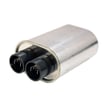
- No-heat or weak-heat conditions (unit runs but food stays cold): kenmore elite microwave magnetron 5304514250 and kenmore microwave high-voltage capacitor 5304513458
- Control and display issues (dead panel, unresponsive keys, random beeping): Microwave Electronic Control Board And Panel Assembly (black And Stainless) 5304527868
- Venting and cooling problems (loud fan, overheating shutdown): exhaust fan 5304514255 and fan blade 5304514297
Quick symptom-to-part guide
| Symptom | Most likely area | Example parts from this model |
|---|---|---|
| Won’t start, “door” behavior, stops when door is touched | Door latch/switch circuit | Latch board 5304515317, latch board 5304515318 |
| Turntable not rotating | Coupler or tray | Microwave Turntable Motor Coupler 5304514229, Microwave Metal Turntable Tray 5304514228 |
| Runs but does not heat | High-voltage heating circuit | Kenmore Elite Microwave Magnetron 5304514250, Kenmore Microwave High-voltage Capacitor 5304513458 |
| No display or keypad issues | User interface/control | Microwave Electronic Control Board And Panel Assembly (black And Stainless) 5304527868 |
Why it matters
Choosing parts by symptom prevents repeat failures and wrong returns. For example, a “no heat” complaint can involve the magnetron, capacitor, or door interlocks; matching the failure pattern to the correct circuit saves time and cost.
Before you order
- Unplug power and verify the outlet works
- Confirm the door closes firmly and the latch feels positive
- Note whether the fan, light, and turntable run during a cook cycle
- Use the model diagrams to match the exact part location
- Follow safety guidance in the owner's manual
Last updated: March 2026


