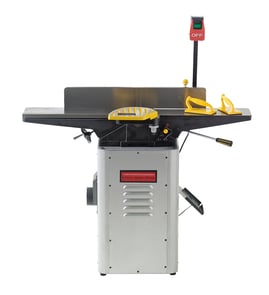

Is an 8 inch jointer worth it?
Yes, an 8-inch jointer is worth it when you regularly flatten wider boards or want more long-term capacity than a 6-1/8 inch machine like the Craftsman 113232200 jointer/planer; it reduces workarounds and helps you get flatter, more consistent stock with less fuss.
When an 8-inch jointer is the better buy
An 8-inch jointer makes sense if your projects often involve wider lumber or you want to joint faces and edges with fewer compromises.
- You commonly use 6 to 8 inch wide boards (or wider boards you can rip and re-glue)
- You want less time spent on workarounds (multiple passes, partial jointing, hand-planing)
- You build furniture, doors, panels, or tabletops where flatness matters
- You want more stability from a heavier machine (often longer beds and more mass)
- You plan to keep the jointer for many years and grow into it
When your 6-1/8 inch jointer/planer is the smarter choice
For many shops, a 6-1/8 inch jointer/planer like model 113232200 is still a solid fit, especially if your work stays in narrower stock.
- Most of your boards are 5-1/2 inches wide or less (common “1x6” actual widths)
- You joint edges more than faces (edge-jointing narrow boards is straightforward)
- Space, budget, or power limits matter more than capacity
- You are comfortable using a planer sled, hand planes, or ripping wider boards
Quick comparison
| Feature | 6-1/8 inch jointer/planer (Craftsman 113232200) | 8-inch jointer |
|---|---|---|
| Max practical board width | Narrow to medium stock | Medium to wider stock |
| Workarounds needed | More often | Less often |
| Typical footprint | Smaller | Larger |
| Typical cost | Lower | Higher |
Why it matters
Jointer width directly affects how easily you can flatten a board face and straighten an edge. If your jointer is too narrow for your typical lumber, you spend more time on alternate methods, and it is harder to get repeatable results.
Parts and model matching tip
If you are maintaining your Craftsman 113232200, match parts by the full model number on the ID plate before ordering; you can also search by model on Sears PartsDirect to find diagrams and compatible replacements.
Last updated: February 2026
What sizes do jointers come in?
Jointers are sized by the maximum board width they can flatten in one pass; common sizes are 6-inch, 8-inch, and 10-inch jointers. Your Craftsman 113232200 is a 6-1/8 inch jointer/planer, which fits the most common “6-inch class” size.
Common jointer sizes (what the number means)
- 6-inch (including 6-1/8 inch models like Craftsman 113232200): best for typical home-shop boards and smaller panels
- 8-inch: handles wider stock with fewer glue-ups and less pre-ripping
- 10-inch and larger: aimed at wider lumber and higher throughput
Quick size comparison
| Jointer size class | Max jointing width | Typical best use |
|---|---|---|
| 6-inch class | About 6 to 6-1/8 inches | General DIY, smaller furniture parts |
| 8-inch class | About 8 inches | Wider boards, fewer rip-and-glue steps |
| 10-inch+ class | 10 inches and up | Wide stock, frequent milling |
How to choose the right size for your shop
- Match the jointer width to the boards you mill most often (not the biggest board you might use once).
- If you routinely work with 7 to 9 inch lumber, an 8-inch jointer reduces extra steps.
- If most of your work is face-jointing narrower parts, a 6-inch class jointer is efficient and space-friendly.
- Plan for dust collection and infeed/outfeed support; longer beds and wider cutters need more room.
Why it matters
Jointer width drives how often you must rip boards narrower, joint them, then glue them back up. A wider jointer saves time and preserves grain continuity, while a 6-1/8 inch jointer/planer like the Craftsman 113232200 covers the majority of everyday shop tasks.
Parts and model lookup
When you are ready to maintain or repair your jointer/planer, use your model number 113232200 to find the correct diagrams and replacement parts on Sears PartsDirect.
Last updated: February 2026
Is there a jointer planer combo?
Yes. A jointer/planer combo is a single woodworking machine that functions as both a jointer (to flatten and square an edge or face) and a planer (to thickness boards). Your Craftsman model 113232200 is itself a 6-1/8" jointer/planer, which is a jointer-planer combo.
What a jointer/planer combo does (and why people buy one)
A combo machine is built for shops that want accurate stock prep without dedicating floor space to two separate tools.
- Jointing mode: flattens one face and squares one edge
- Planing mode: makes the opposite face parallel and brings boards to final thickness
- Space savings: one footprint instead of two machines
- Shared cutterhead: one set of knives does both jobs
- Fewer setups: less moving material between tools
Quick comparison: combo vs separate machines
| Option | Best for | Tradeoffs |
|---|---|---|
| Jointer/planer combo (like Craftsman 113232200) | Small shops, occasional to regular milling | Changeover time between modes, shared capacity limits |
| Separate jointer + planer | Higher throughput, dedicated setups | More space, typically higher total cost |
What to check before choosing a combo
Even within “jointer/planer combo” tools, capacity and workflow vary. These checks help you pick the right fit.
- Width capacity: your unit is 6-1/8 inch, which suits many hobby projects
- Bed length and fence stability: longer and stiffer helps with straight edges
- Knife type and availability: straight knives vs helical inserts (varies by model)
- Dust collection: critical for cut quality and safety
- Changeover steps: how quickly you can switch between jointing and planing
Why it matters
If you regularly mill rough lumber, a jointer/planer combo gives you the two essential “stock prep” operations in one machine. That means flatter glue-ups, tighter joinery, and more consistent thickness across parts.
To look up diagrams and replacement parts for your Craftsman 113232200 jointer/planer, start with the model parts list and search by model number on Sears PartsDirect.
Last updated: February 2026
What can I use instead of a jointer?
If you do not have a jointer for your Craftsman 113232200 6-1/8" jointer/planer, you can still straighten edges and flatten faces using a hand plane, a router with a straightedge jig, a table saw jointing sled, or a thickness planer with a sled and shims; each method trades speed for setup time and technique.
Best jointer alternatives (what each one does well)
- Hand plane (No. 5 or No. 7 style): Best for quiet, controlled edge jointing and fine tuning a glue edge.
- Router + straightedge jig: Great for edge jointing long boards when you need a reliably straight reference.
- Table saw + jointing sled/straight-line rip jig: Fast way to create one straight edge before ripping to final width.
- Planer + sled + shims/hot glue: Best for face jointing (flattening one face) when the board rocks or is twisted.
- Track saw or circular saw + guide: Useful for breaking down rough stock and getting close to straight before final truing.
Quick comparison
| Goal | Best substitute | Typical use case | Watch-outs |
|---|---|---|---|
| Straighten one edge for glue-up | Router jig or table saw sled | Long boards, repeatable results | Tear-out, bit/blade alignment matters |
| Flatten one face | Planer sled + shims | Twisted or cupped boards | Slow passes; secure the board firmly |
| Fine-tune a jointed edge | Hand plane | Final fit before glue | Requires sharp iron and practice |
Setup tips that make these methods work
- Mark high spots with a pencil and remove material gradually.
- Take light cuts; multiple passes beat one heavy pass for accuracy and safety.
- Support long boards with infeed/outfeed stands to prevent snipe and taper.
- For planer sled work, lock the board so it cannot shift (shims plus a small amount of hot glue works well).
- Always create one true reference face or edge first, then use that reference for the next operation.
Why it matters
A jointer’s main job is creating a flat reference surface. Once you have that reference (even from a jig or a hand plane), your planer and table saw can produce parallel faces, square edges, and tight glue joints.
Parts and diagrams
If you are deciding whether to repair or tune up your jointer/planer (fence alignment, cutterhead issues, drive problems), we list model-specific diagrams and replacement options by model number on the parts page, and you can also search by model on Sears PartsDirect.
Last updated: February 2026