 Error Codes


What is the lifespan of a 40 gallon gas water heater?
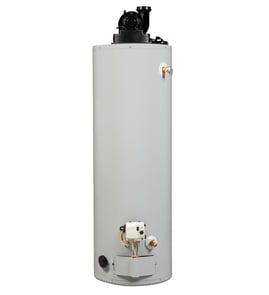
A typical 40-gallon gas tank water heater like the GE GG40T08AYV01 lasts about 10 years. Water quality, temperature setting, and maintenance (especially flushing sediment and checking the anode rod) are the biggest factors that determine whether it reaches that average.
Most standard gas tank water heaters cluster around the same service-life range. Here’s what usually moves the needle:
- Hard water and sediment: faster tank wear and reduced heating efficiency
- Higher thermostat settings: more stress on the tank and components
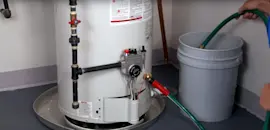
- No tank flushing: sediment buildup can overheat the bottom of the tank
- Anode rod condition: a depleted anode rod speeds up internal corrosion
- Venting and combustion air issues: can cause burner problems and nuisance shutdowns
If your GE GG40T08AYV01 is approaching the 8 to 12 year mark, these symptoms often show up first:
- Rust-colored hot water or metallic smell
- Rumbling, popping, or banging sounds during heating
- Water pooling at the base of the tank
- Inconsistent hot water or longer recovery time
- Pilot or burner problems that keep returning after basic cleaning
| What you’re seeing | What it usually means | What we recommend |
|---|---|---|
| Minor noise, still heats well | Sediment starting to build | Flush tank and lower temp if set high |
| Frequent pilot/burner issues | Combustion/venting or gas control wear | Have a technician check venting and gas valve |
| Any tank leak | Tank failure | Plan replacement (tank leaks do not get better) |
Once a gas tank water heater reaches its typical lifespan, the risk of tank leakage rises quickly. Planning ahead helps you avoid an emergency replacement and lets you match capacity, venting type, and gas supply correctly.
For identifying the exact unit and getting the right replacement parts or guidance, use how to find your appliance model number (and what it means for parts).
Last updated: January 2026
Why do plumbers not recommend tankless water heaters?
Plumbers often steer homeowners away from tankless water heaters because they are rarely a simple swap from a tank-style unit like the GE GG40T08AYV01; they commonly require gas line sizing changes, venting upgrades, and ongoing maintenance that can raise total cost and reduce reliability in hard-water areas.
- Higher install complexity: Tankless units often need larger gas supply, dedicated electrical, and specific venting materials.
- Upfront cost: Equipment plus labor is typically higher than a standard tank replacement.
- Maintenance expectations: Annual descaling and inlet screen cleaning is routine in many homes.
- Flow-rate limits: Running multiple showers, a dishwasher, and laundry at once can exceed the unit’s capacity.
- Hot-water “delay”: You can still wait for hot water at the tap (and sometimes longer without a recirculation setup).
- Serviceability: More sensors and controls can mean more diagnostic time and higher repair costs.
| Situation | Tankless tends to be | Tank-style (like GE GG40T08AYV01) tends to be |
|---|---|---|
| Small home, 1 to 2 bathrooms | Good fit | Also good fit |
| Large home, high simultaneous demand | Needs careful sizing (sometimes multiple units) | Often simpler to meet peak demand |
| Hard water | Requires consistent descaling | Typically more forgiving (still benefits from maintenance) |
| Tight installation budget | Usually not ideal | Often the most cost-effective |
- Confirm gas line size and total BTU load for all gas appliances.
- Confirm venting path and materials allowed for the new heater.
- Check incoming water hardness and plan for descaling or water treatment.
- Decide whether you need a recirculation system to reduce wait time.
- Compare total cost: equipment, labor, permits, and expected maintenance.
A tankless water heater can be an excellent upgrade, but the installation and maintenance requirements are the main reasons plumbers hesitate to recommend it broadly. For many homes, a tank-style gas water heater remains the most straightforward way to get consistent hot water with fewer variables.
For help confirming you have the correct model before buying parts or planning a replacement, use how to find your appliance model number (and what it means for parts).
Last updated: January 2026
What is the average labor cost to install a 50 gallon gas water heater?
For a 50-gallon gas water heater installation, average labor typically runs $400 to $1,000 for a straightforward replacement. For a GE gas water heater like GG40T08AYV01, labor goes up when venting, gas piping, or code upgrades are needed, or when access is difficult.
Most installers price labor based on how much work is required beyond swapping the tank.
- Straight swap (same location, similar venting): $400 to $700
- Moderate complexity (minor pipe/vent changes): $700 to $1,000
- High complexity (new venting, gas line work, tight access): $1,000+
- Permit and inspection: often added separately (varies by area)
- Haul-away/disposal: sometimes included, sometimes extra
These are the most common reasons a “50-gallon gas water heater install” quote comes in higher:
- Reworking venting (draft hood, flue sizing, vent connector routing)
- Modifying gas piping (new shutoff, sediment trap, line resizing)
- Replacing or adding a thermal expansion tank
- Updating water shutoff valves or corroded piping
- Bringing the install up to local code (strapping, drip leg, pan, drain)
- Difficult access (attic, crawlspace, tight closet, long carry)
Use this table to make sure you are comparing the same scope of work.
| Quote item | Included? | Notes to confirm |
|---|---|---|
| Removal of old heater | Yes/No | Includes disconnect and haul-away |
| New gas flex/pipe work | Yes/No | Ask what is being replaced |
| Venting materials and changes | Yes/No | Any resizing or rerouting |
| Permit and inspection | Yes/No | Who pulls the permit |
| Startup and leak test | Yes/No | Gas leak test and burner operation |
A gas water heater install is not just “hook it up”; safe combustion, correct venting, and leak-free gas and water connections protect your home and help the heater run efficiently.
- Must have tools for appliance repair
- Are diy appliance repairs safe
- How to find your appliance model number (and what it means for parts)
Last updated: January 2026
Why are gas water heaters being phased out?
Gas water heaters (including the GE GG40T08AYV01) are being phased out in some areas because local and state rules are targeting air pollution and greenhouse-gas emissions from burning natural gas in homes. The change is policy-driven; it is not a performance issue with your specific water heater.
Most phase-out proposals focus on reducing emissions from residential combustion appliances, especially in dense metro areas where air quality is a concern.
Common drivers include:
- Lowering nitrogen oxides (NOx) that contribute to smog
- Meeting state or regional clean-air targets
- Reducing building-related carbon emissions over time
- Encouraging electrification (heat pump water heaters)
- Standardizing new-construction requirements (electric-ready homes)
In most places, existing gas water heaters can continue operating until they fail or are replaced; the biggest impact is usually on new installations or replacement rules in specific jurisdictions.
Typical outcomes you may see:
- New construction may require electric or heat pump water heaters
- Replacement may require ultra-low-NOx gas models or electric alternatives
- Permit requirements may change (especially for venting and combustion air)
- Rebates may be offered for switching to heat pump water heaters
| Feature | Gas tank water heater | Heat pump water heater |
|---|---|---|
| Energy source | Natural gas | Electricity |
| Venting | Usually required | Not required (needs airflow) |
| Efficiency | Moderate | High |
| Cold-climate performance | Strong | Good with proper placement/model |
Phase-out rules can affect what you are allowed to install, what permits require, and which parts of the system (venting, gas line, electrical circuit) may need updates during replacement planning.
- Check your city or county permitting rules before replacing a gas water heater
- If you stay with gas, confirm whether “ultra-low NOx” is required locally
- If you switch to a heat pump water heater, plan for space, airflow, and a dedicated electrical circuit
- Keep your model number handy when shopping for compatible replacement components and service
For help confirming your exact model identification before ordering service or planning a replacement, use how to find your appliance model number (and what it means for parts).
Last updated: January 2026