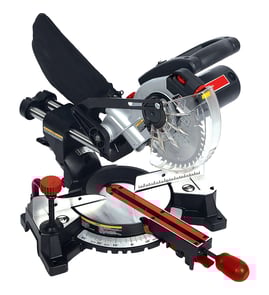

Why is 31.6 on a miter saw?
The 31.6° mark on a miter saw (including many setups used with the Craftsman 900234811 10-inch miter saw) is a common preset for cutting crown molding as a compound miter. It pairs with a typical 33.9° bevel setting to produce tight 90° corner joints when crown is installed at a standard spring angle.
When you cut crown molding as a compound cut (miter plus bevel), the saw angles “translate” the wall and ceiling corner into two saw adjustments.
Common uses:
- Cutting crown molding for inside corners and outside corners
- Speeding up repeat cuts by using a known preset instead of trial-and-error
- Working with crown installed at common spring angles (often 38° or 45°)
- Reducing gaps when the room corner is close to a true 90°
These are the most common “preset” numbers you see printed on many miter saw scales.
| Crown spring angle | Miter setting | Bevel setting |
|---|---|---|
| 38° (common) | 31.6° | 33.9° |
| 45° (common) | 35.3° | 30.0° |
We recommend doing a fast setup check before cutting your finish pieces:
- Confirm the crown’s spring angle (often listed on the molding or packaging)
- Set the saw to the matching miter and bevel values
- Cut two short test pieces and “book” them together to check the joint
- If the corner is not a perfect 90°, fine-tune the miter slightly first
- Keep the molding oriented consistently (same edge against the fence each time)
Crown molding corners are unforgiving; a small angle error shows up as a visible gap. The 31.6° mark is there to make a common crown-molding geometry fast and repeatable, especially when you are doing multiple corners.
For parts diagrams and replacement components for model 900234811, start with the model parts list, or search by model on Sears PartsDirect.
Last updated: February 2026
What should you never cut with a miter saw?
You should never use a Craftsman 900234811 10-inch miter saw to cut tiny, unsupported pieces near the blade, rip-cut lumber (with the grain), or cut materials the saw is not designed for (such as steel/iron or masonry). These cuts raise the risk of kickback, binding, and loss of control.
- Very small workpieces that put your fingers close to the blade path
- Rip cuts (cutting with the grain); a miter saw is for crosscuts, miters, and bevels
- Ferrous metals (iron/steel) unless the saw is specifically equipped and rated for metal cutting
- Masonry (brick, concrete, tile); abrasive dust and improper guarding make this unsafe
- Freehand cuts without the work supported against the fence and table
- Warped, twisted, or bowed boards unless you can clamp them flat and stable
Use the right tool and setup for the job so the material stays supported and the blade does not bind.
| Task you want to do | Better choice than a miter saw | Why it’s safer |
|---|---|---|
| Rip a board | Table saw or circular saw with a guide | Designed to control long, with-the-grain cuts |
| Cut tiny parts | Cut a longer piece first, then trim; use a stop block and clamp | Keeps hands farther from the blade |
| Cut steel/iron | A metal-cutting saw rated for ferrous metal | Correct blade speed, guarding, and blade type |
| Cut brick/tile | Masonry saw or angle grinder with the correct wheel | Controls dust and uses the right abrasive |
- Keep the work tight to the fence and flat on the table.
- Clamp narrow stock; do not “pinch hold” pieces near the blade.
- Let the blade reach full speed before entering the cut; do not force it.
- Support long boards with outfeed support so they do not lever upward.
- Wait for the blade to stop before lifting the saw head or removing offcuts.
Most miter saw injuries and damaged workpieces happen when the blade grabs the material (kickback) or the work shifts mid-cut. Avoiding the wrong materials and unsupported cuts keeps the saw stable and your hands out of the danger zone.
For parts and diagrams for model 900234811, start with the parts list for this model, or search by model number on Sears PartsDirect.
Last updated: February 2026
Can a 10 inch miter saw cut a 2x4?
Yes. A 10-inch miter saw like the Craftsman 900234811 easily cuts a standard 2x4 at 90 degrees (straight crosscut), and it typically handles a 2x4 at common miter angles such as 45 degrees as well.
Cut capacity varies by saw design (standard vs. sliding), blade kerf, and how tall the board sits against the fence. For most 10-inch non-sliding miter saws, these are typical real-world results:
- 2x4 at 90 degrees: standard, no issue
- 2x4 at 45 degrees miter: typically no issue
- Wider boards (2x6 and up): may require flipping the board or using a different saw style
- Bevel cuts (tilting the head): reduces capacity compared to a 90-degree cut
- Sliding feature (if equipped): increases crosscut width significantly
These are common guidelines for many 10-inch and 12-inch miter saws.
| Saw size | Typical 90-degree crosscut | Typical 45-degree miter crosscut |
|---|---|---|
| 10-inch | Up to about a 2x6 | Up to about a 2x4 |
| 12-inch | Up to about a 2x8 | Up to about a 2x6 |
A 2x4 is a simple cut, but accuracy and safety depend on setup.
- Use a sharp, appropriate blade (fine-tooth for trim, general-purpose for framing)
- Keep the board flat on the table and tight to the fence
- Let the blade reach full speed before entering the wood
- Support long stock so it does not lift or twist during the cut
- If the cut binds, stop and check for warping, pinching, or a dull blade
Knowing your saw’s practical cut capacity helps you avoid forcing the cut, which can cause binding, tear-out, and inaccurate miters. It also helps you choose the right approach (standard cut, flip cut, or a different saw) for wider lumber.
If you need replacement parts (blade guard components, switches, brushes, or hardware) for the Craftsman 900234811, start with the parts list for this model, or search by model number on Sears PartsDirect.
Last updated: February 2026
Will any miter saw stand work with any miter saw?
No. A miter saw stand is not truly “one size fits all”; for your Craftsman 900234811 10" miter saw, the stand must match the saw’s base mounting-hole pattern and support the saw’s weight and footprint. Many “universal” stands work, but only after you confirm fitment.
Before you buy or mount a stand, we recommend verifying these basics:
- Mounting-hole spacing on the saw base (front-to-back and side-to-side)
- Stand bracket range (how far the mounting rails/brackets can slide)
- Weight capacity (saw plus any workpiece support load)
- Base footprint (some compact stands interfere with wider bases)
- Fence and bevel clearance (nothing should hit the stand when you pivot)
- Stability (wide stance, solid locking legs, minimal flex)
Most universal stands use adjustable mounting brackets or quick-release rails. Brand-specific stands often line up faster, but universal stands are usually fine when the brackets can reach your hole pattern.
| Stand type | Typical compatibility | Best for | Common drawback |
|---|---|---|---|
| Universal (adjustable brackets) | Works with many saws after setup | Mixed brands, portability | Setup time; hole alignment varies |
| Quick-release rail style | Works well once mounted | Frequent transport | Needs correct rail placement |
| Brand/model-specific | Best match for that brand line | Fastest bolt-on fit | Less flexible across brands |
When the stand brackets cannot reach the mounting holes, the reliable fix is an adapter plate.
- Use 3/4-inch plywood or a flat, rigid plate
- Bolt the saw to the plate using the saw’s base holes
- Then bolt the plate to the stand using the stand’s bracket slots
- Keep hardware tight; use lock washers or thread-locking nuts
- Confirm the plate does not block the blade guard movement
A stand that does not match the mounting pattern can twist under load, shift during a cut, or reduce accuracy. Proper fit keeps your Craftsman 900234811 stable so your miter and bevel cuts stay square.
For replacement parts and diagrams for your saw, start with the model parts list, or search by model number on Sears PartsDirect.
Last updated: February 2026
What size is the miter slot on a Craftsman table saw?
Craftsman model 900234811 is a 10-inch miter saw, not a table saw; it does not have a tabletop miter slot. If you are asking about a Craftsman table saw, most use the standard 3/4 inch wide x 3/8 inch deep miter slot, but you should measure your saw’s slot to confirm before buying a miter gauge or sled runner.
Use this quick check to match accessories like a miter gauge, crosscut sled runner, or featherboard.
- Unplug the saw before measuring near the blade area
- Measure the inside width at the tabletop surface (common target: 3/4 inch)
- Measure the depth from the tabletop to the bottom of the slot (common target: 3/8 inch)
- Check whether the slot is a T-slot (undercut lip) for anti-lift miter bars
- Measure in a few spots along the slot to confirm it is consistent
A miter saw like the Craftsman 900234811 uses a rotating base with detents and a fence; it does not accept miter-slot accessories.
| Tool type | Has a miter slot? | What it uses instead | What you buy based on it |
|---|---|---|---|
| Table saw | Yes | Miter slot(s) in the tabletop | Miter gauge, sled runners, featherboards |
| Miter saw (900234811) | No | Miter detents, turntable, fence | Blade, fence parts, detent/lock parts |
- Too loose: adjust expansion discs/set screws on the miter bar, or shim a wood runner
- Binds: clean sawdust and pitch; lightly deburr slot edges
- Rubs bottom: reduce runner height slightly
A correctly fitting miter bar reduces side play, improves cut accuracy, and helps prevent unsafe binding during crosscuts.
To find the right parts or accessories by model number, start with the model-specific parts list when available, or search by model on Sears PartsDirect.
Last updated: February 2026