


What is the life expectancy of a KitchenAid oven?
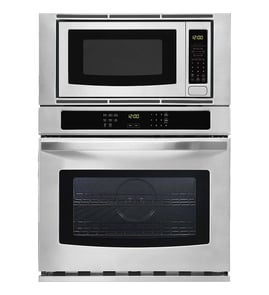
KitchenAid ovens typically last 10 to 15 years with normal use and basic maintenance. For your KitchenAid KOCE507ESS11 wall oven/microwave combo, keeping the oven cavity clean, protecting electronics from heat and moisture, and fixing small issues early helps you reach the full expected lifespan.
Typical lifespan and what affects it
Most oven failures over time come from heating components, door hardware, and electronic controls.
- Usage frequency: daily cooking wears parts faster than occasional use
- Heat and ventilation: restricted airflow can shorten control and wiring life
- Cleaning habits: heavy buildup can stress the door seal area and cooling system
- Power quality: surges can damage control boards
- Prompt repairs: replacing a failing part early prevents secondary damage
Common “end-of-life” symptoms (and what they usually mean)
| Symptom | Most common cause | What we usually check first |
|---|---|---|
| Oven not heating or heats unevenly | Failed bake element | Inspect and test the range bake element W11545804 |
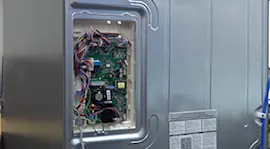
| Display dead, random resets, or won’t start | Control or power supply issue | Check connections, then evaluate the control (with power supply) W11179310 |
| Microwave runs but doesn’t heat | High-voltage component issue | Diagnose the magnetron W11346197 (high-voltage repair) |
| Door won’t latch or self-clean won’t start | Latch mechanism problem | Inspect the door latch W10883049 |
Maintenance that extends life
These steps reduce heat stress and prevent avoidable failures:
- Keep vents clear and wipe spills soon after the oven cools
- Avoid slamming the oven or microwave door; it stresses hinges and interlocks
- Use cookware that fits; oversized pans can block airflow
- If you notice arcing, burning smells, or intermittent operation, stop using the unit and troubleshoot
- Use a surge protector rated for the appliance circuit where appropriate (especially for sensitive controls)
Why it matters
A wall oven/microwave combo like the KOCE507ESS11 has more electronics than a basic oven, so protecting the control area and addressing early symptoms can add years of reliable service and reduce the chance of a larger, more expensive failure.
If you need replacement parts for KOCE507ESS11, we list compatible parts on this page, and you can also search by model on Sears PartsDirect.
Last updated: February 2026
How to know if the KitchenAid wall oven thermostat is bad?
If your KitchenAid KOCE507ESS11 wall oven consistently overheats, underheats, or swings widely in temperature even after you recalibrate and verify settings, the thermostat or temperature-sensing circuit is likely failing. We recommend confirming the problem with a simple temperature test before replacing parts.
Quick signs the thermostat (or sensing circuit) is bad
- Oven temperature is off by 25 to 50 degrees or more across multiple bakes
- Temperature swings are extreme (food burns outside, undercooked inside)
- Preheat takes much longer than normal or never seems to stabilize
- Oven cycles too hot (elements stay on too long) or too cool (elements shut off early)
- Error codes or intermittent heating that comes and goes with door movement or vibration
How we test it at home (simple, reliable method)
- Place an oven-safe thermometer in the center of the oven (middle rack).
- Set the oven to 350°F.
- After preheat, let it cycle for 20 to 30 minutes.
- Record the thermometer reading every 5 minutes.
What “normal” looks like: most ovens cycle above and below the set temp; an average close to 350°F with moderate swings is expected.
| What you see | What it usually means | What to check next |
|---|---|---|
| Average temp is consistently high | Sensing/thermostat circuit reading too low | Sensor wiring, control, calibration |
| Average temp is consistently low | Sensing/thermostat circuit reading too high | Sensor wiring, bake element output |
| Big swings, unstable cycling | Control not regulating heat correctly | Control board, harness connections |
Parts that commonly cause “bad thermostat” symptoms on KOCE507ESS11
On many KitchenAid wall ovens, temperature regulation problems are often caused by the control or wiring rather than a standalone thermostat.
- Control (with power supply) W11179310 (heat regulation logic and power)
- Wall oven wire harness W11449277 (loose or damaged connections can skew readings)
- Range bake element W11545804 (weak element can mimic a sensing problem)
Why it matters
An oven that runs hot can burn food and stress components; an oven that runs cool can lead to undercooking. Confirming the pattern first helps you replace the right part the first time and avoid repeat repairs.
You can order replacement parts for your KOCE507ESS11 from the parts list for this model, or search by model number on Sears PartsDirect.
Last updated: February 2026
Can I air fry in my KitchenAid convection oven?
Yes. Your KitchenAid KOCE507ESS11 convection oven can be used to “air fry” by using convection baking or roasting to circulate hot air around the food for browning and a crisp exterior. Results are closest to an air fryer when you use a high temperature, a shallow pan, and plenty of airflow around the food.
Best settings and technique for air-fry style results
- Use convection bake for most foods; use convection roast for larger, thicker items.
- Preheat fully; crisping improves when the oven and cookware are already hot.
- Spread food in a single layer; avoid crowding so hot air can circulate.
- Use a wire rack on a sheet pan (or a perforated tray if you have one) to boost airflow.
- Flip or rotate food halfway through for even browning.
Temperature and time starting points
These are reliable starting ranges for most convection ovens; adjust based on thickness and your preferred crispness.
| Food type | Convection temp | Typical time | Tip |
|---|---|---|---|
| Frozen fries, nuggets | 400 to 450°F | 12 to 25 min | Shake or flip halfway |
| Wings, breaded chicken | 425°F | 20 to 35 min | Use a rack for airflow |
| Vegetables | 400 to 425°F | 10 to 20 min | Light oil helps browning |
| Reheating leftovers | 375 to 400°F | 6 to 15 min | Keep portions small |
What to use (and what to avoid)
- Use: sheet pan plus rack, shallow metal pan, parchment rated for high heat.
- Avoid: deep dishes that block airflow, overcrowded pans, excessive oil (it can smoke).
Why it matters
“Air frying” is really fast convection cooking. When air can move freely around the food, you get better dehydration and browning, which is what creates that crisp texture.
Parts and accessories that can help
If you need to replace a damaged rack or want an extra rack for multi-level cooking, we list compatible options for this model, including the range oven rack WPW10554532. You can also find additional KOCE507ESS11 parts and accessories on Sears PartsDirect.
Last updated: February 2026
What size breaker do I need for a microwave oven combo?
For the KitchenAid KOCE507ESS11 wall oven/microwave combo, use a dedicated 2-pole breaker sized to the unit’s nameplate kW rating: 30 amps for 4.8 kW or less at 240V (3.6 kW or less at 208V), or 40 amps for 7.3 to 9.6 kW at 240V (5.4 to 7.4 kW at 208V).
How to choose the correct breaker for KOCE507ESS11
Check the electrical rating label (often on the oven frame behind the door, or on the unit’s data plate). Match the breaker to the kW rating and supply voltage.
- Use a dedicated circuit (no other appliances on the same breaker)
- If your supply is 240V, use the 240V kW rating
- If your supply is 208V (common in some condos), use the 208V kW rating
- Use a 2-pole breaker for 208/240V appliances
- If you see nuisance trips, confirm tight connections and correct wire size before replacing parts
Breaker size quick reference
| Nameplate total rating | Supply voltage | Dedicated breaker size |
|---|---|---|
| 4.8 kW or less | 240V | 30A (2-pole) |
| 3.6 kW or less | 208V | 30A (2-pole) |
| 7.3 to 9.6 kW | 240V | 40A (2-pole) |
| 5.4 to 7.4 kW | 208V | 40A (2-pole) |
Why it matters
An undersized breaker can trip during baking or microwave use. An oversized breaker paired with undersized wiring can overheat the circuit. Correct sizing protects the wiring and sensitive electronics.
If you’re chasing power symptoms
If the display is dead, the unit resets, or functions cut out, verify the breaker, terminal block connections, and harness plugs. If power is correct and problems continue, a common electrical suspect is the control (with power supply) W11179310. For ordering model-matched parts, use the KOCE507ESS11 parts list or search by model on Sears PartsDirect.
Last updated: February 2026