 Owner’s manual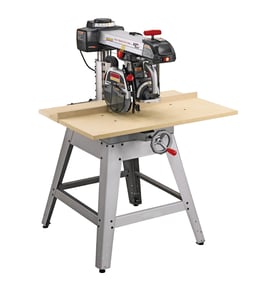

Why are radial arm saws no longer made?
Radial arm saws are much less common today because many woodworkers shifted to tools that are simpler to set up and easier to use accurately, such as compound miter saws and table saws. With a radial arm saw like the Craftsman 113197750, safe, accurate results depend heavily on correct guarding, alignment, and technique.
What changed in most shops
Radial arm saws can do a lot (crosscuts, miters, bevels, and some ripping), but they demand more adjustment and operator discipline than newer saw designs.
- More setup points: arm, yoke, bevel, miter, elevation, and carriage all affect accuracy
- More opportunities for misuse: the same versatility can lead to unsafe setups
- More sensitivity to alignment: small changes in indexing and locking can show up in the cut
- More emphasis on guarding: the guard, spreader, and anti-kickback system must be positioned correctly for the operation
Safety and control factors that influenced the decline
For many users, the biggest practical issue was control during certain operations, especially ripping. The 113197750 manual calls out specific requirements when ripping, including locking the carriage, locking the arm at 0°, and properly setting the guard, spreader, and anti-kickback mechanism. Those extra steps are easy to skip, and skipping them increases risk.
Ripping requirements (example checklist)
| Item | What you do | Why it matters |
|---|---|---|
| Carriage lock | Lock the carriage | Prevents the saw from moving unexpectedly |
| Arm position | Lock arm at 0° | Keeps the cut path stable |
| Guard system | Set guard, spreader, anti-kickback | Helps reduce kickback and binding |
| Blade condition | Use a sharp, correct blade | Reduces grabbing and burning |
Why it matters
Radial arm saws did not disappear because they cannot cut accurately; they became less popular because many owners wanted faster, more repeatable results with fewer adjustments. If you use a Craftsman 113197750, following the safety and setup procedures in the owner's manual is what makes the tool perform the way it was designed to.
Last updated: February 2026
Where can I buy Craftsman replacement parts?
You can buy replacement parts for your Craftsman 113197750 10-inch radial saw through Sears PartsDirect by searching the model number and using the parts diagrams and parts lists in the owner's manual. This helps you match the correct part number before you order.
Best way to get the right part for model 113197750
We recommend using the model and serial number from the saw, then confirming the exact part number in the repair parts section.
- Find the model and serial number on the front of the saw base.
- Use the repair parts lists and diagrams to identify the exact part number.
- Order by part number (not by the diagram key number).
- For standard hardware (nuts, washers, common screws), you can often buy equivalents locally.
- If the repair involves the motor or internal wiring, use a qualified service technician.
What you can identify from the manual (examples)
The Craftsman 113197750 manual includes repair parts lists for assemblies like the leg set and arm assembly, plus common electrical items like the power cord.
| What you need | Where to confirm it | Why it helps |
|---|---|---|
| Power cord, strain relief, switch-related items | Repair parts list and figure diagrams | Prevents ordering the wrong electrical part |
| Arm, yoke, table, and adjustment hardware | Assembly-specific parts lists | Ensures fit and alignment |
| Leg set parts (if your saw has legs) | Leg set parts list | Matches the correct fasteners and levelers |
Why it matters
Radial arm saw parts are model-specific; using the correct Craftsman model number (113197750) and ordering by the exact part number prevents fit issues, unsafe operation, and repeat repairs.
Last updated: February 2026
Are radial arm saws worth anything?
Yes. A Craftsman radial arm saw like model 113197750 is worth something when it is complete, runs smoothly, and can be tuned accurately; these saws still excel at long, repeatable crosscuts and dado work, but they require careful setup and strict safety habits to use well.
What drives the value of a radial arm saw
Radial arm saw value is mostly about condition and completeness, not age.
- Motor health: starts quickly, no burning smell, no excessive sparking at brushes
- Arm and carriage travel: slides smoothly with minimal play
- Column and elevation: raises/lowers without binding; locks hold firmly
- Table and fence condition: flat enough to tune; fence not split or badly chewed up
- Safety parts present: blade guard, anti-kickback/spreader parts for ripping, switch key
- Included stand/legs: model 113197750 originally included steel legs (a plus)
What this saw is still great at (and what to avoid)
Radial arm saws are still useful, but they are not the best “do everything” saw.
| Task | Radial arm saw performance | Notes |
|---|---|---|
| Long crosscuts | Excellent | Strong advantage over many miter saw setups |
| Dadoes/rabbets | Very good | Best with a stable table and accurate setup |
| Angle cuts | Good | Depends on how well the arm and miter scales are calibrated |
| Ripping | Use caution | Requires correct guard/anti-kickback setup and technique |
Quick checks before you decide to keep, tune, or sell
We recommend doing these basics first so you know what you have.
- Unplug the saw before inspecting or adjusting anything
- Confirm the model and serial number on the front of the base
- Verify the arm locks, bevel index, and swivel latch levers hold securely
- Inspect the cord and switch; the manual shows an on-off switch with a key
- Review the control locations and setup diagrams so you can tune it correctly using the owner's manual
Why it matters
A tuned radial arm saw can be extremely accurate and productive for crosscutting, but a loose carriage, misaligned fence, or missing guarding makes it frustrating and unsafe. Knowing the condition and completeness is what determines real-world value.
Last updated: February 2026
What is the best brand of radial arm saw?
There is no single “best” brand of radial arm saw; the best choice depends on how you will use it (fine crosscuts, repetitive production work, or occasional DIY), the condition of the saw, and parts availability. If you already own a Craftsman 113197750 10-inch radial saw, keeping it aligned and maintained often matters more than the name on the badge.
What to look for when comparing brands
- Arm and column rigidity: less flex means more accurate crosscuts and miters.
- Fence and table system: a straight fence and flat table help prevent drift and burning.
- Adjustment and lock mechanisms: solid locks for miter, bevel, and arm travel reduce movement.
- Guarding and anti-kickback features: safer ripping and better control.
- Parts support: easier long-term ownership when common wear items are still obtainable.
How Craftsman 113197750 fits in
Our Craftsman 113197750 shipped with steel legs (the closely related 113.19770 version did not), which can be a plus for stability when set up correctly. For setup, alignment, and parts identification, use the owner's manual.
Quick comparison: “best” by use case
| Use case | What typically works best | What to prioritize |
|---|---|---|
| Occasional DIY and home shop | Well-maintained vintage saws (including many Craftsman units) | Alignment, smooth carriage travel, intact guards |
| Furniture-grade accuracy | Heavier, more rigid industrial-style saws | Minimal play in arm/yoke, repeatable locks |
| Production and daily use | New or rebuilt industrial machines | Serviceability, parts pipeline, duty cycle |
Why it matters
Radial arm saw performance is dominated by setup and calibration. A perfectly tuned “mid-tier” saw will outcut a premium saw that is out of square. The manual’s squaring checks (table, fence, and arm alignment) are the fastest way to improve accuracy and reduce binding.
Last updated: February 2026
When did Craftsman stop making radial arm saws?
Craftsman radial arm saws were produced and sold for decades, and there is no single universal “stop date” that applies to every Craftsman radial arm saw model. For your Craftsman model 113197750 (10-inch radial saw), use the 113197750 owner's manual to identify the exact model and serial number details that help place your specific saw in its production era.
What we know for Craftsman model 113197750
The documentation for this saw confirms the model family and the major assemblies used on it.
- The manual covers model numbers 113.19770 and 113.197750.
- It identifies the tool as a Craftsman 10-inch radial saw.
- The model and serial number are found at the front of the base.
- The manual includes parts breakdowns for assemblies like the arm assembly, base assembly, and guard assembly.
- It includes key safety instructions (grounding, guarding, and general power tool precautions).
How to date your specific saw (most reliable method)
Because “Craftsman” spans many production runs and suppliers, the best way to narrow timing is to use the information on your saw itself.
| What to check | Where to find it | What it tells you |
|---|---|---|
| Model number | Front of the base | Confirms you have 113197750 (or a close variant) |
| Serial number | Front of the base | Helps narrow the build period for that exact unit |
| Guard and table components | On the saw | Helps match the correct guard, pawls, and table parts for safe setup |
Why it matters
Knowing the era of your 113197750 helps you match compatible repair parts and set the saw up safely. On any radial arm saw, the blade guard and anti-kickback components are critical to inspect and keep properly installed.
Last updated: February 2026